Free teaching diagram
Spider-Tailed Viper Diagram: Luring Birds With a Fake Spider
The viper's tail tip is a fake spider made of skin and scales; when a bird pecks at it, the hidden head strikes in 0.2 seconds.
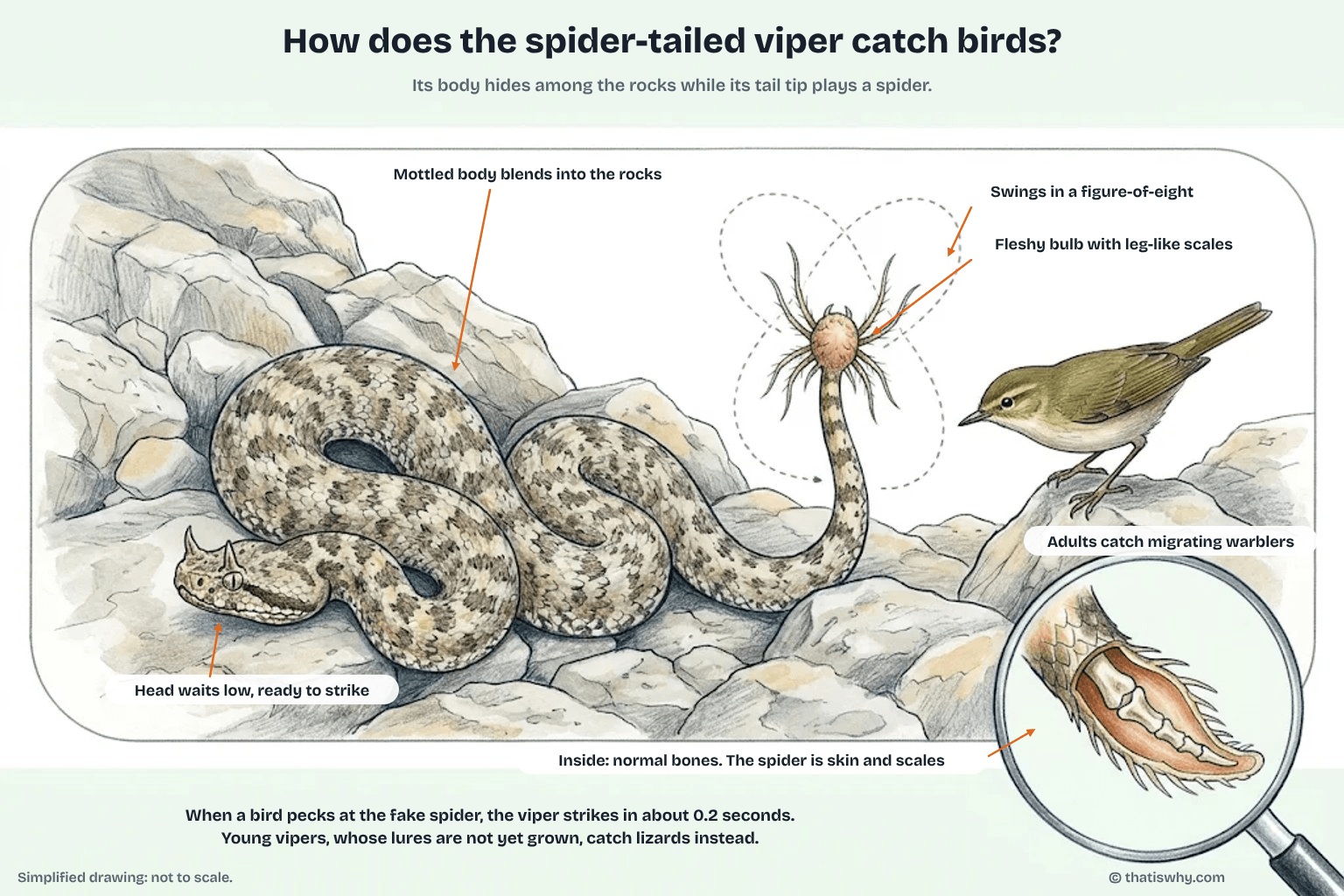
The detailed teaching diagram
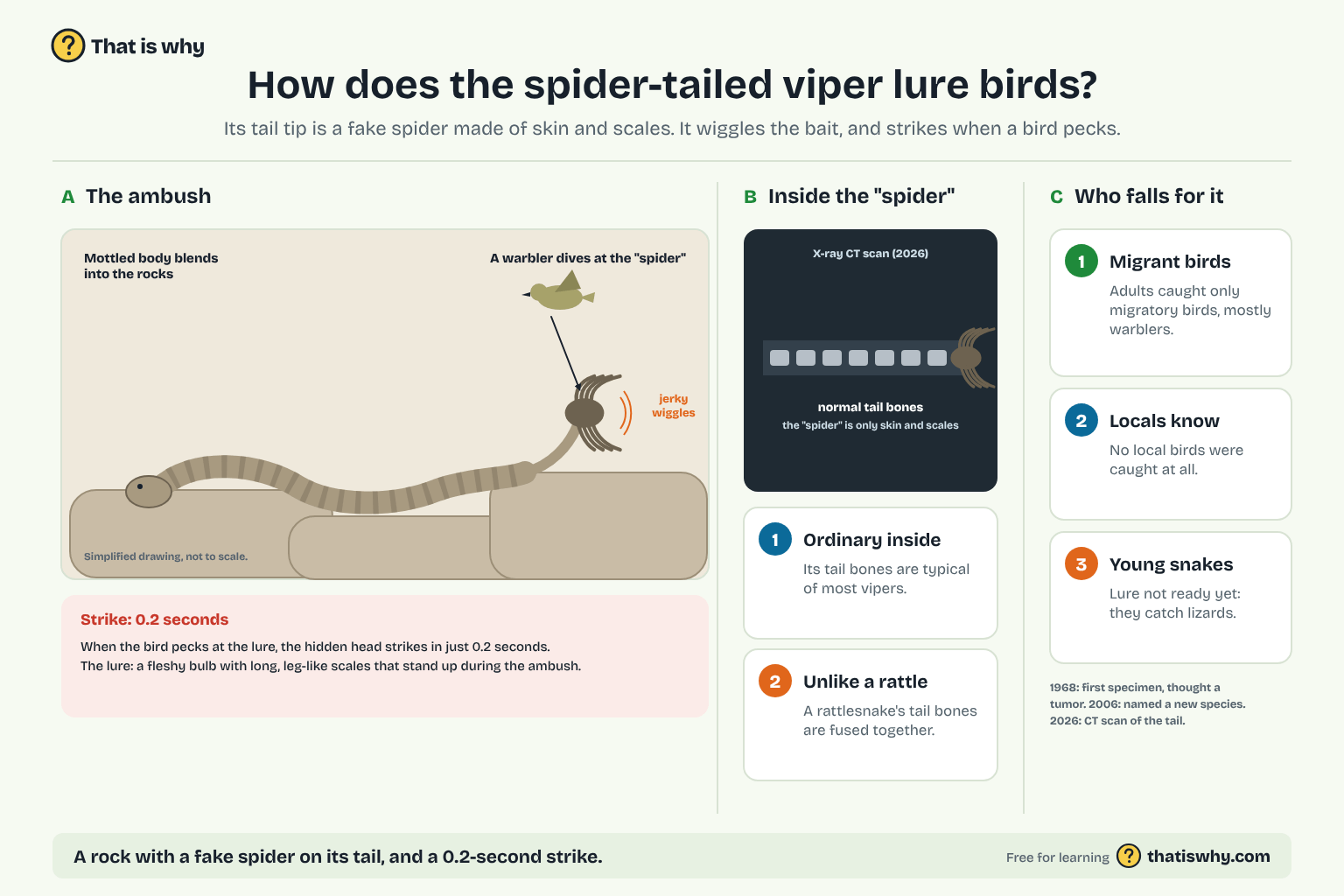
What the diagram shows
A. The ambush. The spider-tailed horned viper, Pseudocerastes urarachnoides, lies still on rocks in western Iran, its mottled body blending in. Its tail tip is a fleshy bulb with long, leg-like scales that stand up during an ambush, and it wiggles this "spider" in a jerky way. When a bird pecks at it, the hidden head strikes in just 0.2 seconds. This is aggressive mimicry, and luring with the tail is called caudal luring. The drawing is simplified.
B. Inside the "spider." A 2026 X-ray CT scan at the Field Museum showed that the tail bones are typical of most vipers. The spider is only skin and scales on the outside. A rattlesnake's rattle, by contrast, comes with fused tail bones.
C. Who falls for it. In a three-year field study, adult vipers caught only migratory birds, mostly warblers, and no local birds were caught. Young snakes, whose lures are not yet developed, caught lizards. The first specimen, collected in 1968, was thought to have a tumor; the snake was named as a new species in 2006.
Key numbers
| Fact | Value |
|---|---|
| Strike time | 0.2 seconds |
| First specimen collected | 1968 |
| Described as a new species | 2006 |
| Field study length | three years |
| CT scan of the tail | 2026 |
Common misconceptions
Myth The spider is a separate animal riding on the snake.
The truth The lure is the snake's own skin and scales: a fleshy bulb with long, leg-like scales.
Myth The tail has special bones to make the spider.
The truth A 2026 X-ray CT scan showed its tail bones are typical of most vipers; the spider is only on the outside.
Myth It catches any bird that comes close.
The truth Adults caught only migratory birds, mostly warblers; no local birds were caught.
Questions to use in class
Tap a question to reveal a model answer.
1How fast does the spider-tailed viper strike?
In just 0.2 seconds, when a bird pecks at its lure.
2What is the spider on its tail made of?
A fleshy bulb with long, leg-like scales that stand up during an ambush.
3What do young spider-tailed vipers eat?
Lizards. Their lures are not yet developed.
4When was the spider-tailed viper discovered?
The first specimen was collected in 1968 and mistaken for a deformity; it was described as a new species in 2006.
Key terms
- Aggressive mimicry
- When a predator or parasite copies something attractive, such as food, to lure another animal. Zombie snail brood sacs look like caterpillars to birds.
- Caudal luring
- Wiggling the tip of the tail as bait to draw prey within reach. The spider-tailed viper does it with a tail tip shaped like a spider.
Sources
- Viper lures birds with a fake spider on its tail (Fathinia et al., Amphibia-Reptilia) National Geographic
- Fake spider at the tip of this snake's tail helps it lure birds (Georgalis et al., The Anatomical Record) Field Museum
- Bizarre biodiversity: spider-tailed viper Beaty Biodiversity Museum, University of British Columbia