Free teaching diagram
Orchid Mantis Diagram: Luring Pollinators Better Than Flowers
The orchid mantis looks like an average flower to a bee and draws pollinators about 30% more often than real flowers do, then eats them.
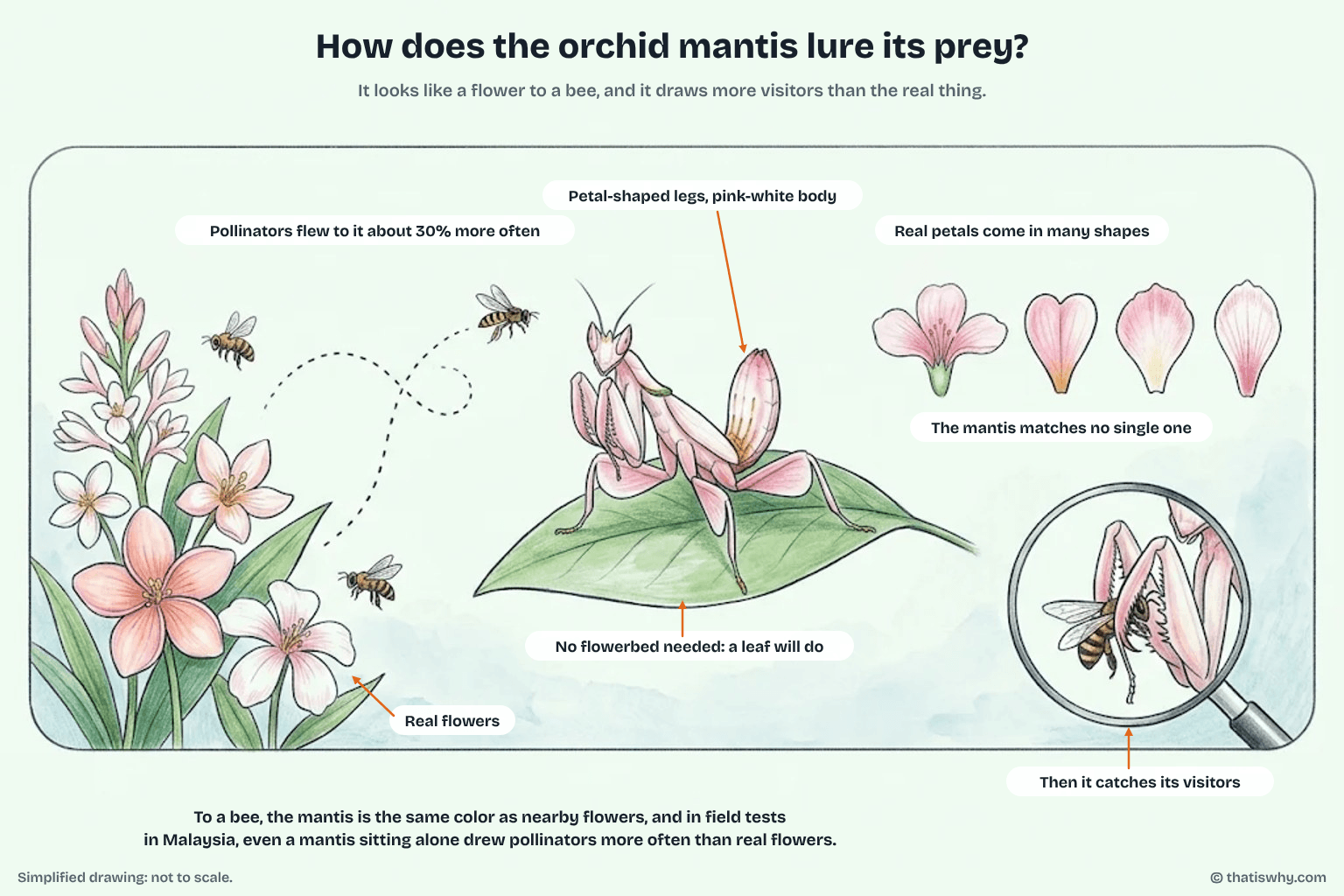
The detailed teaching diagram
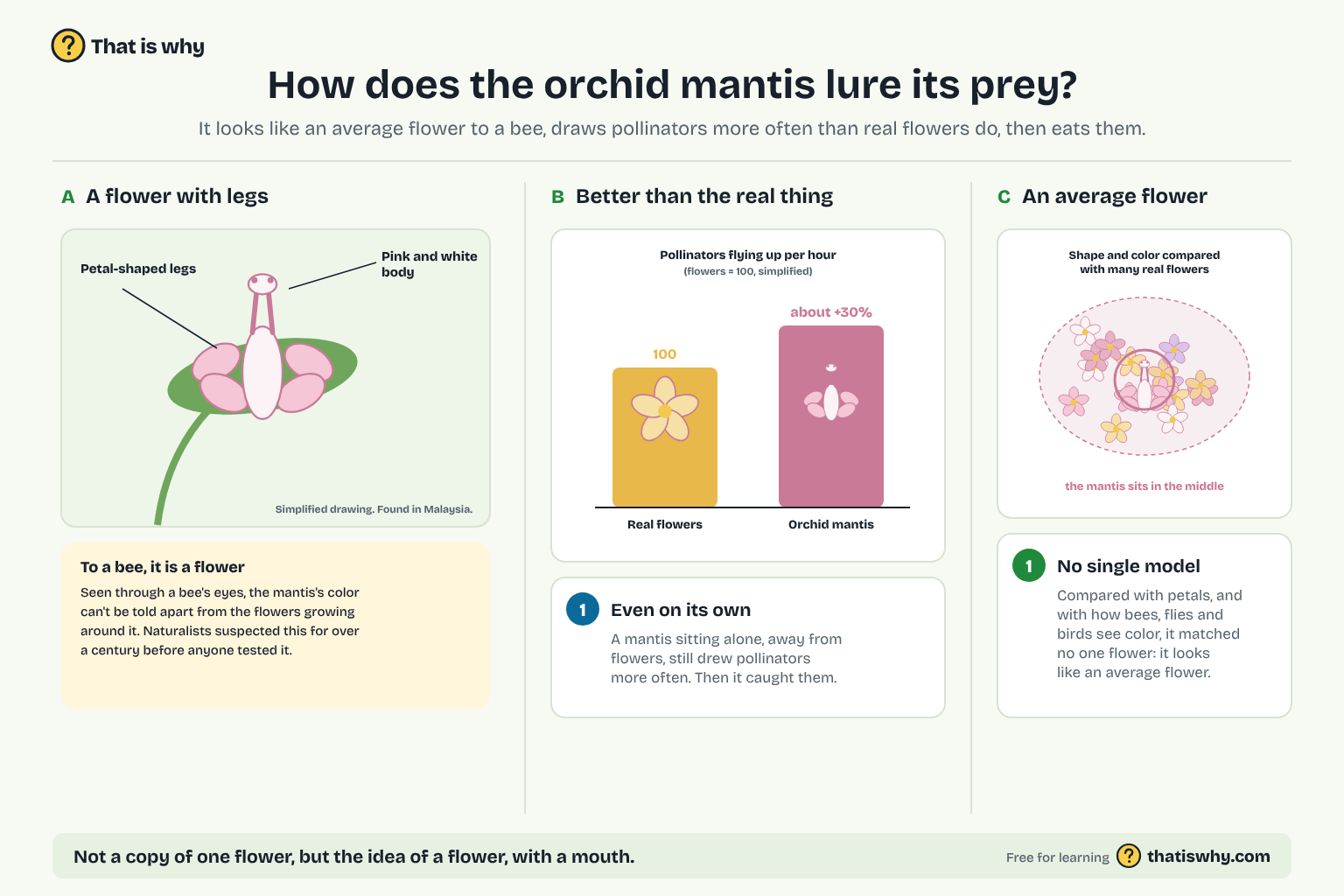
What the diagram shows
A. A flower with legs. The orchid mantis, Hymenopus coronatus, has petal-shaped legs and a pink and white body. Seen through a bee's eyes, its color can't be told apart from the flowers growing around it. Naturalists suspected it imitated flowers for over a century before anyone tested the idea. The drawing is simplified.
B. Better than the real thing. In field tests in Malaysia, researchers counted how often pollinators flew up to orchid mantises and to real flowers. The mantises drew them about 30% more often, even when a mantis sat alone, away from flowers, and then caught them. This was the first experimental evidence that the mantis deceives pollinators, a form of aggressive mimicry. The bar chart is simplified.
C. An average flower. When scientists compared the mantis's petal-like legs with real petals, and its colors as bees, flies and birds would see them, it matched no single flower. It falls in the middle of many flowers, like an average flower.
Key numbers
| Fact | Value |
|---|---|
| How much more often pollinators approached mantises than flowers | about 30% |
| How long the flower-mimic idea went untested | over a century |
| Where the field tests took place | Malaysia |
| Single model flower found | none |
Common misconceptions
Myth The orchid mantis copies one kind of orchid.
The truth Compared with many flowers, it matched no single species; it resembles an average flower.
Myth It only fools insects when it hides among flowers.
The truth Even a mantis sitting on its own drew pollinators more often than real flowers did.
Myth The orchid mantis eats flowers.
The truth It eats the insects it lures in.
Questions to use in class
Tap a question to reveal a model answer.
1How much better than a flower is the orchid mantis at attracting pollinators?
In field tests in Malaysia, pollinators flew up to mantises about 30% more often than to real flowers.
2Can a bee tell the mantis from a flower?
Seen through a bee's eyes, the mantis's color can't be told apart from the flowers around it.
3Which flower does the orchid mantis imitate?
None in particular. Its shape and color fall in the middle of many flowers, like an average flower.
4What does the orchid mantis eat?
The pollinating insects it attracts.
Key terms
- Aggressive mimicry
- When a predator or parasite copies something attractive, such as food, to lure another animal. Zombie snail brood sacs look like caterpillars to birds.
- Pollinator
- An animal, such as a bee or a fly, that visits flowers and carries pollen between them. The orchid mantis lures pollinators in order to eat them.
Sources
- Pollinator deception in the orchid mantis (O'Hanlon et al., The American Naturalist 2014) The American Naturalist
- Mimicking mantis outperforms orchids Australian Geographic
- Predatory pollinator deception: does the orchid mantis resemble a model species? (O'Hanlon et al.) University of New England