Free teaching diagram
Femme Fatale Firefly Diagram: How Photuris Fakes Signals
Photuris females copy the reply of Photinus females, lure the males in, and take their chemical shield.
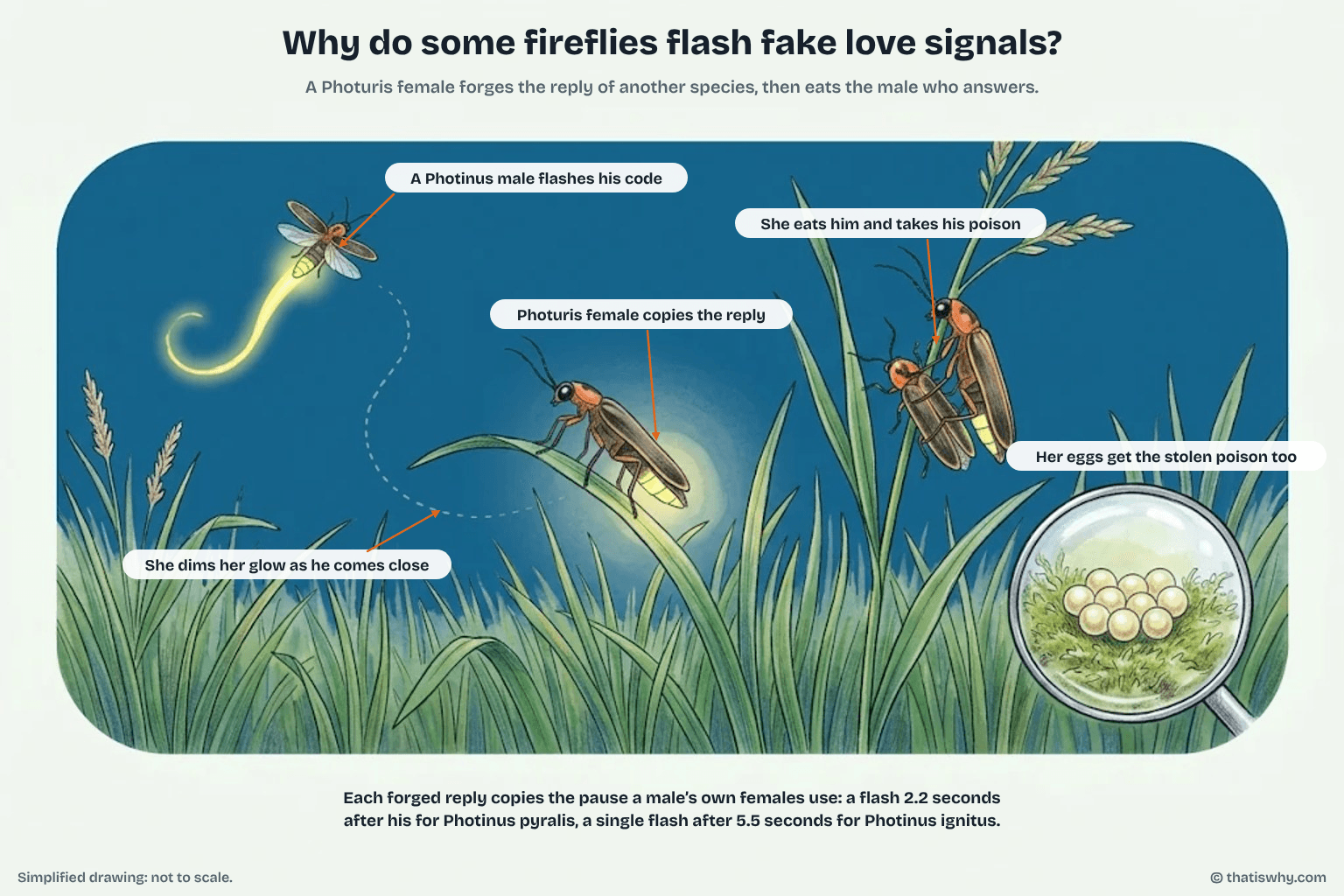
The detailed teaching diagram
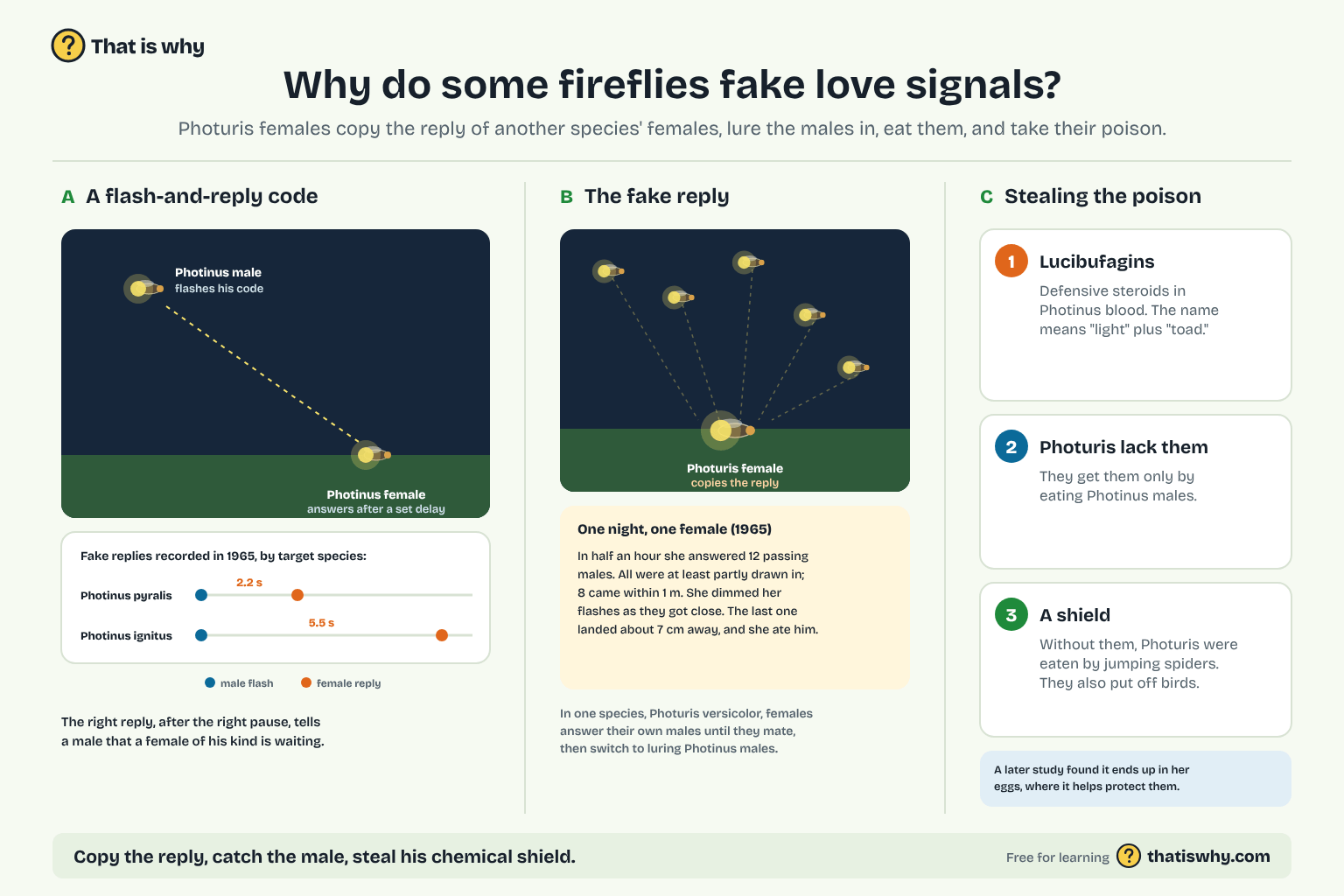
What the diagram shows
A. A flash-and-reply code. A Photinus male flashes his code in flight, and a female of his species answers from the ground after a set delay. When the biologist James Lloyd mimicked Photinus males with a flashlight in 1965, femme fatale replies came 2.2 seconds after the flash for Photinus pyralis and 5.5 seconds for Photinus ignitus.
B. The fake reply. Photuris females copy the reply of Photinus females, a trick called aggressive mimicry. One Photuris female answered 12 passing males in half an hour. All were at least partly drawn in, and 8 came within 1 m. She dimmed her flashes as they got close, and the last one, which landed about 7 cm away, was eaten. In Photuris versicolor, females answer their own species' males until they mate, then switch to luring Photinus males.
C. Stealing the poison. Photinus fireflies carry lucibufagins, defensive steroids whose name means "light" plus "toad." Photuris fireflies get them only by eating Photinus males. Without them, Photuris fireflies were eaten by jumping spiders, and the chemicals also put off birds such as thrushes. A later Cornell study found that females who had eaten Photinus males packed lucibufagins into their eggs, and in the field these defenses reduced egg predation.
Key numbers
| Fact | Value |
|---|---|
| Fake reply delay for Photinus pyralis (1965) | 2.2 seconds |
| Fake reply delay for Photinus ignitus (1965) | 5.5 seconds |
| Males answered by one female in half an hour | 12 |
| Males that came within 1 m | 8 |
| Distance of the male she caught | about 7 cm |
Common misconceptions
Myth Every female firefly that flashes back is looking for a mate.
The truth Photuris females can copy the reply of Photinus females to lure Photinus males in and eat them.
Myth Femme fatale fireflies only hunt for food.
The truth By eating Photinus males they also take in lucibufagins, defensive chemicals they cannot get any other way.
Myth Femmes fatales trick every male that flies by.
The truth In 1965, one female drew in 12 males over half an hour; 8 came within 1 m, but only the last one landed close enough to be caught.
Questions to use in class
Tap a question to reveal a model answer.
1What is a femme fatale firefly?
A Photuris female that copies the flash reply of Photinus females to lure Photinus males, then eats them.
2How do fireflies recognize their own species?
The male flashes a code and the female answers after a set delay that differs from species to species.
3What are lucibufagins?
Defensive steroids in the blood of Photinus fireflies; the name means "light" plus "toad."
4Why does the femme fatale need them?
Photuris fireflies cannot make lucibufagins; without them, they were eaten by jumping spiders.
Key terms
- Aggressive mimicry
- When a predator or parasite copies something attractive, such as food, to lure another animal. Zombie snail brood sacs look like caterpillars to birds.
- Bioluminescence
- Light made by a living thing through a chemical reaction. Most deep-sea bioluminescence is blue, the color that travels furthest in water.
- Lucibufagins
- Defensive steroids found in the blood of Photinus fireflies; the name means "light" plus "toad." Photuris femme fatale fireflies get them by eating Photinus males, which helps protect them from spiders.
Sources
- Aggressive Mimicry in Photuris: Firefly Femmes Fatales (Lloyd, Science 1965) University of Florida
- Mating-induced behavioural switch in female fireflies (Nelson, Carlson & Copeland, 1975) Nature
- Lured and liquidated, gullible male fireflies supply 'femmes fatales' with a lifesaving chemical Cornell Chronicle
- Chemical egg defense in Photuris 'femme-fatales' (González and Eisner, 1999) International Society of Chemical Ecology