Free teaching diagram
Nature's Tricksters Map: How Animals and Plants Deceive
Ten tricksters, one rule: fake a signal that others trust, and collect the reward.
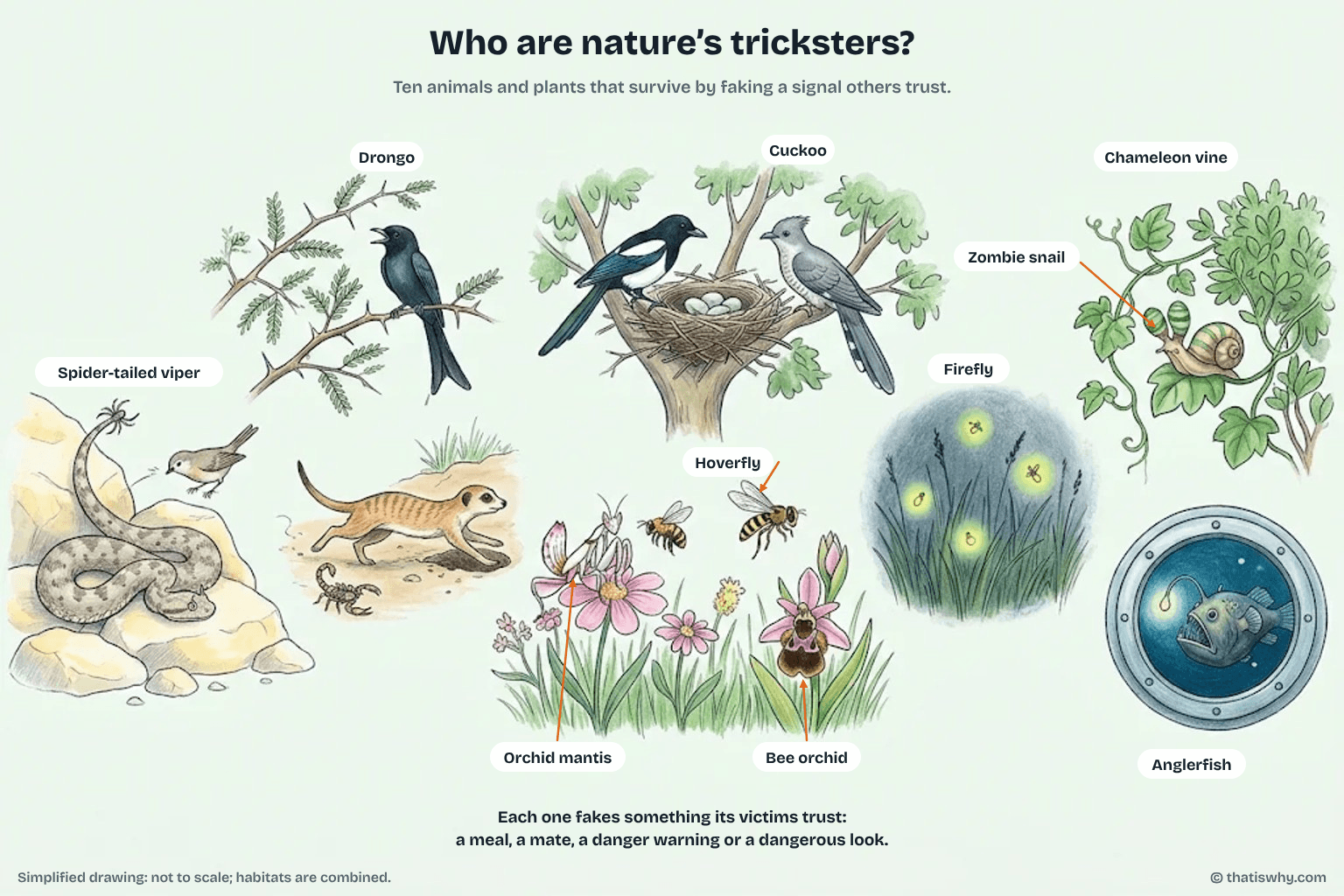
The detailed teaching diagram
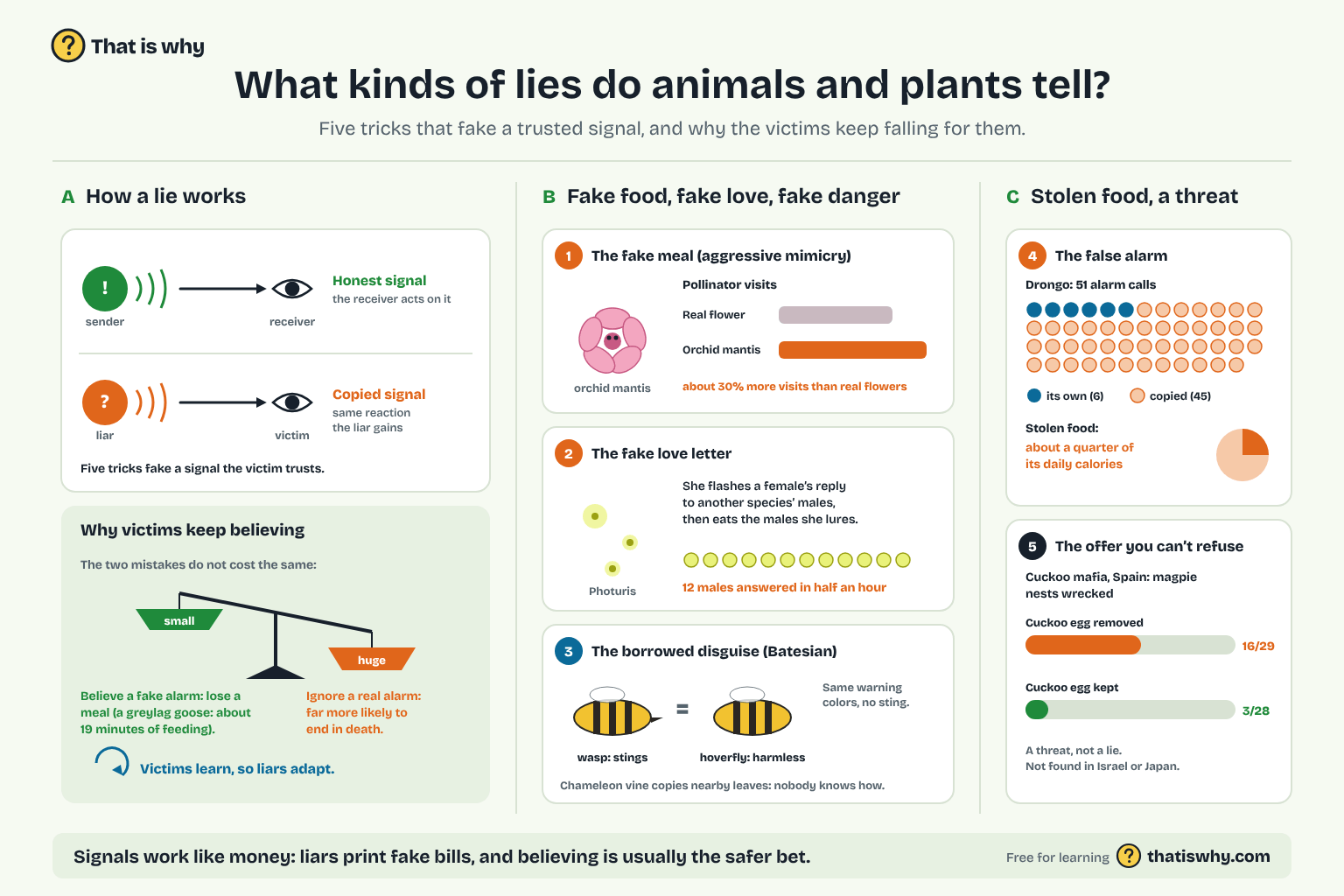
What the map shows
The fake meal. The orchid mantis looks like a flower, the spider-tailed viper waves a fake spider on its tail, the anglerfish dangles a glowing lure, and a parasite turns a snail's eye stalks into pulsing bait. Each copies something tempting so the victim comes closer (aggressive mimicry).
The fake love letter. A Photuris firefly female flashes the reply of another species' female and eats the males she lures. Bee orchid relatives fake a female bee, down to her scent (sexual deception).
The borrowed disguise. The hoverfly has no sting, but it wears a wasp's colors (Batesian mimicry). The chameleon vine copies the leaves of nearby plants, and nobody yet knows how. The opossum, not on the map, goes one step further and fakes being a corpse when a predator grabs it (why opossums play dead).
The false alarm and the threat. The fork-tailed drongo calls fake alarms to make meerkats and babblers drop their food. Great spotted cuckoos lay eggs in magpie nests and may wreck the nests of magpies that throw the egg out (brood parasitism).
The drawing is simplified: it combines habitats from several continents and the deep sea, and it is not to scale. The detailed chart below sorts the tricks into five kinds, with real numbers.
Key numbers
| Fact | Value |
|---|---|
| Extra pollinator visits to orchid mantises vs real flowers (Malaysia) | about 30% more |
| Different alarm calls a drongo can make | at least 51 (only 6 its own) |
| Males answered by one Photuris female in half an hour | 12 |
| Magpie nests destroyed after the cuckoo egg was removed (Spain) | 16 of 29, against 3 of 28 that kept it |
| Feeding time a greylag goose loses per false alarm | about 19 minutes |
Common misconceptions
Myth Animals that fall for tricks are stupid.
The truth Believing an alarm is usually the safe bet: ignoring a real one is far more likely to end in death than fleeing from a fake one.
Myth The orchid mantis copies a particular orchid.
The truth It resembles a generic flower, and in Malaysia it drew about 30% more pollinator visits than real flowers.
Myth Only animals deceive.
The truth Plants do too: bee orchid relatives fake a female bee, and the chameleon vine copies the leaves of nearby plants.
Questions to use in class
Tap a question to reveal a model answer.
1What is the difference between Batesian and aggressive mimicry?
In Batesian mimicry a harmless species copies a dangerous one to be left alone, like a hoverfly. In aggressive mimicry a predator copies something harmless or tempting to lure victims, like the orchid mantis.
2How does the drongo steal food?
It calls a fake alarm when another animal has found food, and when the victim flees, it takes the food. It can make at least 51 alarm calls, only 6 its own.
3Why don't victims stop believing liars?
Missing a real predator can be fatal, while a fake alarm usually costs only some feeding time. Victims do learn, so liars such as the drongo keep changing their calls.
4Which of the five tricks is a threat rather than a lie?
The cuckoo mafia: cuckoos may wreck the nests of magpies that throw out their egg.
Key terms
- Aggressive mimicry
- When a predator or parasite copies something attractive, such as food, to lure another animal. Zombie snail brood sacs look like caterpillars to birds.
- Batesian mimicry
- When a harmless species resembles a harmful or unpalatable one, so predators or plant-eaters avoid it too.
- Sexual deception
- A pollination trick in which a flower imitates a female insect's look, feel or scent, so males try to mate with it and carry its pollen away without any reward.
- Vocal mimicry
- Copying the sounds of other animals. Fork-tailed drongos make at least 51 alarm calls, and all but six are copies of other species.
- Brood parasitism
- When a bird lays its eggs in another bird's nest, so the host hatches and raises its young. Great spotted cuckoos do this to magpies.
- Leaf mimicry
- When a plant's leaves come to resemble those of another plant. The chameleon vine changes its leaves to match nearby hosts.
Sources
- Deception in animals Wikipedia
- Why prey animals often see threats where there are none, and how it costs them The Conversation
- Pollinator deception in the orchid mantis (O'Hanlon et al., The American Naturalist 2014) The American Naturalist
- Predatory pollinator deception: does the orchid mantis resemble a model species? (O'Hanlon et al.) University of New England
- Viper lures birds with a fake spider on its tail (Fathinia et al., Amphibia-Reptilia) National Geographic
- Study illuminates link between anglerfish, bacteria Cornell Chronicle, Cornell University
- Leucochloridium paradoxum Wikipedia
- Aggressive Mimicry in Photuris: Firefly Femmes Fatales (Lloyd, Science 1965) University of Florida
- Lured and liquidated, gullible male fireflies supply 'femmes fatales' with a lifesaving chemical Cornell Chronicle
- Evolution of reproductive strategies in the sexually deceptive orchid Ophrys sphegodes (Ayasse et al., Evolution 2000) Lund University
- Mapping the adaptive landscape of Batesian mimicry using 3D-printed stimuli (Taylor et al., Nature 2025) University of Nottingham
- Boquila Wikipedia
- The bird that cries wolf changes its lies (Flower et al., Science 2014) National Geographic
- Sly birds cleverly 'cry wolf' to steal food Live Science
- Bullies of the Bird World National Wildlife Federation
- Magpie host manipulation by great spotted cuckoos: evidence for an avian mafia? (Soler et al., Evolution 1995) University of Granada