Free teaching diagram
Chameleon Vine Diagram: The Plant That Copies Leaves
One vine wears several disguises, copying the leaves of whichever plant grows nearest. How it does this is still unknown.
The detailed teaching diagram
What the diagram shows
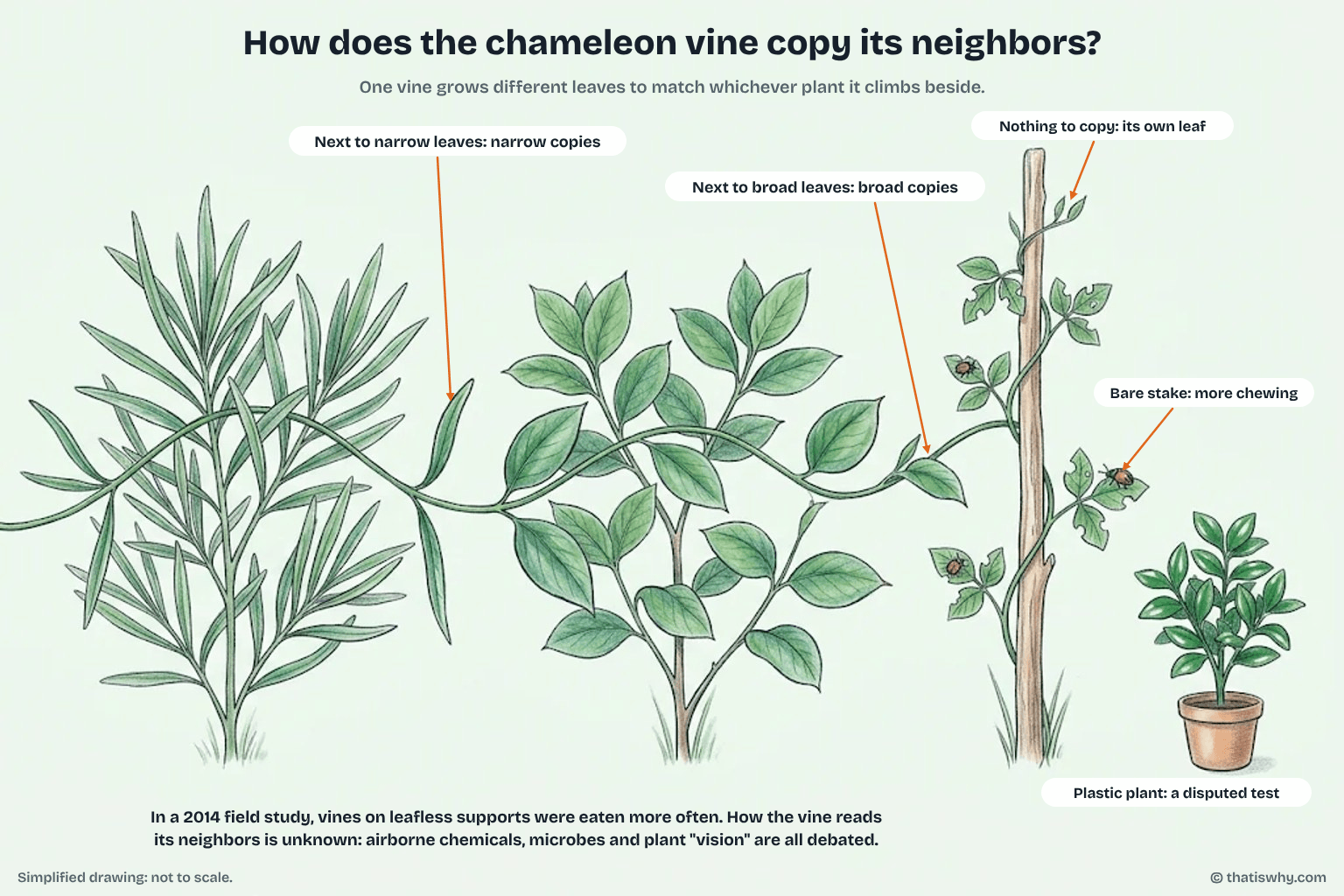
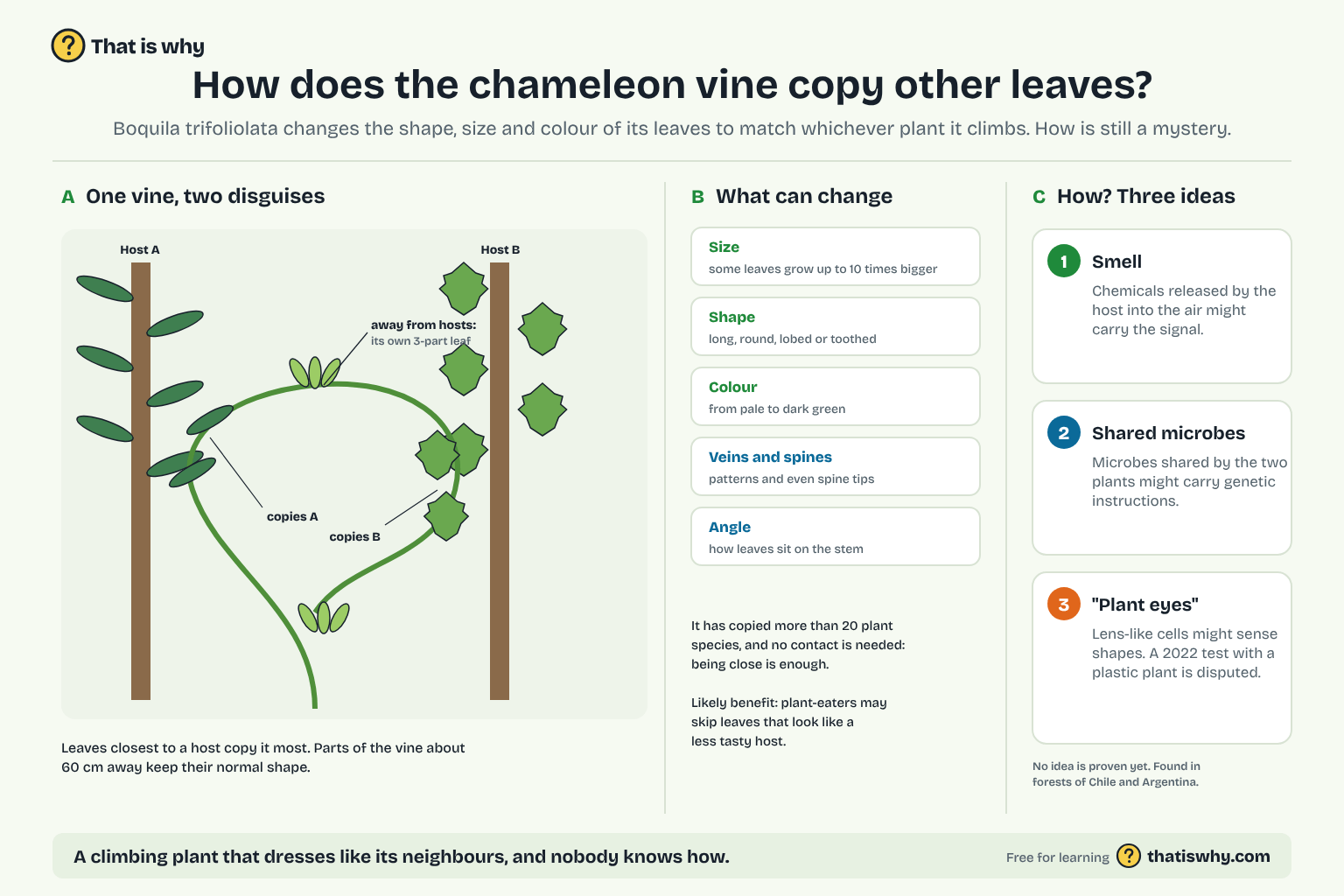
A. One vine, two disguises. The chameleon vine, Boquila trifoliolata, climbs other plants in the temperate forests of Chile and Argentina. Its leaves change to resemble whichever plant they are closest to (leaf mimicry). One vine can copy the long, narrow leaves of one host and the broad, toothed leaves of another along the same stem. Parts of the vine about 60 cm from any host keep their own simple three-part leaf.
B. What can change. Leaves can change size (some grow up to ten times larger), shape, color, vein pattern, spines and the angle at which they sit. The vine has been recorded copying more than 20 plant species, without needing to touch them. A likely benefit is protection: plant-eaters that avoid the host may skip the vine too, a kind of Batesian mimicry.
C. How? Three ideas. No explanation is proven:
- Smell: the host might release airborne chemicals (volatile organic compounds) that the vine detects.
- Shared microbes: microbes moving between the plants might carry genetic instructions (horizontal gene transfer).
- "Plant eyes": lens-like cells on the leaves might sense shapes. A 2022 study reported the vine copying a plastic plant, but it is disputed and has not been independently repeated.
Common misconceptions
Myth Scientists have proven the chameleon vine can see.
The truth Plant vision is only one hypothesis. The 2022 study using a plastic host plant is disputed, and no explanation has been confirmed.
Myth The vine has to touch a plant to copy it.
The truth Being close is enough. Leaves nearest the host copy it most, while parts about 60 cm away keep their own shape.
Myth It can only copy one kind of plant.
The truth It has been recorded copying more than 20 species, and one vine can copy two different hosts along its length.
Questions to use in class
Tap a question to reveal a model answer.
1Why might copying a host's leaves help the vine?
Plant-eaters that avoid the host may also avoid the vine's leaves, so it gets eaten less, a form of protective mimicry.
2What evidence suggests the vine responds to nearby plants rather than its own genes alone?
Leaves change to match whichever host is nearest, and parts of the vine far from any host keep the normal shape.
3Describe one experiment that could test the 'smell' idea.
Grow the vine near a host but separated by a clear, airtight barrier, then compare with a barrier that lets air through. If mimicry only happens with shared air, airborne chemicals may be involved.
4Why do scientists call the plastic-plant study controversial?
Critics questioned its methods and conflicts of interest, and the result has not been independently repeated.
Key terms
- Leaf mimicry
- When a plant's leaves come to resemble those of another plant. The chameleon vine changes its leaves to match nearby hosts.
- Batesian mimicry
- When a harmless species resembles a harmful or unpalatable one, so predators or plant-eaters avoid it too.
- Volatile organic compound
- A carbon-based chemical that easily evaporates into the air. Plants release many of them, for example as scents.
- Horizontal gene transfer
- The movement of genes between organisms other than from parent to offspring, for example via microbes.
Sources
- Boquila trifoliolata mimics leaves of an artificial plastic host plant (White & Yamashita, 2022) Plant Signaling & Behavior (NASA ADS)
- Researchers discover vine that is able to mimic multiple hosts Phys.org
- South American vine is a masterful mimic Science News
- The most versatile impressionist in the forest National Geographic
- Understanding Plant Abilities without Animal Metaphors (Gianoli) Harvard Divinity School, Center for the Study of World Religions
- Can Plants See? In the Wake of a Controversial Study, the Answer's Still Unclear The Scientist
- Boquila Wikipedia
- Leaf mimicry Wikipedia