Free teaching diagram
Eucalyptus Fire Diagram: How the Tree Survives the Flames
Eucalyptus lets its oily outside burn while its buds stay sealed in bark, twigs and an underground lignotuber, ready to regrow.
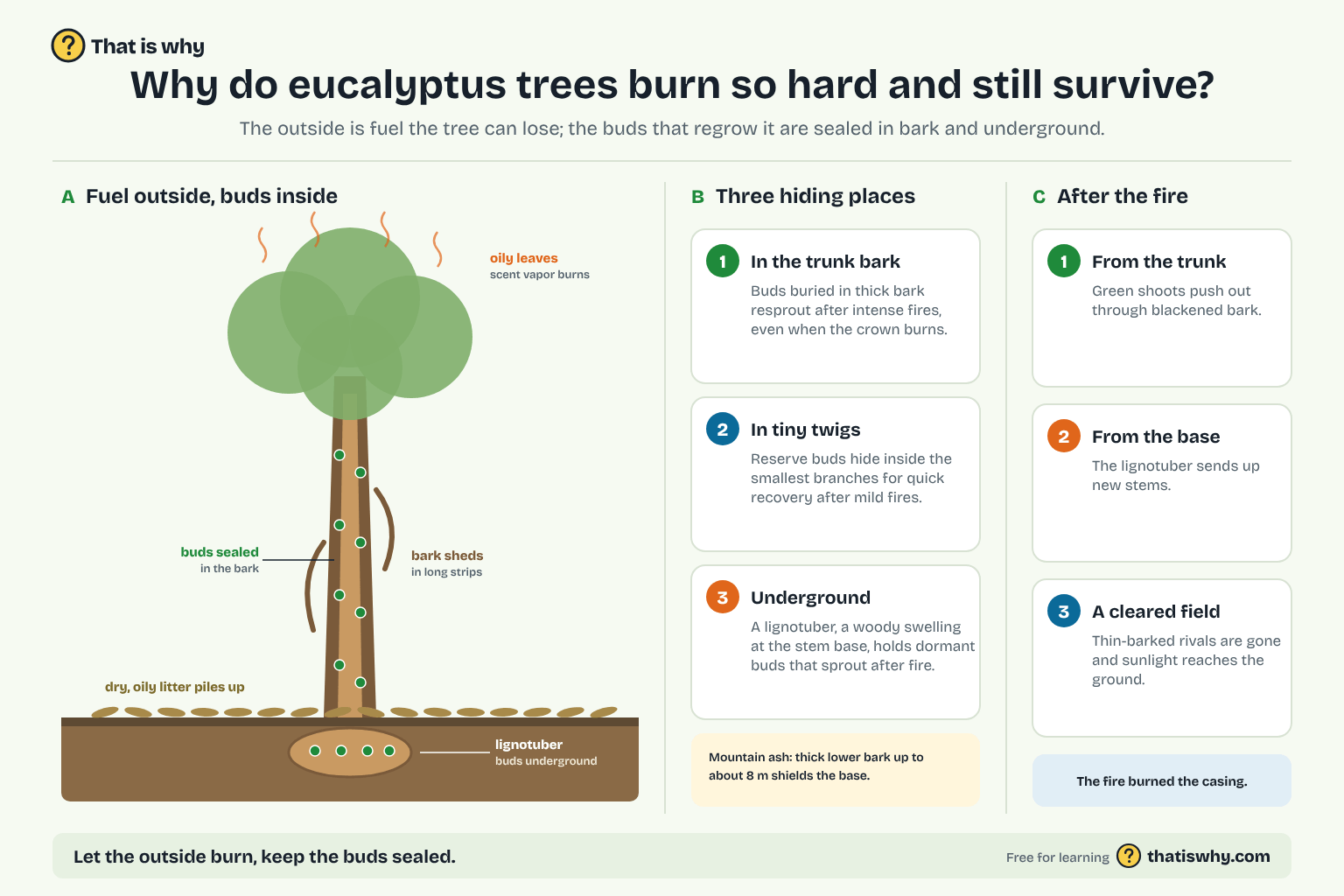
What the diagram shows
A. Fuel outside, buds inside. A eucalyptus surrounds itself with things that burn: oily leaves that release a flammable scent (a volatile organic compound), bark that sheds in long strips, and dry, oily litter that piles up underneath. Hidden away from the flames are the buds the tree will regrow from.
B. Three hiding places. Researchers at Charles Sturt University found buds buried in the trunk bark, which resprout after intense fires even when the crown burns, and reserve buds hidden inside the smallest branches, which allow quick recovery after milder fires. These bark buds are called epicormic buds. Many eucalypts also grow a lignotuber, a woody swelling at the base of the stem that holds dormant buds and sprouts after fire. In mountain ash, thick lower bark, up to about 8 m high, shields the base from low-intensity fires.
C. After the fire. Green shoots push out through the blackened trunk, the lignotuber sends up new stems, and thin-barked rivals have been cleared away, leaving sunlight on open ground.
Key numbers
| Fact | Value |
|---|---|
| Places buds are hidden | trunk bark, smallest twigs, lignotuber |
| Mountain ash thick lower bark | up to about 8 m |
Common misconceptions
Myth Eucalyptus trees start wildfires.
The truth They don't ignite fires on their own, but their oily leaves, shed bark and litter make fires burn hotter once they start.
Myth A burned eucalyptus is a dead tree.
The truth Buds sealed in the bark and in the lignotuber at the base can sprout new shoots after the fire.
Myth All eucalypts recover the same way.
The truth Mountain ash has thin bark higher up, so a crown fire can kill it, while thick lower bark protects the base from milder fires.
Questions to use in class
Tap a question to reveal a model answer.
1Which parts of a eucalyptus act as fuel?
The oily leaves, the bark that sheds in long strips, and the dry, oily leaf litter on the ground.
2Where does a eucalyptus keep the buds it regrows from?
Buried in the trunk bark, hidden in the smallest twigs, and in the lignotuber, a woody swelling at the stem base.
3What is a lignotuber?
A woody swelling at the base of the stem that holds dormant buds. After fire destroys the shoots, those buds sprout new stems.
4How does fire help eucalyptus compete?
It removes thin-barked rivals and opens the ground to sunlight, while the eucalyptus regrows from protected buds.
Key terms
- Epicormic bud
- A bud kept dormant inside the bark of a trunk or branch. When fire or damage removes the crown, it sprouts new shoots straight through the bark.
- Lignotuber
- A woody swelling at the base of a stem, often partly underground, that holds dormant buds. After fire destroys the shoots, those buds sprout new stems.
- Volatile organic compound
- A carbon-based chemical that easily evaporates into the air. Plants release many of them, for example as scents.
Sources
- Bushfires reveal budding talent of eucalypt Charles Sturt University
- World's tallest flowering plant more fire-proof than thought Australian Geographic
- Fire and Plants UC Botanical Garden at Berkeley