Free teaching diagram
Dodder Vine Diagram: How a Parasitic Plant Smells Its Host
A dodder seedling swings in circles, follows the scent of the host it prefers, then taps into it with haustoria.
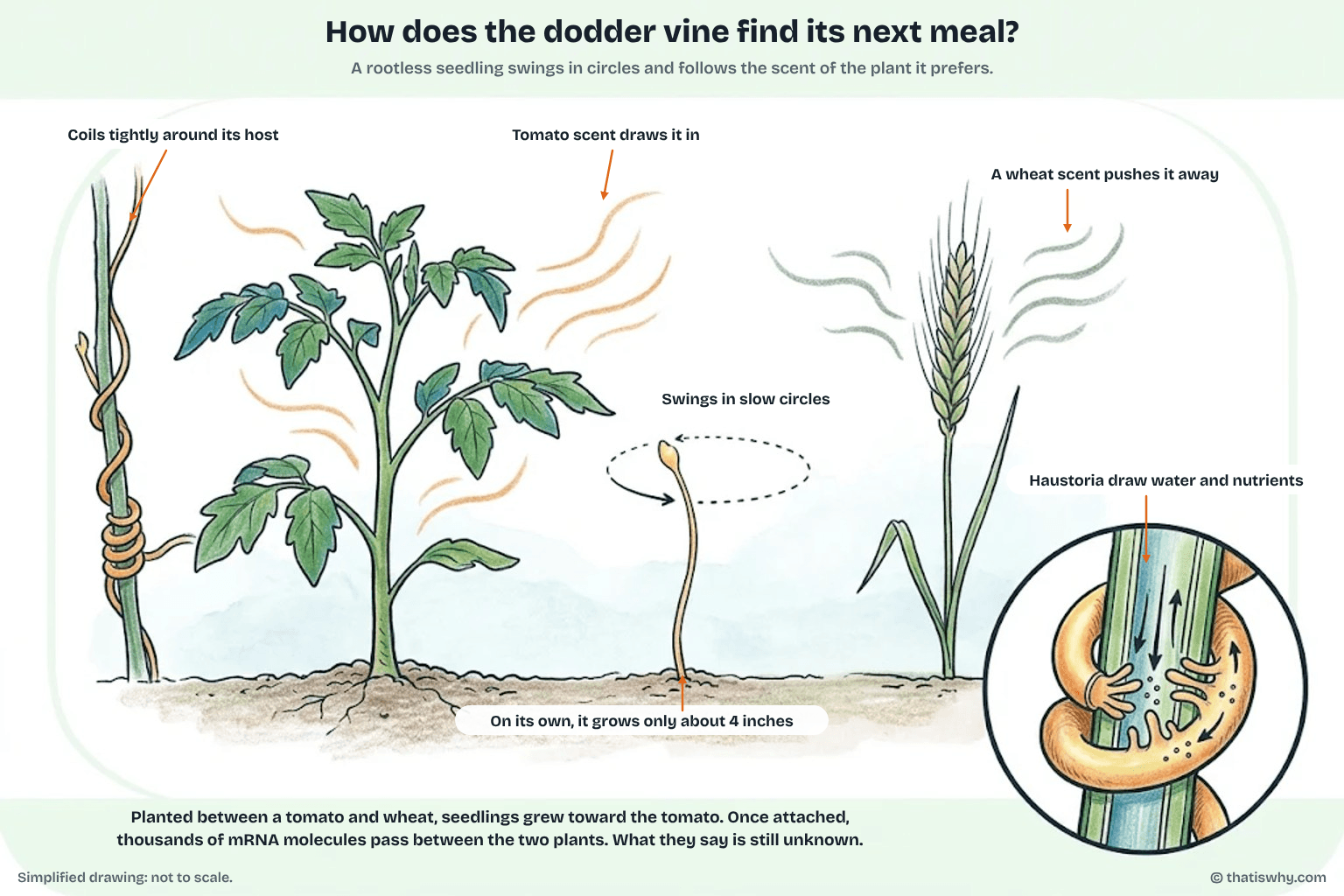
The detailed teaching diagram
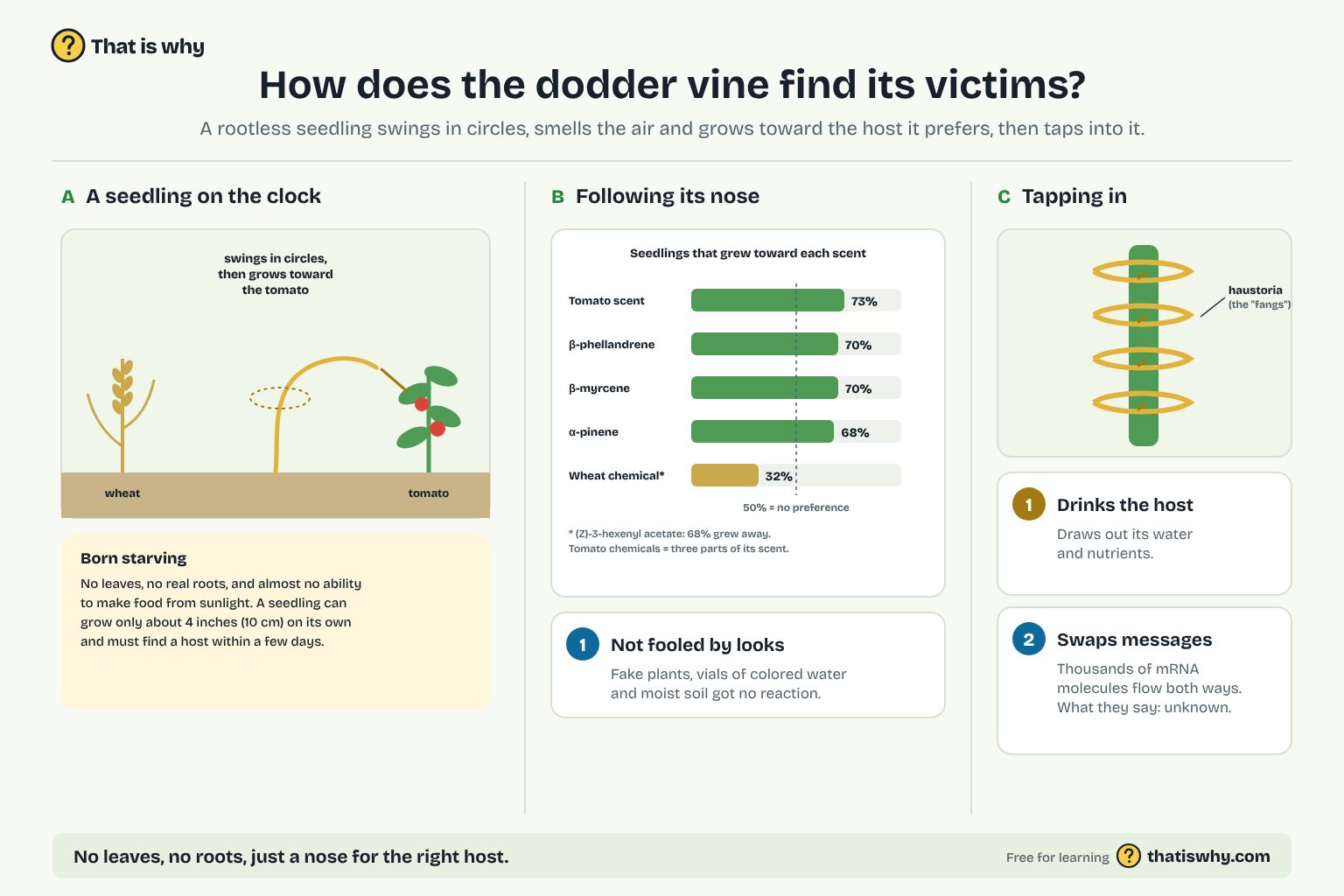
What the diagram shows
A. A seedling on the clock. A dodder seedling has no leaves and no real roots, and almost no ability to make food from sunlight. It can grow only about 4 inches (10 cm) on its own and must find a host within a few days. It swings in slow circles (circumnutation) and, planted between a tomato and a wheat plant, grows toward the tomato.
B. Following its nose. When tomato scent was released from a piece of rubber, 73% of seedlings grew toward it. Three single chemicals from tomato scent each drew 68 to 70% of seedlings. A chemical from wheat, (Z)-3-hexenyl acetate, drew only 32%; the rest grew away. Fake plants, vials of red or green colored water and pots of moist soil got no reaction. These are volatile organic compounds, chemicals that drift through the air.
C. Tapping in. Once it reaches a host, dodder coils around the stem and pushes in haustoria that draw out the host's water and nutrients. Thousands of mRNA molecules flow between dodder and host in both directions; what they say is still unknown.
Key numbers
| Fact | Value |
|---|---|
| Growth before finding a host | about 4 inches (10 cm) |
| Time to find a host | a few days |
| Seedlings drawn to tomato scent | 73% |
| Seedlings drawn to single tomato chemicals | 68 to 70% |
| Seedlings drawn to the wheat chemical | 32% (68% grew away) |
Common misconceptions
Myth Dodder finds its host by sight.
The truth Fake plants, vials of colored water and moist soil got no reaction; tomato scent alone drew 73% of seedlings.
Myth Dodder attacks any plant it meets.
The truth Given the choice, it grows toward tomato rather than wheat, and a wheat chemical seems to push it away.
Myth We know dodder hypnotizes its host.
The truth Thousands of mRNA molecules flow between them, but what those messages say is still unknown.
Questions to use in class
Tap a question to reveal a model answer.
1How long does a dodder seedling have to find a host?
A few days, and it can grow only about 4 inches (10 cm) on its own.
2How did scientists prove dodder follows scent?
They released tomato scent from a piece of rubber; 73% of seedlings grew toward it rather than toward a blank.
3What does dodder take from its host?
Its haustoria draw out the host's water and nutrients.
4Why does dodder avoid wheat?
Wheat gives off (Z)-3-hexenyl acetate, which drew only 32% of seedlings; 68% grew away from it.
Key terms
- Haustorium
- The attachment organ a parasitic plant pushes into its host to draw out water and nutrients. Dodder grows them along the coils it wraps around a stem.
- Circumnutation
- The slow, circling growth of a plant tip. A dodder seedling swings around this way while it searches for a host.
- Volatile organic compound
- A carbon-based chemical that easily evaporates into the air. Plants release many of them, for example as scents.
Sources
- Volatile chemical cues guide host location and host selection by parasitic plants (Runyon et al., Science 2006) USDA Forest Service
- Parasitic plants sniff out hosts, according to Penn State research Penn State University
- Plants may use language to communicate with each other, Virginia Tech researcher finds Virginia Tech