Free teaching diagram
Spider Silk Glands and Spinnerets: Labeled Diagram
Spiders make silk by stretching, acidifying and drying a liquid protein as it flows from the silk glands to the spinnerets.
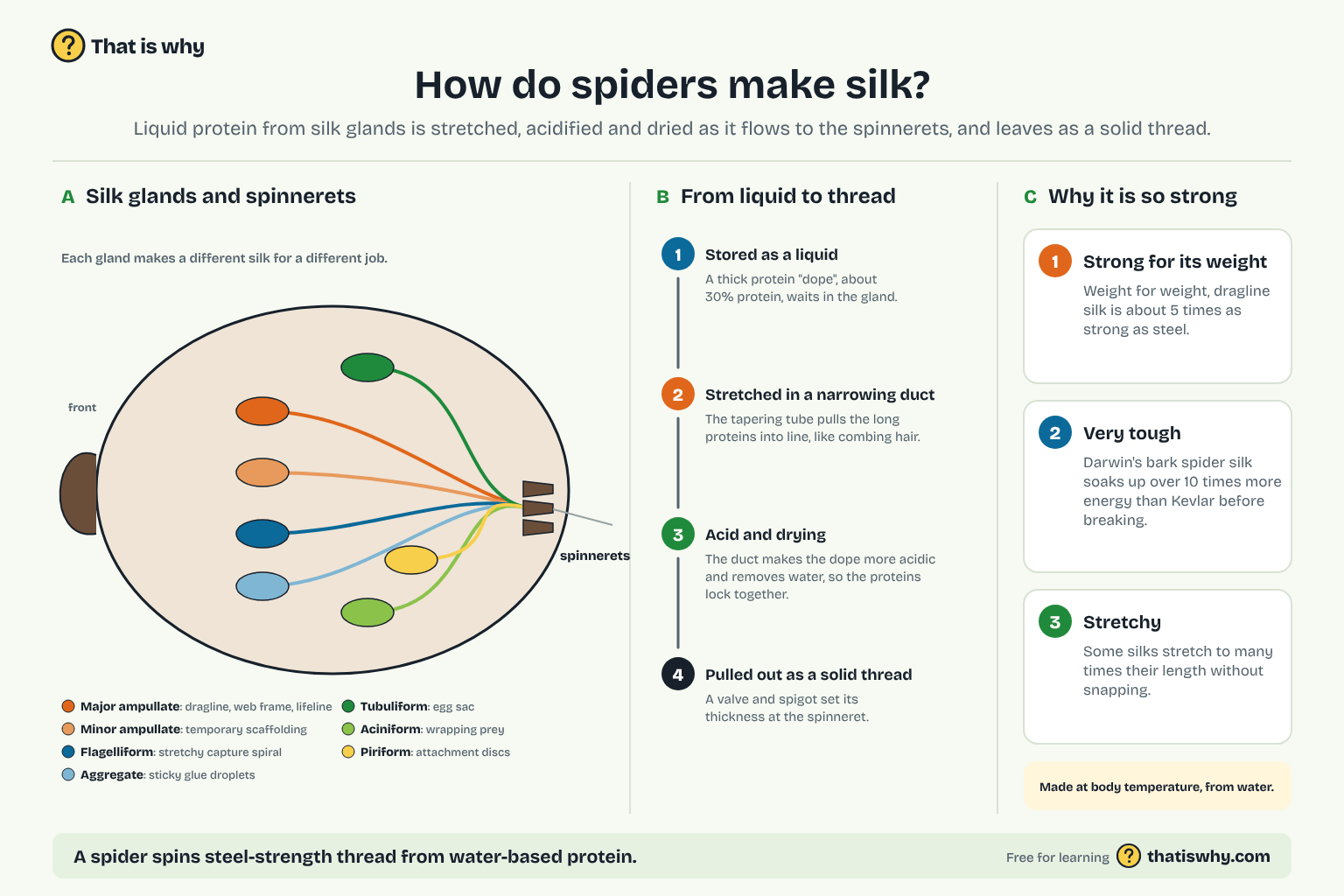
What the diagram shows
A. Silk glands and spinnerets. Inside a spider's abdomen are several kinds of silk gland, each making a different silk. Ducts carry the silk to the spinnerets, the small nozzles at the back of the abdomen (spiders have two to eight). An orb-weaving spider can have seven gland types:
| Gland | Silk used for |
|---|---|
| Major ampullate | dragline silk: lifeline, web frame and spokes |
| Minor ampullate | temporary scaffolding while building |
| Flagelliform | the stretchy capture spiral |
| Aggregate | sticky glue droplets on the spiral |
| Tubuliform | egg sacs |
| Aciniform | wrapping prey |
| Piriform | attachment discs that glue threads to surfaces |
B. From liquid to thread. Silk is stored as a thick liquid "dope", about 30% protein. As it flows down a narrowing duct, it is stretched so the long proteins line up. Cells lining the duct make it more acidic and remove water, so the proteins lock together. A valve and spigot at the spinneret set the thread's thickness as the spider pulls it out.
C. Why it is so strong. Weight for weight, dragline silk is about five times as strong as steel (high tensile strength). It is also extremely tough: silk from Darwin's bark spider absorbs over ten times more energy than Kevlar before breaking. And some silks can stretch many times their length without snapping. All of this is made at body temperature, from a water-based protein.
Common misconceptions
Myth Spiders store silk as ready-made thread.
The truth Silk is stored as a thick liquid protein. It only becomes a solid thread as it is stretched and dried on its way out.
Myth All spider silk is the same.
The truth Many spiders have several kinds of silk gland, each making a different silk: strong lines, stretchy spirals, glue, egg-sac silk and more.
Myth Spider silk is stronger than steel in every way.
The truth Weight for weight it is about five times as strong, and it is much tougher. But a steel cable of the same thickness is stiffer and, for some silks, about as strong.
Questions to use in class
Tap a question to reveal a model answer.
1Why does stretching the liquid silk in a narrowing duct make it stronger?
The stretching pulls the long protein molecules into line, side by side, so they can bond to each other along their length.
2What is the difference between strength and toughness?
Strength is how much pulling force a material takes before breaking; toughness is how much energy it can absorb before breaking, which depends on both strength and stretch.
3Why would a spider need a stretchy silk for the capture spiral?
A flying insect hits the web hard. A stretchy spiral absorbs that energy without snapping, so the prey is caught instead of tearing through.
4Why do engineers find spider silk-making so interesting?
Spiders make a high-performance fiber at body temperature from a water-based protein, while factories need high heat and harsh chemicals for fibers like Kevlar.
Key terms
- Silk gland
- A gland in a spider's abdomen that makes liquid silk protein. Many spiders have several types, each producing a different silk.
- Spinneret
- One of the small, nozzle-like organs at the back of a spider's abdomen through which silk is pulled out as a thread. Spiders have two to eight.
- Dragline silk
- The strong silk from a spider's major ampullate glands, used for the safety line and the frame and spokes of a web.
- Tensile strength
- How much pulling force a material can take before it breaks. Weight for weight, dragline silk has about five times the tensile strength of steel.
Sources
- Spider silk Wikipedia
- How spiders spin silk (PLOS Biology, 2014) PubMed Central