Free teaching diagram
Slime Mold Maze Diagram: How It Finds the Shortest Path
Spread out, thicken the busy tubes, let the rest fade: a network with no planner.
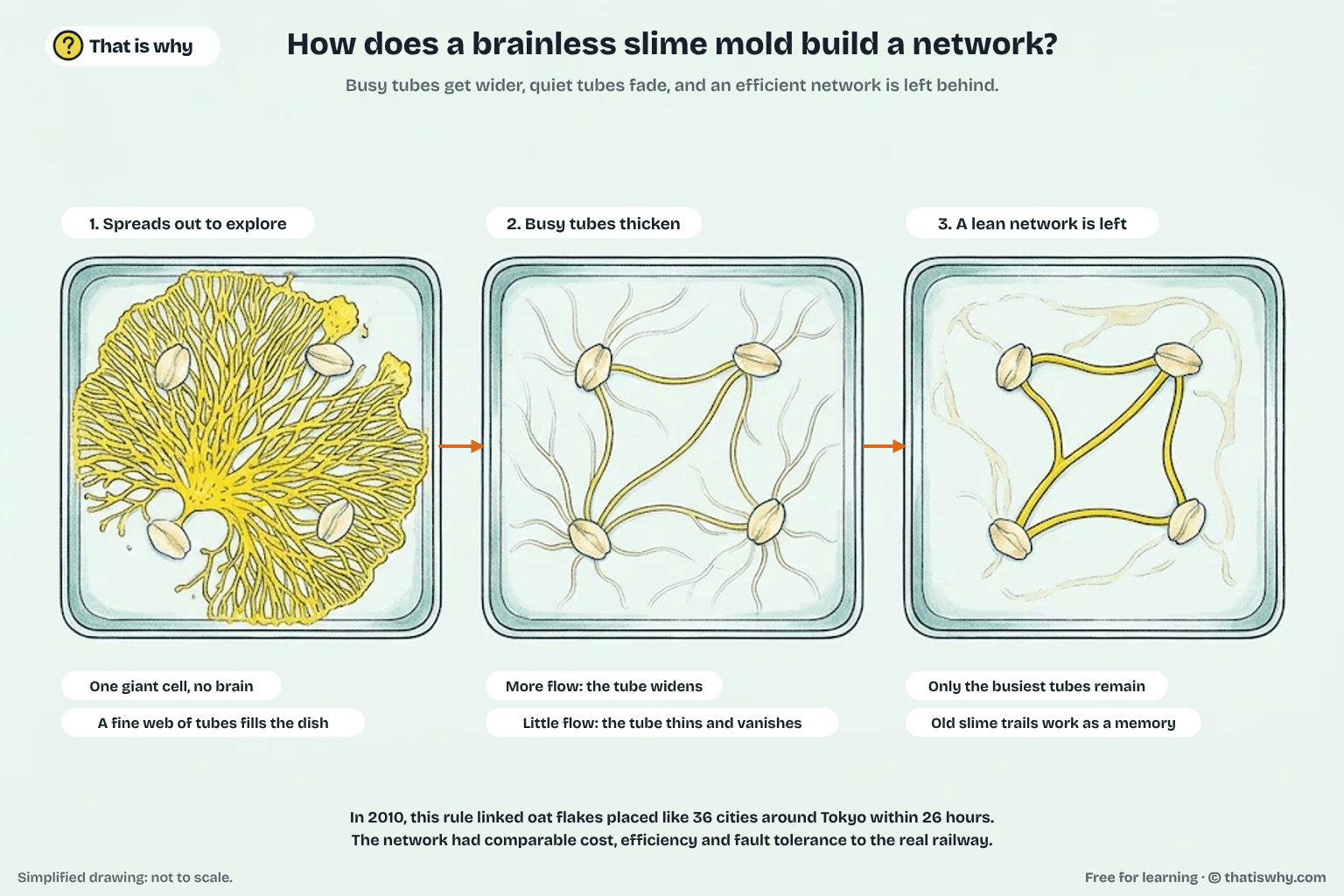
The detailed teaching diagram
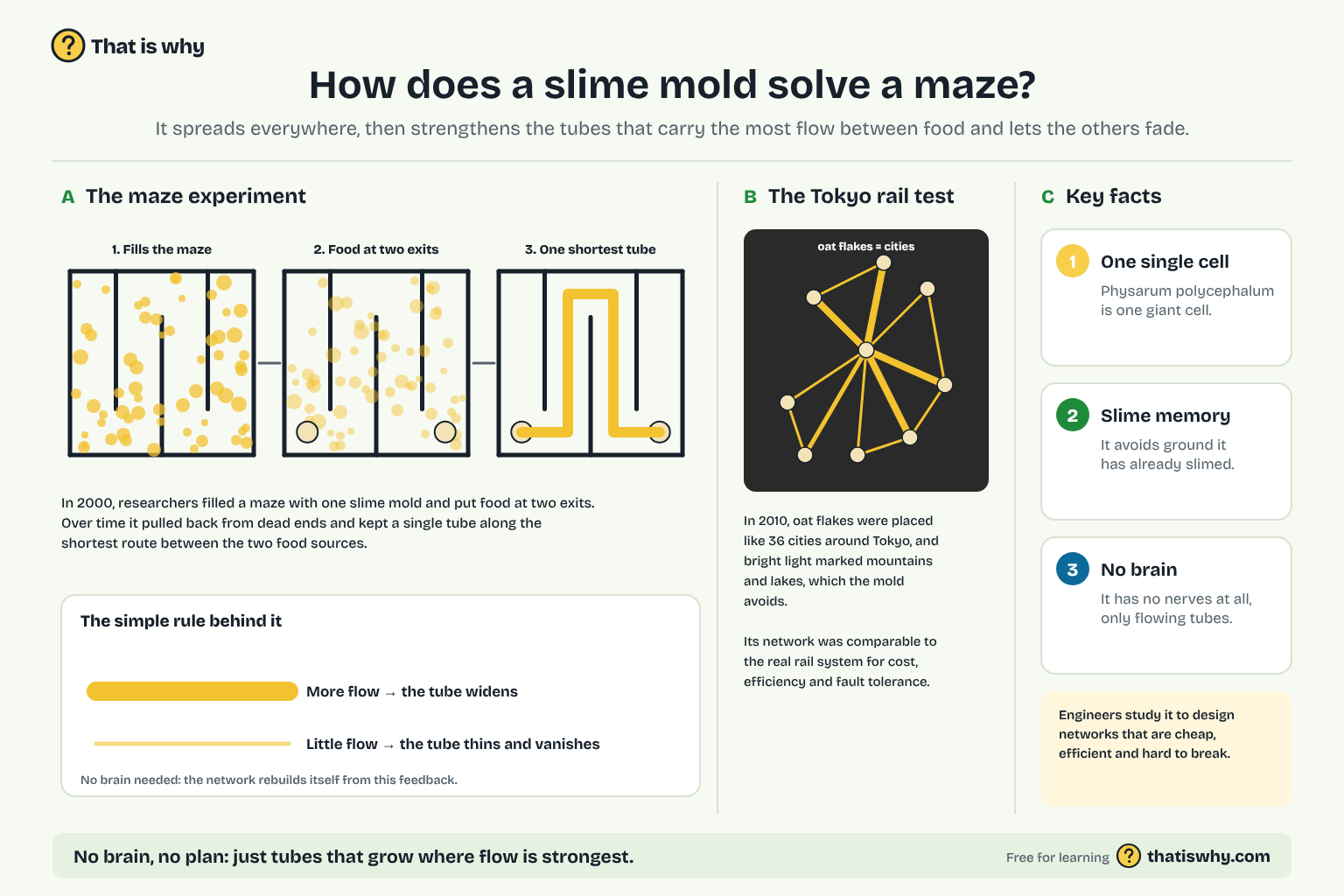
What the diagram shows
A. The maze experiment. In 2000, researchers filled a maze with a single slime mold, Physarum polycephalum, then placed food at two exits. The mold, a network of tubes called a plasmodium, gradually pulled back from the dead ends and kept one tube along the shortest route between the two food sources.
The simple rule behind it. Fluid constantly flows through the mold's tubes. Tubes that carry more flow grow wider, so they carry even more; tubes with little flow thin and disappear. This positive feedback needs no brain: the network rebuilds itself until only the best connections are left.
B. The Tokyo rail test. In 2010, oat flakes were placed like the cities around Tokyo, and bright light, which the mold avoids, marked mountains and lakes. The network it grew had a cost, efficiency and resistance to breaks comparable to the real rail system, which took engineers decades to plan.
C. Key facts. The whole organism is one giant cell. It has no brain and no nerves, only flowing tubes, and it avoids ground it has already covered in slime, a kind of memory stored outside its body. Engineers and computer scientists study it to design networks that are cheap, efficient and hard to break.
Key facts
| Fact | Value |
|---|---|
| Species | Physarum polycephalum |
| Cells | one (a giant single cell) |
| Cities in the Tokyo test | 36 |
| Time to grow the Tokyo network | about 26 hours |
| Maze experiment | 2000 (Nature) |
| Tokyo rail experiment | 2010 (Science) |
Common misconceptions
Myth Slime molds are a kind of fungus.
The truth Despite the name, they are not fungi. Physarum polycephalum is a single-celled organism that can grow into a large, branching network.
Myth The slime mold plans its route like we would.
The truth It has no brain. A simple rule, more flow makes a tube wider and less flow makes it shrink, gradually leaves only the best routes.
Myth It copied the Tokyo rail map.
The truth It was never shown the map. Food was placed where the cities are, and the network it grew happened to match the real rail system in cost, efficiency and resilience.
Questions to use in class
Tap a question to reveal a model answer.
1Why does the slime mold first spread through the whole maze?
It does not know where food is, so it explores every path. Only once food is found can the useful routes be strengthened.
2Explain the rule 'more flow, wider tube' in your own words.
Tubes that carry a lot of fluid between food sources get thicker, which lets them carry even more, while little-used tubes shrink and disappear.
3Why did the researchers shine bright light on parts of the Tokyo map?
The slime mold avoids light, so lit areas acted like mountains and lakes that a railway would have to avoid.
4Why might engineers be interested in how slime molds build networks?
They make networks that are cheap, efficient and still work if one link breaks, without any central planning.
Key terms
- Slime mold
- A brainless, often single-celled organism that crawls and feeds like an amoeba and can grow into large networks. It is not a fungus.
- Plasmodium (slime mold)
- The feeding stage of a slime mold such as Physarum: one giant cell with many nuclei, spread out as a network of tubes.
- Positive feedback
- A loop in which a change causes more of the same change. In a slime mold, a tube with more flow widens, which lets even more flow through.
Sources
- Maze-solving by an amoeboid organism (Nakagaki, Yamada & Tóth, 2000) Nature
- Slime mold validates efficiency of Tokyo rail network Scientific American
- Brainless creature solves problems with memories of slime (Reid et al., PNAS 2012) National Geographic
- Slime mould attacks simulates Tokyo rail network (Tero et al., Science 2010) National Geographic