Free teaching diagram
Carbonate Compensation Depth Diagram: Why Shells Dissolve
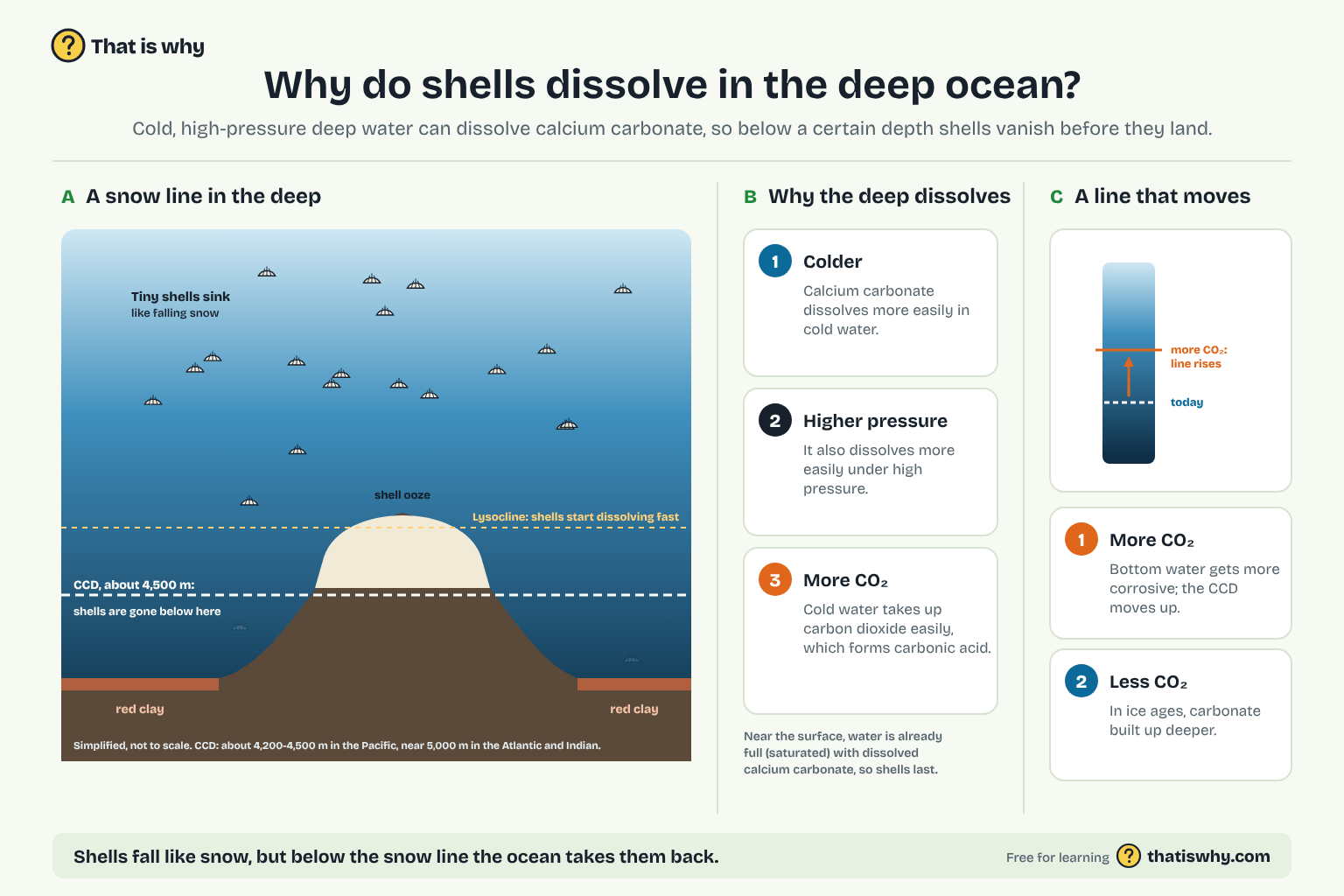
Shells fall like snow, start dissolving below the lysocline and are gone below the carbonate compensation depth, where only red clay remains.
What the diagram shows
A. A snow line in the deep. Tiny calcium carbonate shells sink through the ocean like falling snow. Below the lysocline, they start to dissolve quickly, and below the carbonate compensation depth (CCD) none are left by the time they would reach the floor. So high seafloor, such as ridges, is covered in pale calcareous ooze made of shells, while the deep floor is covered in fine, iron-rich red clay. The CCD is typically about 4,200 to 4,500 m in the Pacific and near 5,000 m in the Atlantic and Indian oceans. The picture is simplified and not to scale.
B. Why the deep dissolves. Calcium carbonate dissolves more easily in colder water and under higher pressure, and cold water takes up carbon dioxide easily, which forms carbonic acid. Near the surface, the water is already saturated with dissolved calcium carbonate, so shells last.
C. A line that moves. More carbon dioxide makes bottom water more corrosive and pushes the CCD upward. In ice ages, with less carbon dioxide in the air, carbonate built up deeper.
Key numbers
| Fact | Value |
|---|---|
| Carbonate compensation depth, Pacific | about 4,200 to 4,500 m |
| Carbonate compensation depth, Atlantic and Indian | near 5,000 m |
| Below the CCD, the floor is | iron-rich red clay |
| Above the CCD, the floor is | calcareous ooze (shell mud) |
Common misconceptions
Myth Deep-sea pressure crushes shells.
The truth Pressure changes the chemistry: calcium carbonate dissolves more easily in cold, high-pressure water.
Myth The whole seafloor is covered in shells.
The truth Shell ooze builds up only above the carbonate compensation depth; below it, the floor is iron-rich red clay.
Myth The line where shells dissolve never moves.
The truth More carbon dioxide makes bottom water more corrosive and pushes the line up; in ice ages, with less carbon dioxide, carbonate built up deeper.
Questions to use in class
Tap a question to reveal a model answer.
1What is the carbonate compensation depth?
The depth below which calcium carbonate dissolves as fast as shells arrive, so none builds up on the seafloor.
2How deep is the carbonate compensation depth?
Typically about 4,200 to 4,500 m in the Pacific, and deeper, near 5,000 m, in the Atlantic and Indian oceans.
3What is the lysocline?
The depth where shells first start to dissolve quickly, above the carbonate compensation depth.
4Why is surface water safe for shells?
It is already saturated with dissolved calcium carbonate, and calcium carbonate forms easily in shallow, warm seawater.
Key terms
- Carbonate compensation depth
- The ocean depth below which calcium carbonate shells dissolve as fast as they arrive, so none build up on the seafloor. It is typically about 4,200 to 4,500 m deep in the Pacific.
- Lysocline
- The depth in the ocean where calcium carbonate shells first start to dissolve quickly. It lies above the carbonate compensation depth.
- Calcareous ooze
- Pale seafloor mud made mostly of tiny calcium carbonate shells. It builds up only above the carbonate compensation depth.
Sources
- Calcium carbonate compensation depth (CCD) LibreTexts Geosciences, Oceanography 101 (MiraCosta College)
- Carbonate Compensation Depths EBSCO Research Starters