Free teaching diagram
Pit Viper Diagram: How Snakes Sense Heat in the Dark
The pit is a heat detector: infrared warms a thin membrane, and the brain turns the signal into a map of warm prey.
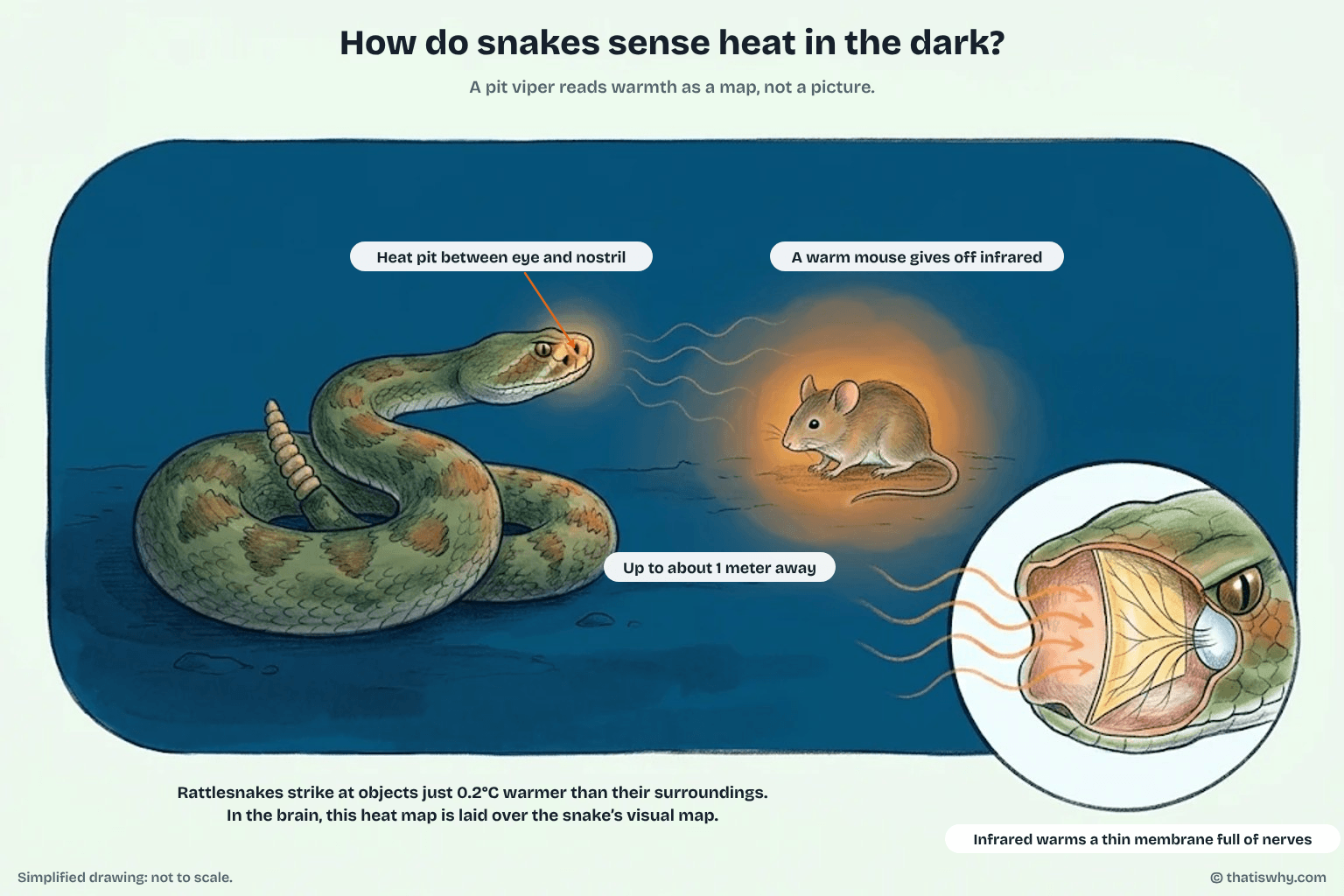
The detailed teaching diagram
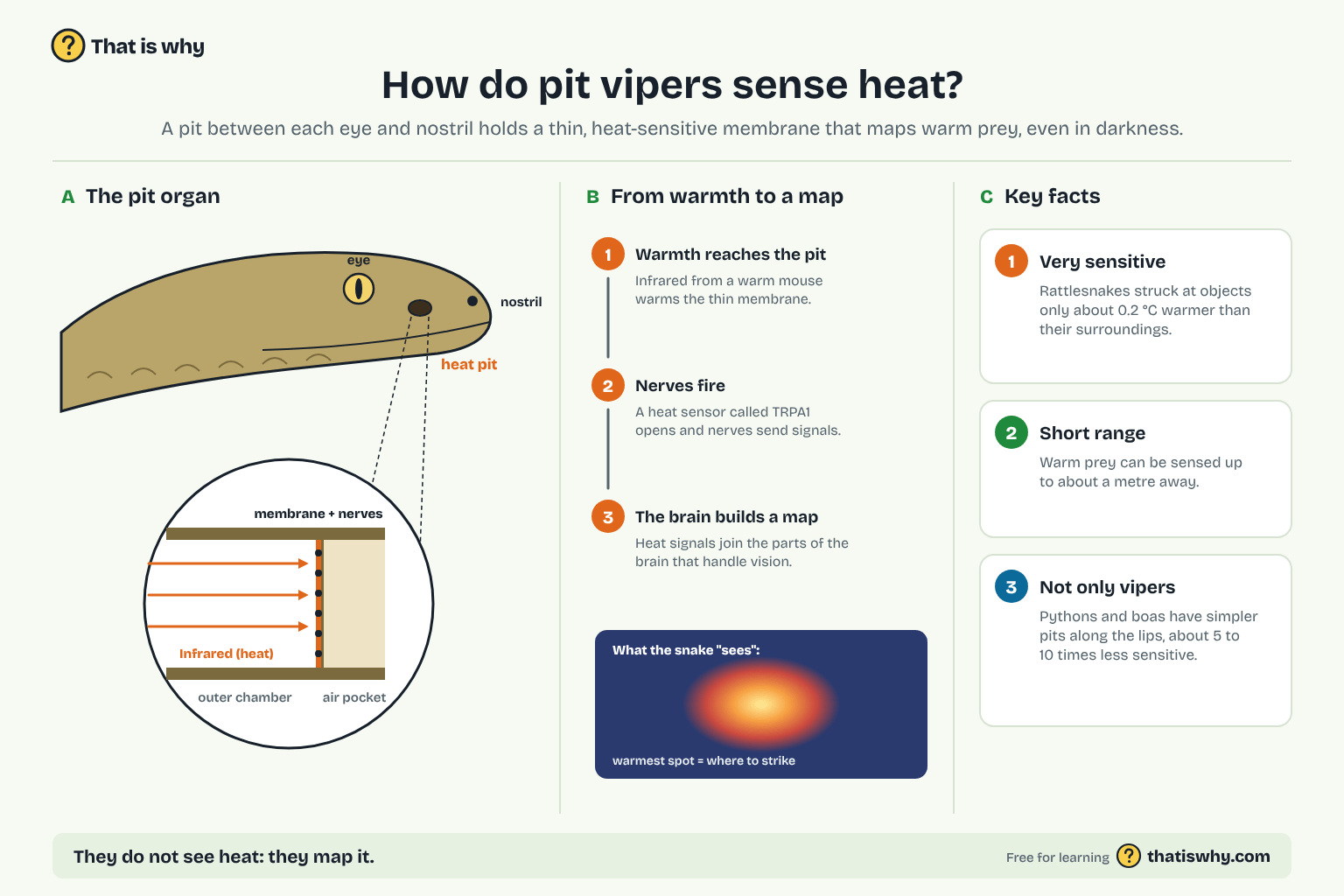
What the diagram shows
A. The pit organ. Pit vipers, such as rattlesnakes, have a small pit on each side of the head, between the eye and the nostril. Inside, a very thin membrane is stretched across the pit, with an air pocket behind it. Infrared radiation, the heat given off by warm bodies, enters the outer chamber and warms the membrane. The membrane is packed with nerve endings and has so little mass that it heats up almost at once.
B. From warmth to a map. When the membrane warms, a heat-sensitive channel in the nerve endings, called TRPA1, opens and the nerves fire. The signals travel to parts of the brain that also handle vision, where they are combined into a kind of heat map. The warmest spot shows where to strike, even in total darkness.
C. Key facts. The system is remarkably sensitive: rattlesnakes have struck at objects only about 0.2 °C warmer than their surroundings. It works at short range, up to about a meter. Pythons and boas have simpler pits along their lips that are about 5 to 10 times less sensitive.
Key numbers
| Fact | Value |
|---|---|
| Smallest difference detected | about 0.2 °C |
| Range | up to about 1 m |
| Python and boa pits | about 5 to 10 times less sensitive |
| Heat sensor | TRPA1 channel |
Common misconceptions
Myth Pit vipers see heat with their eyes.
The truth Their eyes see light much as ours do. Heat is picked up by separate pit organs, and the brain combines the two kinds of signal.
Myth Snakes can sense heat from far away.
The truth The pits are very sensitive but short-range: warm prey can be detected up to about a meter away.
Myth All snakes have heat-sensing pits.
The truth Only pit vipers, pythons and boas do, and the pits of pythons and boas are simpler and less sensitive.
Questions to use in class
Tap a question to reveal a model answer.
1Why is the membrane in the pit so thin, with air behind it?
A thin membrane with little mass warms up quickly, and the air behind it keeps that heat from draining away into the head, so even tiny changes can be detected.
2A mouse is 0.2 °C warmer than the ground around it. Could a rattlesnake detect it?
Yes. Rattlesnakes have struck at objects only about 0.2 °C warmer than their surroundings.
3Why is it useful that heat signals reach the parts of the brain that handle vision?
The brain can combine the heat image with what the eyes see, so the snake knows exactly where warm prey is, even in darkness.
4TRPA1 also exists in people. What does it do there?
In humans it reacts to irritating chemicals, such as those in wasabi and mustard, rather than to infrared heat.
Key terms
- Infrared
- Invisible light with longer waves than red light. Warm objects, including animals, give off infrared, which is why it is often called heat radiation.
- Pit organ
- A heat-sensing pit on the head of pit vipers, between the eye and the nostril. A thin membrane inside detects infrared from warm prey. Pythons and boas have simpler pits along their lips.
- TRPA1
- A channel protein in nerve cells that opens in response to a trigger. In pit vipers it opens when warmed, making the pit organ's nerves fire; in people it reacts to irritants like wasabi.
- Thermoreceptor
- A sense receptor that detects temperature or changes in temperature, such as the nerve endings in a snake's pit organ or in our skin.
Sources
- Molecular basis of infrared detection by snakes (Gracheva et al., Nature 2010) PubMed
- 'Wasabi protein' responsible for the heat-seeking sixth sense of rattlesnakes National Geographic
- Pit Vipers Can Detect Prey Via Heat American Museum of Natural History
- Snakes' heat vision enables accurate attacks on prey (Sichert, Friedel and van Hemmen, Physical Review Letters 2006) Phys.org
- Infrared sensing in snakes Wikipedia