Free teaching diagram
Immortal Jellyfish Life Cycle Diagram (Turritopsis dohrnii)
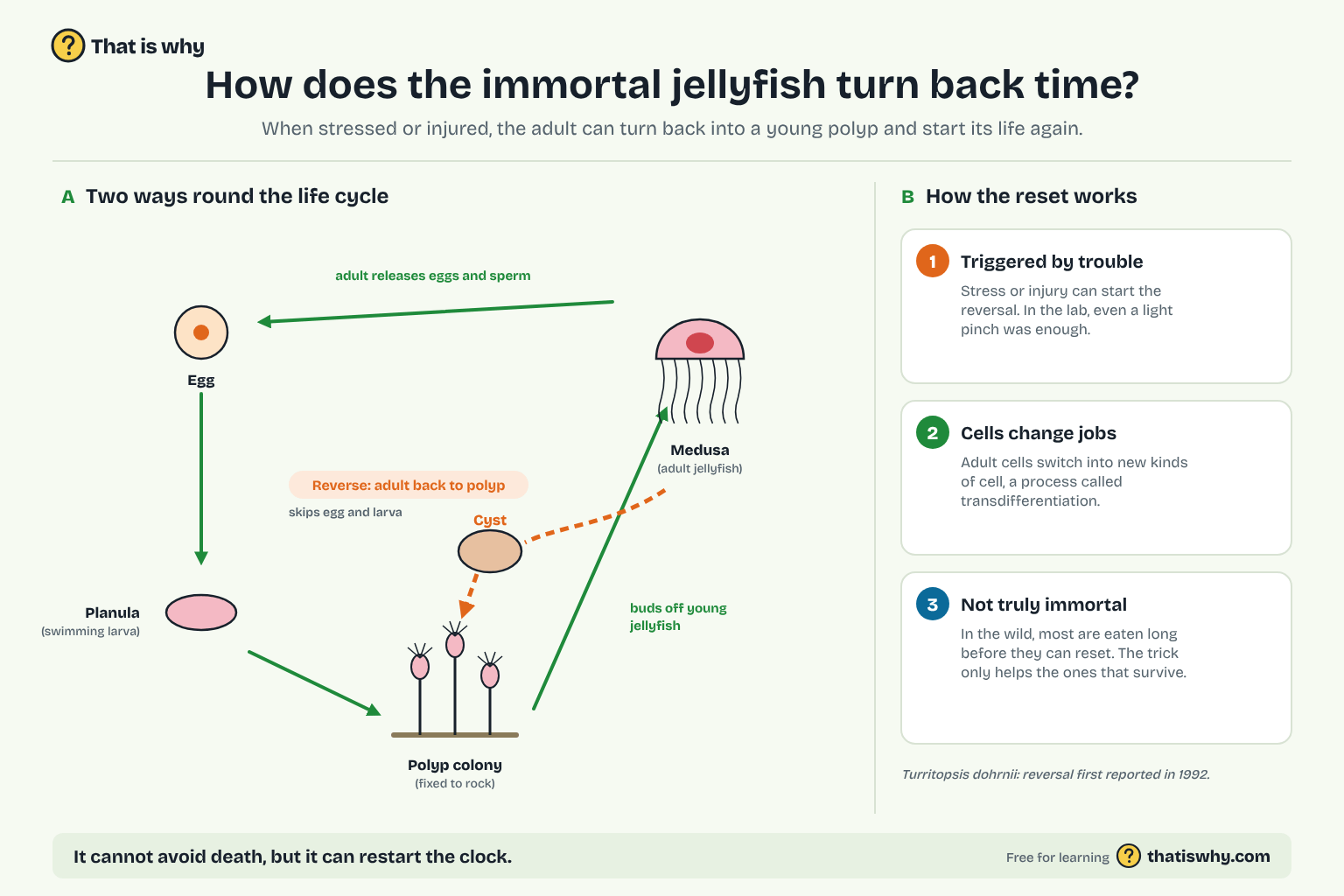
Two ways round the life cycle: the immortal jellyfish can turn from an adult back into a polyp and start again.
The detailed teaching diagram
What the diagram shows
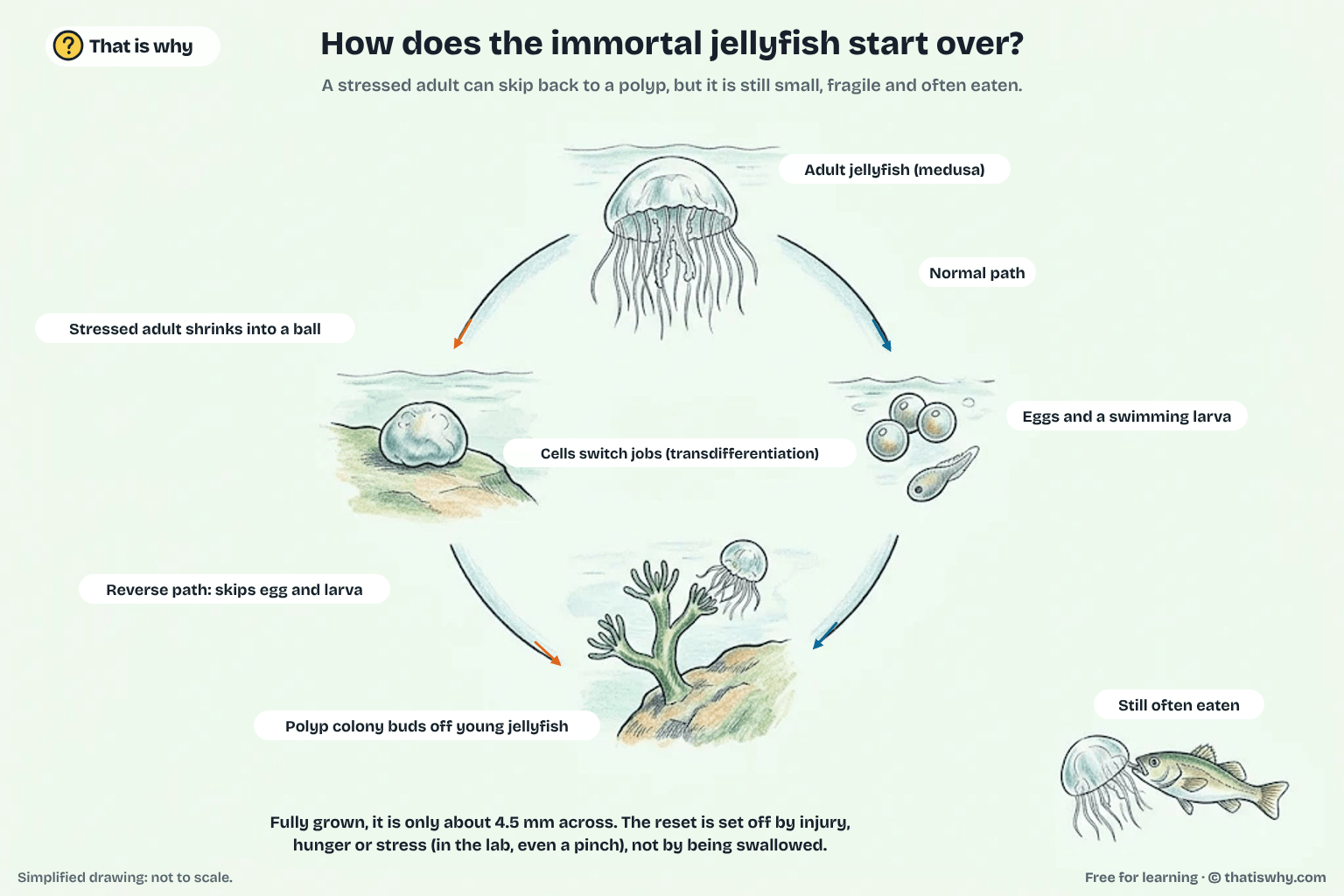
A. Two ways round the life cycle. Like many of its relatives, Turritopsis dohrnii has two body forms. The medusa is the free-swimming adult jellyfish. It releases eggs and sperm, and a fertilized egg grows into a planula, a tiny swimming larva. The planula settles on a rock and becomes a polyp colony, which buds off young jellyfish. That is the normal loop (green arrows).
The orange path is the unusual one. When the adult is stressed or injured, it can shrink into a cyst-like ball of tissue, settle, and grow back into a polyp colony, skipping the egg and larva entirely.
B. How the reset works. Stress or injury can start it: in the laboratory, even a light pinch was enough. During the change, the adult's cells switch into new kinds of cell, a process called transdifferentiation, and rebuild a polyp. The reversal was first reported in 1992 and studied cell by cell in 1996, and later work showed it can happen several times in the same animal.
Not truly immortal. These jellyfish are tiny and fragile, and they often fall victim to predators. The trick helps against injury, hunger and stress, not against being eaten.
The stages
| Stage | What it is |
|---|---|
| Egg | Released by the adult medusa |
| Planula | A tiny swimming larva |
| Polyp | A colony fixed to a surface that buds off young jellyfish |
| Medusa | The free-swimming adult jellyfish |
| Cyst (reverse path only) | A ball of tissue that turns back into a polyp |
Common misconceptions
Myth The immortal jellyfish cannot die.
The truth It can be eaten, catch diseases or be destroyed. What it can do is escape a failing adult body after injury, hunger or stress by turning back into a polyp.
Myth The jellyfish repairs itself and becomes young again in the same body.
The truth The adult body is taken apart. Its cells change into new kinds of cell and rebuild a completely different form, a polyp.
Myth Every jellyfish can do this.
The truth Reversing from adult to polyp is extremely rare. Turritopsis dohrnii is the best-known example.
Questions to use in class
Tap a question to reveal a model answer.
1Put these stages of the normal life cycle in order: polyp, egg, medusa, planula.
Egg, planula, polyp, medusa (and the medusa releases eggs and sperm to start again).
2Which stages does the reverse path skip?
The egg and the planula larva. The adult goes straight back to a polyp through a cyst-like stage.
3What is transdifferentiation?
When a specialized cell changes directly into a different kind of specialized cell, for example a muscle cell becoming a different type of cell in the new polyp.
4If the jellyfish can reset, why isn't the sea full of them?
It is tiny and fragile, and it often falls victim to predators. The reset helps against injury, hunger and stress, not against being eaten.
Key terms
- Medusa
- The free-swimming, bell-shaped adult form of a jellyfish, the shape most people picture. It releases eggs and sperm.
- Polyp
- The small, tube-shaped form of jellyfish and corals that stays fixed to a surface, with a ring of tentacles around its mouth. Jellyfish polyps bud off young medusae.
- Planula
- The tiny, oval, swimming larva of a jellyfish or coral. It grows from a fertilised egg and settles on a surface to become a polyp.
- Transdifferentiation
- When a specialized cell changes directly into a different kind of specialized cell. The immortal jellyfish uses it to rebuild its adult body into a polyp.
Sources
- Reversing the life cycle: medusae transforming into polyps and cell transdifferentiation in Turritopsis nutricula (Piraino et al., 1996) Biological Bulletin (University of Salento repository)
- Everlasting life: the 'immortal' jellyfish (Ferdinando Boero) The Biologist, Royal Society of Biology
- Turritopsis dohrnii (immortal jellyfish) EBSCO Research Starters