Free teaching diagram
Hamster Cheek Pouch Anatomy: Labeled Diagram
Hamster cheek pouches are dry, stretchy pockets from mouth to shoulders: food goes in, not down.
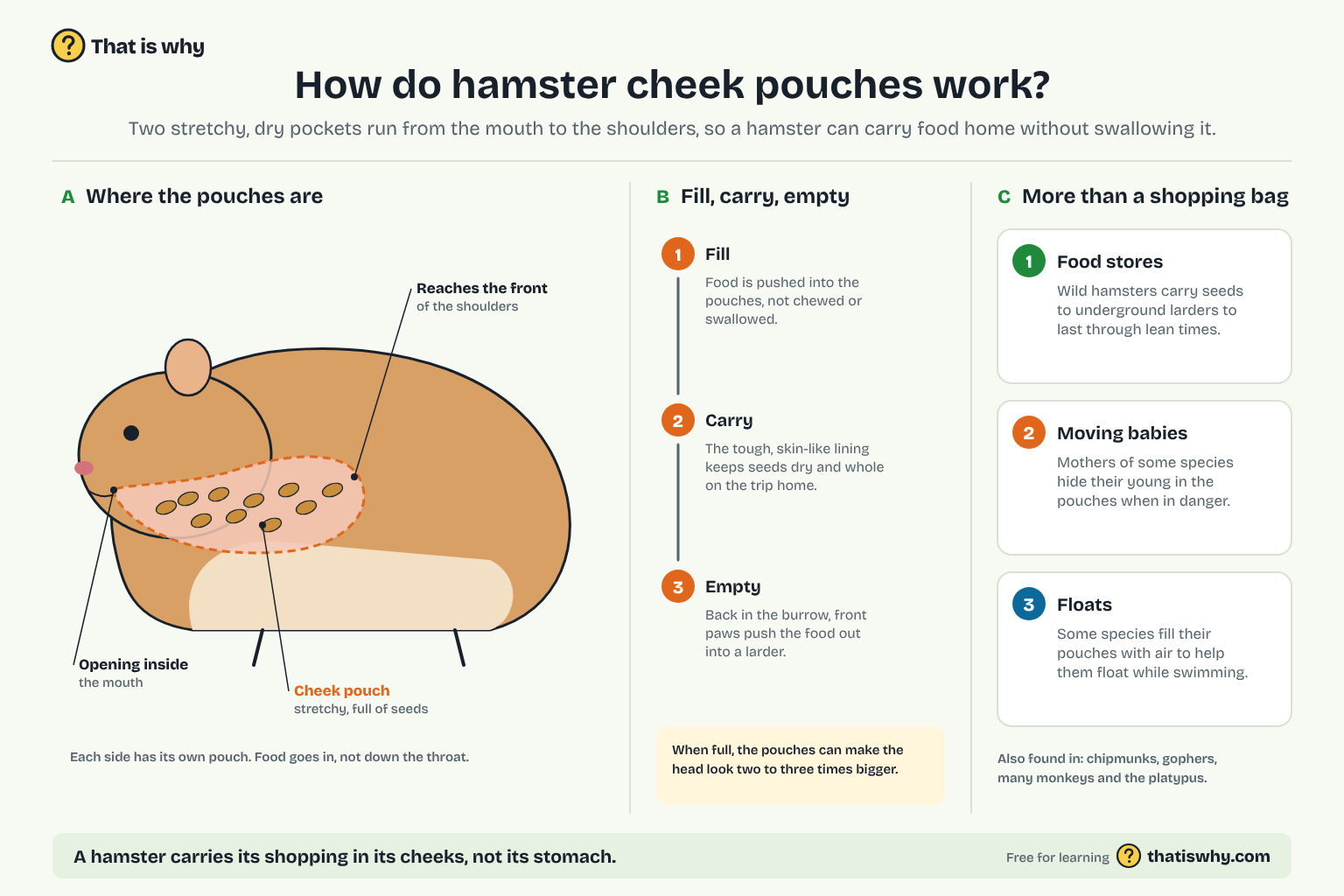
What the diagram shows
A. Where the pouches are. A hamster has two cheek pouches, one on each side. Each opens inside the mouth and runs back under the skin as far as the front of the shoulders. When empty they lie flat; when full they bulge, and the head can look two to three times its normal size.
B. Fill, carry, empty.
- Fill. Food is pushed into the pouches instead of being chewed and swallowed.
- Carry. The pouches are lined with tough, skin-like tissue (a keratin-rich layer), so seeds stay dry and whole on the trip home.
- Empty. Back in the burrow, the hamster pushes the food out with its front paws into a larder.
C. More than a shopping bag. In the wild, hamsters use their pouches to stock underground larders (food hoarding). Mothers of some species hide their young in the pouches to move them away from danger, and some species fill the pouches with air to help them float while swimming. Cheek pouches are also found in chipmunks, pocket gophers, many monkeys and the platypus.
Key facts
| Fact | Value |
|---|---|
| Number of pouches | 2, one on each side |
| How far back they reach | the front of the shoulders |
| Head size when full | up to 2 to 3 times larger |
| Lining | tough, keratinised skin-like tissue |
Common misconceptions
Myth Hamsters swallow their food and bring it back up later.
The truth Food in the pouches is never swallowed. It sits in pockets beside the mouth until the hamster pushes it out with its front paws.
Myth A hamster with full cheeks is greedy.
The truth It is hoarding. In the wild, hamsters carry food back to underground larders to survive times when food is scarce.
Myth Only hamsters have cheek pouches.
The truth Chipmunks, pocket gophers, many monkeys and even the platypus have them too.
Questions to use in class
Tap a question to reveal a model answer.
1Why is it useful that the pouch lining is tough and dry rather than wet like the rest of the mouth?
Seeds stay dry and whole, so they can be stored for a long time without going soggy or starting to be digested.
2How does carrying food in pouches help a small animal stay safe?
It can collect a lot of food quickly and eat it later in the safety of its burrow, instead of spending a long time out in the open.
3Name two uses of cheek pouches other than carrying food.
Mothers of some species hide their young in them when in danger, and some species fill them with air to help them float.
4A full pouch can make the head look up to three times bigger. Why can the pouch stretch so much?
Its wall is thin, folded and stretchy, so it can expand far beyond its resting size and shrink back when empty.
Key terms
- Cheek pouch
- A pocket of skin opening inside the mouth, used to carry food without swallowing it. Hamsters, chipmunks, many monkeys and the platypus have them.
- Keratin
- A tough protein found in skin, hair, nails and claws. Tissue rich in keratin is dry and hard-wearing, like the lining of a hamster's cheek pouches.
- Food hoarding
- Collecting food and storing it to eat later, often in a burrow or hidden caches, to survive times when food is scarce.
- Buoyancy
- The upward push a liquid or gas gives to an object in it. An animal less dense than the water around it floats; one that is denser sinks.
Sources
- Cheek pouch Wikipedia
- Histomorphology of the hamster cheek pouch (Ghoshal & Bal, 1990) Laboratory Animals