Free teaching diagram
Goldfish Alcohol Diagram: How Goldfish Survive Without Oxygen
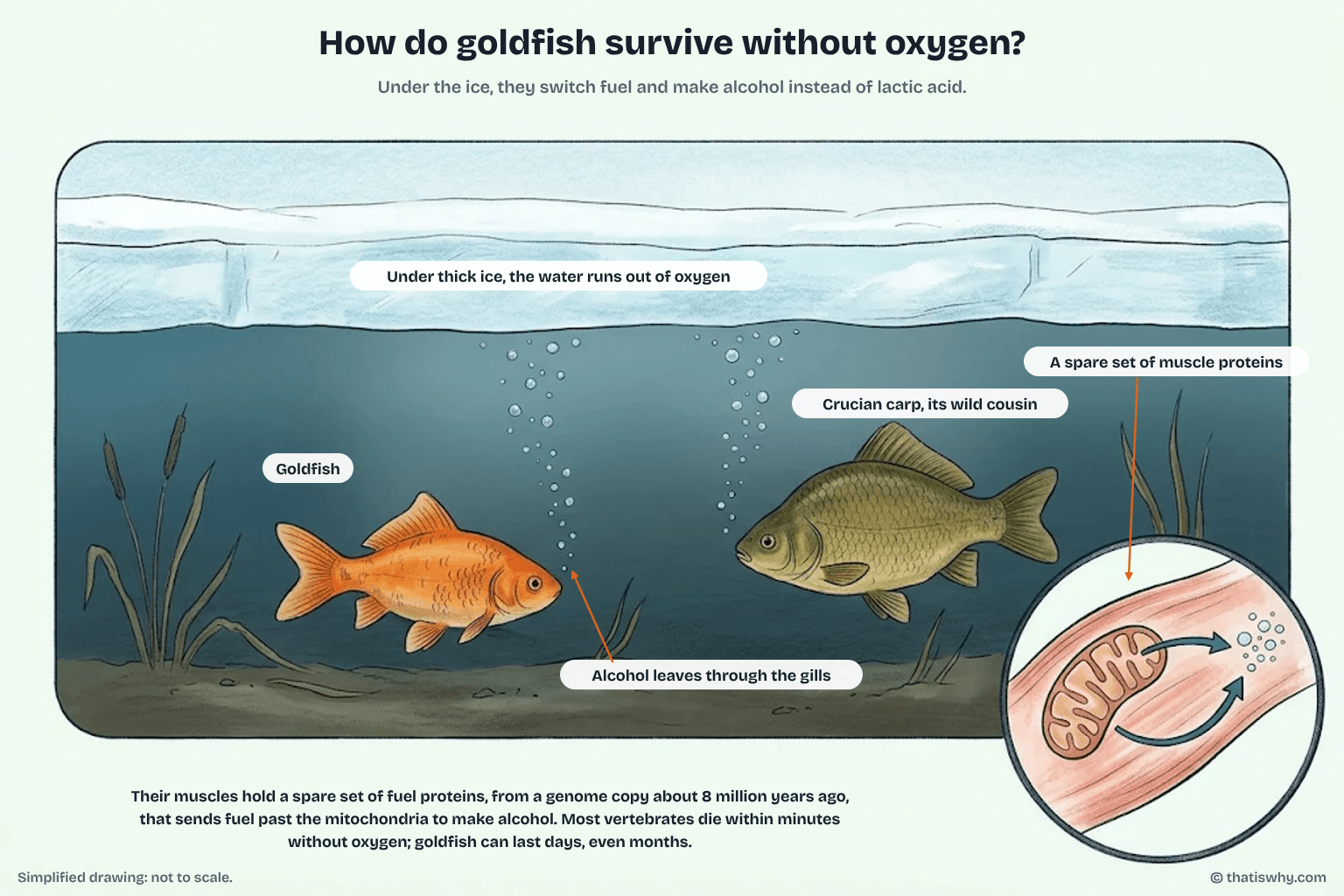
Instead of filling up with lactic acid, goldfish make alcohol and breathe it out through their gills, a trick born from a genome copy 8 million years ago.
The detailed teaching diagram
What the diagram shows
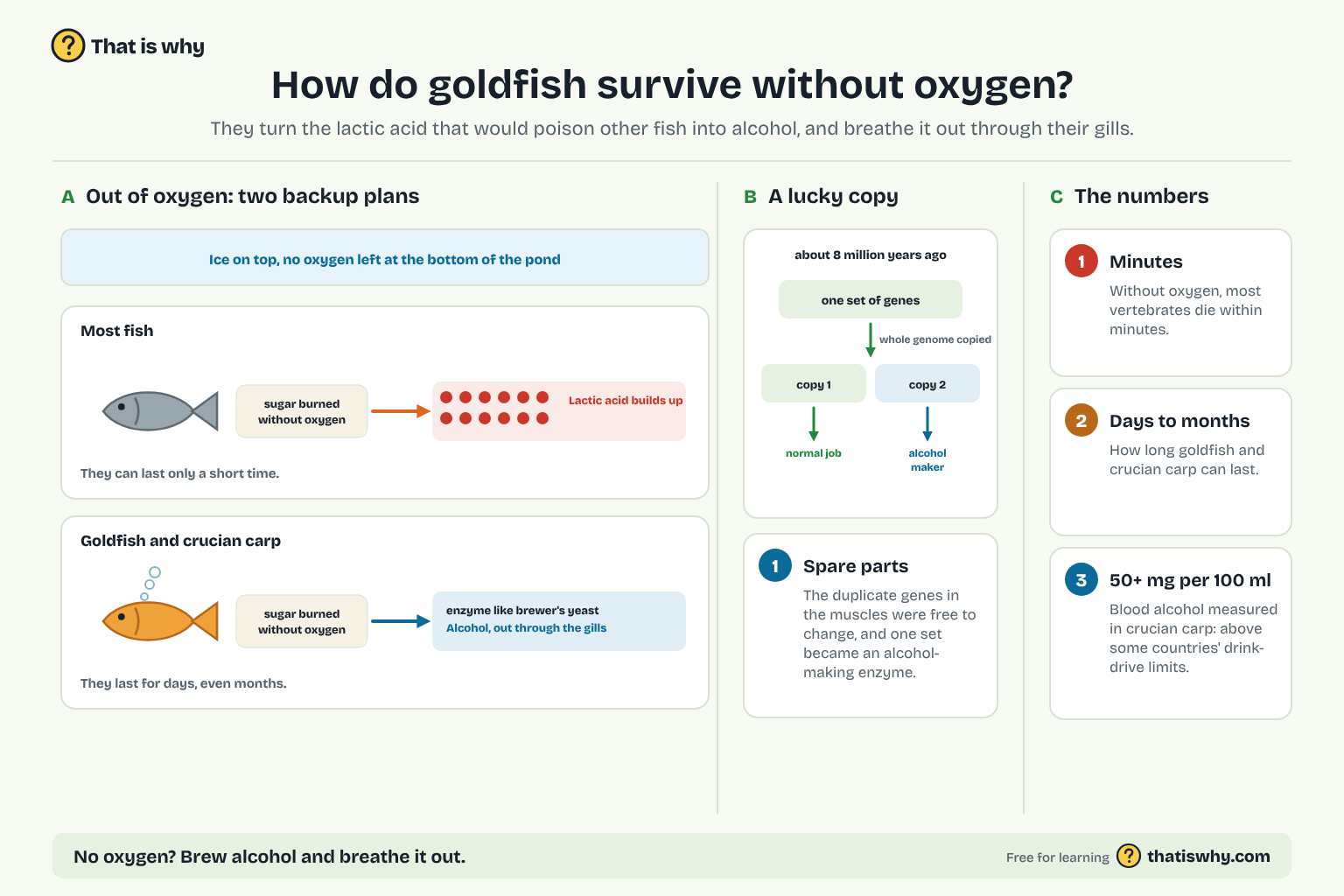
A. Out of oxygen: two backup plans. At the bottom of an ice-covered pond, the water can run out of oxygen. Most fish then burn sugar without oxygen (anaerobic metabolism), and lactic acid builds up, so they can last only a short time. Goldfish and their wild relative, the crucian carp, have an enzyme like the one brewer's yeast uses: they turn the lactic acid into alcohol, which diffuses out through their gills. They can last for days, even months.
B. A lucky copy. About 8 million years ago, the common ancestor of goldfish and crucian carp copied its whole genome (genome duplication). Their muscles now carry two sets of the proteins that normally send fuel into the mitochondria, and one set evolved into the alcohol-making enzyme, the first of its kind described in a vertebrate.
C. The numbers. Without oxygen, most vertebrates die within minutes. Goldfish and crucian carp can last days to months, and blood alcohol in crucian carp can top 50 mg per 100 ml, above the drink-drive limit in the northern European countries where they live.
Key numbers
| Fact | Value |
|---|---|
| Survival without oxygen | days, even months |
| Genome duplication | about 8 million years ago |
| Blood alcohol in crucian carp | more than 50 mg per 100 ml |
| Most vertebrates without oxygen | die within minutes |
Common misconceptions
Myth Goldfish just hold their breath under the ice.
The truth They switch fuel: without oxygen they make alcohol instead of lactic acid and release it through their gills.
Myth Many fish can make alcohol.
The truth It is unique among vertebrates: only goldfish and their wild relative, the crucian carp.
Myth Fish under the ice are sluggish because they are drunk.
The truth Researchers can't yet tell whether the sluggishness comes from the alcohol or from sitting still to save energy.
Questions to use in class
Tap a question to reveal a model answer.
1How long can goldfish survive without oxygen?
For days, even months, at the bottom of ice-covered ponds.
2What happens to the alcohol goldfish make?
It diffuses across the gills into the surrounding water.
3Where did the alcohol-making enzyme come from?
About 8 million years ago, the ancestor of goldfish and crucian carp copied its whole genome; a spare copy of a gene became an enzyme like the one brewer's yeast uses.
4Do the fish get drunk?
Blood alcohol in crucian carp can top 50 mg per 100 ml, above some countries' drink-drive limits.
Key terms
- Anaerobic metabolism
- Getting energy from food without using oxygen. In most animals it makes lactic acid; goldfish and crucian carp make alcohol instead.
- Lactic acid
- A waste product that builds up when cells burn fuel without oxygen. Most fish can only cope with it for a short time.
- Genome duplication
- When an organism copies its entire set of genes. About 8 million years ago this gave goldfish and crucian carp spare genes, one of which became an alcohol-making enzyme.
Sources
- Extreme anoxia tolerance in crucian carp and goldfish through neofunctionalization of duplicated genes creating a new ethanol-producing pyruvate decarboxylase pathway (Fagernes et al., 2017) Scientific Reports (University of Liverpool repository)
- How goldfish make alcohol to survive without oxygen University of Liverpool
- Now we know how goldfish produce alcohol Smithsonian Magazine