Free teaching diagram
Drongo Fake Alarm Diagram: How a Bird Tricks Meerkats Out of Food
The drongo fakes an alarm so its victim drops its food, and when a call stops working it switches to a different one.
The detailed teaching diagram
What the diagram shows
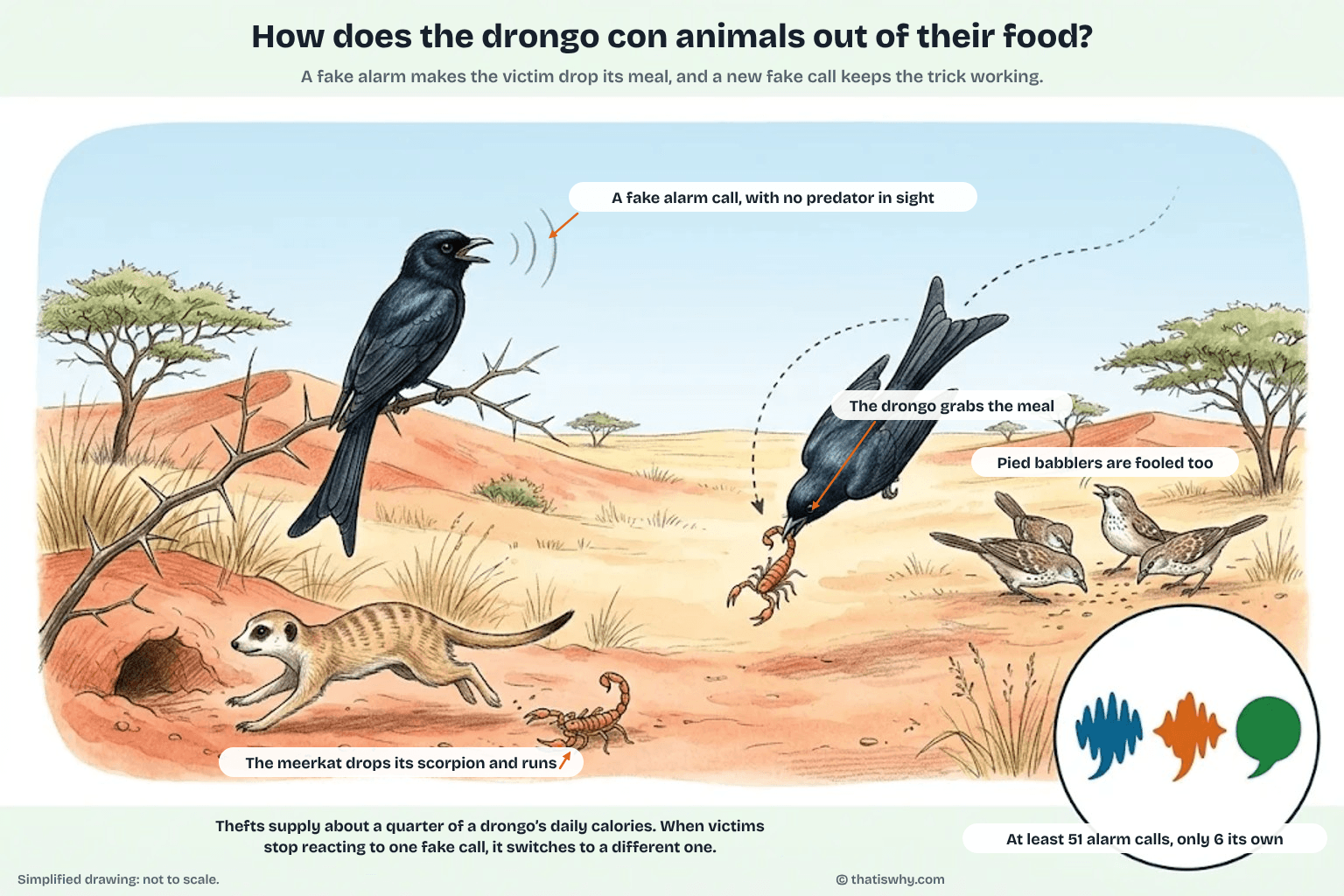
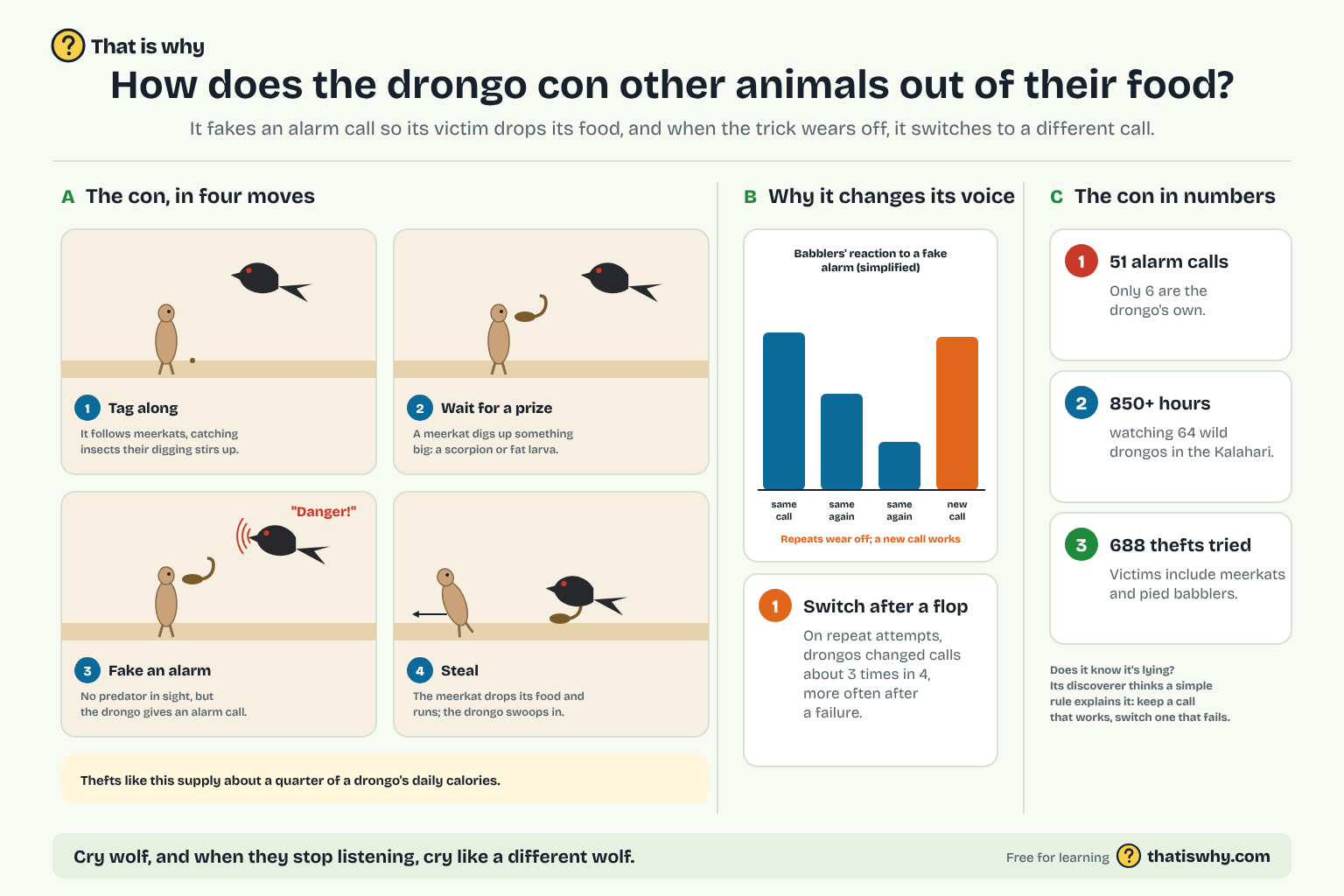
A. The con, in four moves. A fork-tailed drongo spends about a quarter of its time following other animals, such as meerkats, catching insects their digging stirs up. When a meerkat digs up something big, like a scorpion or a fat larva, the drongo gives an alarm call with no predator in sight. The startled meerkat drops its food and runs, and the drongo swoops in. Stealing like this, called kleptoparasitism, supplies about a quarter of a drongo's daily calories.
B. Why it changes its voice. In playback tests, pied babblers reacted less and less to the same fake alarm played again and again, but a different alarm call made them react strongly again. Drongos use this: on repeat attempts against the same victim, they switched calls about three times in four, more often right after a failure, and were then more likely to succeed. The chart is a simplified sketch, not measured values.
C. The con in numbers. Drongos make at least 51 different alarm calls, and only six are their own; the rest are vocal mimicry of other animals. The study followed 64 wild drongos in the Kalahari for more than 850 hours and recorded 688 attempted thefts. Its lead researcher thinks a simple rule of thumb explains the switching.
Key numbers
| Fact | Value |
|---|---|
| Different alarm calls recorded | at least 51 (6 their own) |
| Share of daily calories from theft | about a quarter |
| Time spent following other animals | about a quarter |
| Call switching on repeat attempts | about 3 times in 4 |
| Drongos studied | 64 |
| Hours of observation | more than 850 |
| Theft attempts recorded | 688 |
Common misconceptions
Myth Drongos only copy one or two calls.
The truth They make at least 51 different alarm calls, and only six are their own.
Myth The victims never learn.
The truth Babblers react less and less to the same fake alarm; the drongo keeps the trick working by switching calls.
Myth The drongo must be reading minds.
The truth The researcher who studied it thinks a simple rule explains it: keep a call that works, switch one that fails.
Questions to use in class
Tap a question to reveal a model answer.
1How does a drongo steal food?
It waits until another animal finds something big, gives a fake alarm call, and grabs the food the startled animal drops.
2How much of its food does a drongo steal?
Thefts supply about a quarter of its daily calories.
3Why does the drongo switch calls?
Victims react less to the same fake alarm repeated, but a new call makes them react again.
4How was this studied?
Researchers watched 64 wild drongos in the Kalahari for more than 850 hours and recorded 688 attempted thefts.
Key terms
- Kleptoparasitism
- Getting food by stealing it from other animals. The fork-tailed drongo gets about a quarter of its daily calories this way.
- Vocal mimicry
- Copying the sounds of other animals. Fork-tailed drongos make at least 51 alarm calls, and all but six are copies of other species.
Sources
- The bird that cries wolf changes its lies (Flower et al., Science 2014) National Geographic
- Sly birds cleverly 'cry wolf' to steal food Live Science
- African bird shouts false alarms to deceive and steal, study shows National Geographic