Free teaching diagram
Ultra-Black Fish Diagram: How They Swallow Light
Ultra-black fish skin soaks up over 99.5% of light, thanks to tightly packed pigment grains at the surface.
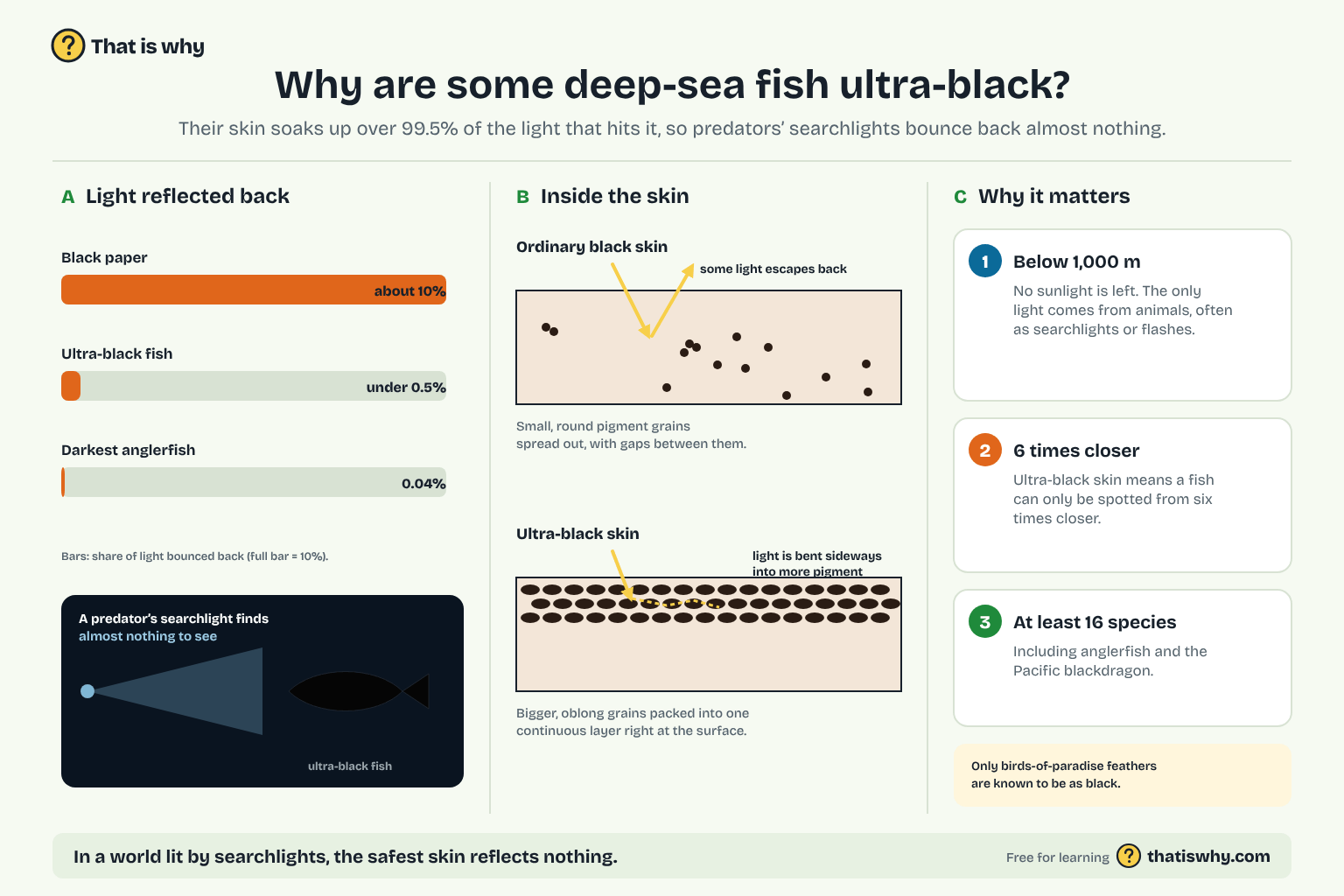
What the diagram shows
A. Light reflected back. Black paper reflects about 10% of the light that hits it. At least 16 species of deep-sea fish have ultra-black skin that reflects less than 0.5%, and the darkest, a small anglerfish, reflects only about 0.04%. When a predator's light sweeps over them, almost nothing comes back.
B. Inside the skin. Skin color comes from pigment grains called melanosomes. In ordinary black skin they are small, round and spread out, with gaps that let some light escape back out. In ultra-black skin they are bigger, oblong and packed into one continuous layer right at the surface. Light that hits one grain is bent sideways into the next and absorbed (light absorption), so very little escapes.
C. Why it matters. Below about 1,000 m no sunlight is left; the only light comes from animals (bioluminescence), often used as searchlights or flashes. Ultra-black skin means a fish can only be spotted from six times closer than an ordinary black fish, which can be the difference between eating and being eaten. The only other animals known to be as black are some birds-of-paradise.
Key numbers
| Surface | Light reflected |
|---|---|
| Black paper | about 10% |
| Ultra-black fish | less than 0.5% |
| Darkest fish (an anglerfish) | about 0.04% |
| Species found | at least 16 |
Common misconceptions
Myth In total darkness, color does not matter.
The truth Deep-sea predators carry their own light. A fish that reflects even a little of it can be spotted, so the blackest skin wins.
Myth Ultra-black skin just has more pigment.
The truth It is about how the pigment is arranged: bigger, oblong grains packed into one continuous layer at the surface trap light far better than scattered grains.
Myth Black paper is about as dark as anything gets.
The truth Black paper reflects about 10% of light. The darkest fish reflect as little as 0.04%.
Questions to use in class
Tap a question to reveal a model answer.
1Black paper reflects about 10% of light and an ultra-black fish under 0.5%. How many times less light does the fish reflect?
More than 20 times less (10 ÷ 0.5 = 20).
2Why does packing pigment grains into one continuous layer help?
With no gaps, light cannot slip between grains and bounce back out. Light that hits one grain is bent sideways into neighboring grains and absorbed.
3Why do deep-sea fish need camouflage if there is no sunlight?
Many deep-sea animals make light, and some use it like a searchlight to find prey. Reflecting that light would give a fish away.
4Why might transparency work less well than ultra-black skin in the deepest water?
A transparent body can still reflect or glint when a light beam hits it, while ultra-black skin absorbs almost all of the beam.
Key terms
- Ultra-black
- A surface that reflects less than 0.5% of the light that hits it. At least 16 deep-sea fish species have ultra-black skin.
- Melanosome
- A tiny packet of the dark pigment melanin inside a skin cell. Their size, shape and packing decide how black the skin looks.
- Light absorption
- When a material takes in light energy instead of letting it pass or bounce off. Seawater absorbs red light first and blue light last.
- Bioluminescence
- Light made by a living thing through a chemical reaction. Most deep-sea bioluminescence is blue, the color that travels furthest in water.
Sources
- Scientists find first ultra-black color in deep-sea fishes Smithsonian Ocean
- Ultra-black skin allows some fish to lurk unseen Duke Today, Duke University