Free teaching diagram
Cuttlefish Skin Diagram: How Chromatophores Work Like a Screen
Living pixels on top, shimmering and white layers below, and a brain that can redraw the whole picture in a fraction of a second.
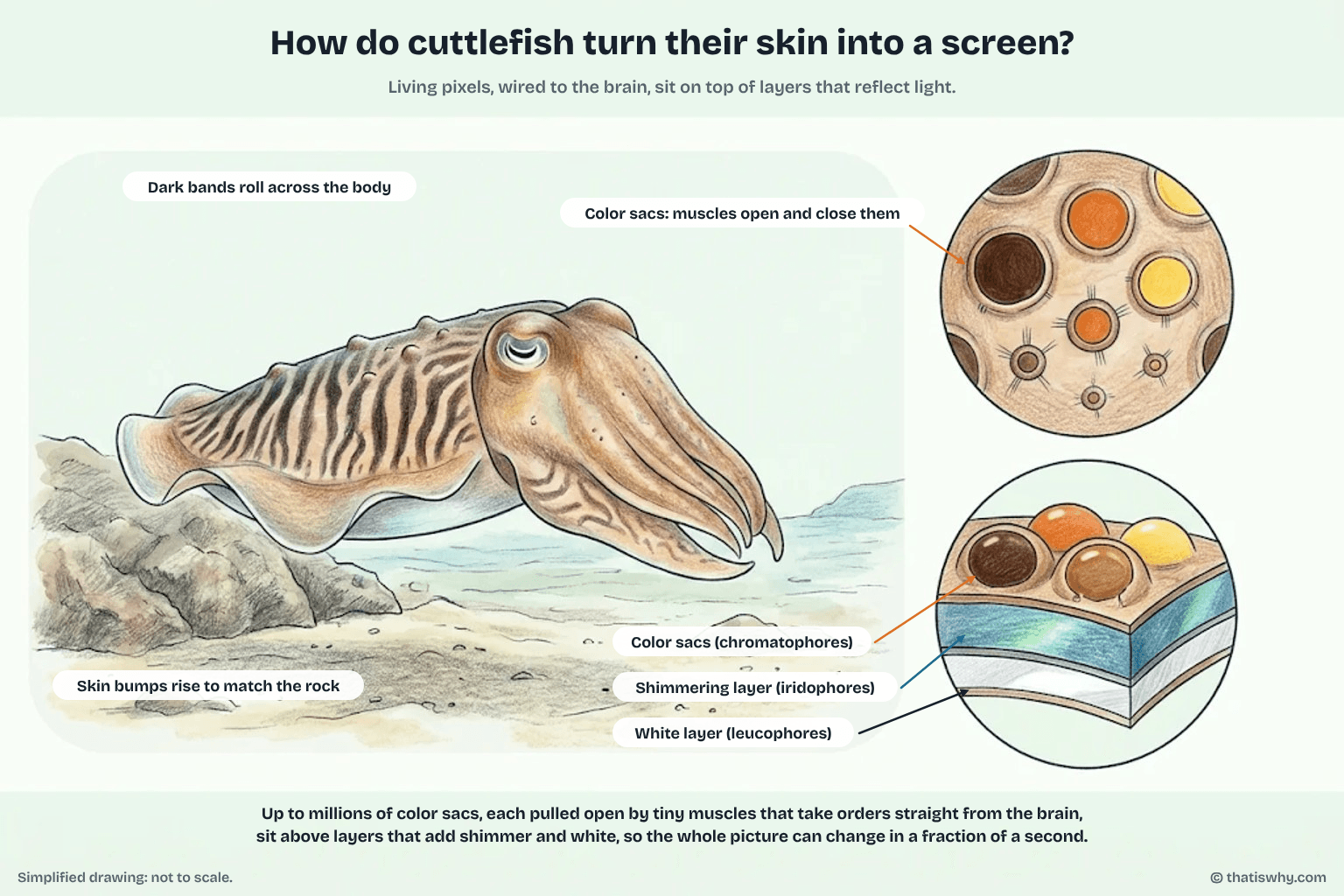
The detailed teaching diagram
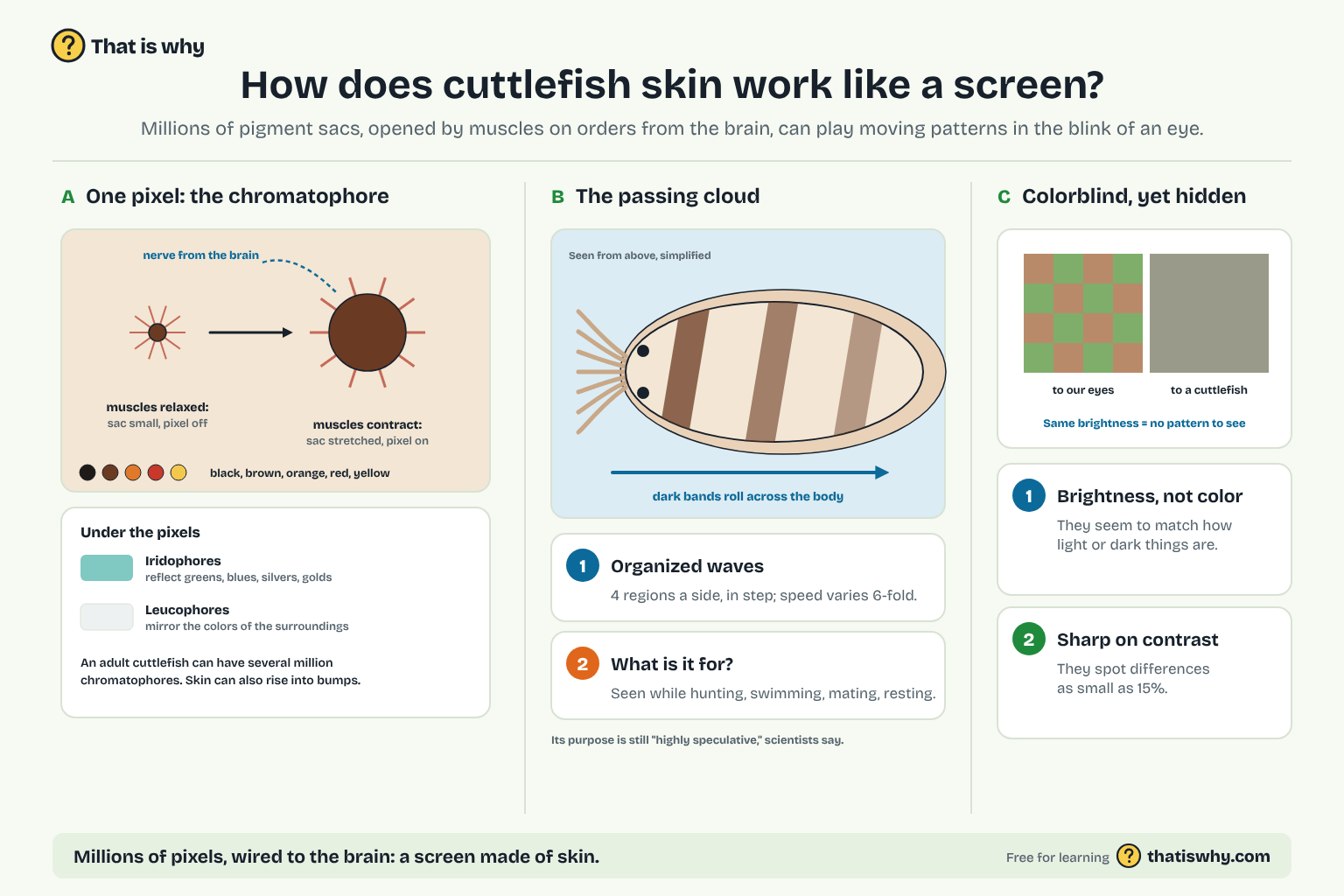
What the diagram shows
A. One pixel: the chromatophore. Each chromatophore is an elastic sac of pigment, black, brown, orange, red or yellow, ringed by tiny muscles. When nerves from the brain make the muscles contract, the sac stretches open and the pixel turns on; when they relax, it shrinks. An adult cuttlefish can have several million. Beneath them, iridophores reflect iridescent greens, blues, silvers and golds, and leucophores mirror the colors of the surroundings. The skin can also rise into bumps.
B. The passing cloud. Dark bands roll across the body as chromatophores switch on in coordinated waves. Each side of the mantle has four regions, each with its own direction, all kept in step; the wave speed can vary six-fold but stays the same in every region at a given moment. The display is seen while cuttlefish hunt, swim, mate and rest, and its purpose is still "highly speculative." The drawing is seen from above and simplified.
C. Colorblind, yet hidden. Cuttlefish are colorblind: in a 2006 study, a checkerboard whose colors looked equally bright to them was treated like a plain background. They seem to camouflage by matching how light or dark things are, and they can spot contrast differences as small as 15%.
Key numbers
| Fact | Value |
|---|---|
| Chromatophores in an adult cuttlefish | several million |
| Chromatophores tracked at once (2018 study) | tens of thousands, at 60 frames a second |
| Passing-cloud regions | 4 per side of the body |
| Range of wave speeds | up to six-fold |
| Smallest contrast difference shown to be seen | about 15% |
Common misconceptions
Myth Cuttlefish change color with hormones that slowly spread through the body.
The truth Each pigment sac is opened by muscles worked by motor neurons from the brain, so the skin changes in the blink of an eye.
Myth Cuttlefish must see colors to match them.
The truth Cuttlefish are colorblind; they seem to camouflage by matching brightness and contrast.
Myth We know exactly why cuttlefish make passing clouds.
The truth The display is seen while hunting, swimming, mating and resting, and scientists call its function highly speculative.
Questions to use in class
Tap a question to reveal a model answer.
1What is a chromatophore?
An elastic sac of pigment (black, brown, orange, red or yellow) in the skin, stretched open by tiny muscles to show its color.
2How many chromatophores does a cuttlefish have?
An adult cuttlefish can have several million.
3What is the passing cloud?
Dark bands that roll across the cuttlefish's body, made by chromatophores switching on in coordinated waves.
4Can cuttlefish see color?
No. In a 2006 study, they ignored a checkerboard whose colors looked equally bright to them.
Key terms
- Chromatophore
- A tiny elastic sac of pigment in the skin of cuttlefish, squid and octopuses. Muscles stretch it open to show its color; an adult cuttlefish can have several million.
- Iridophore
- A skin cell with reflecting plates that makes iridescent greens, blues, silvers and golds from structure rather than pigment.
- Leucophore
- A skin cell in cephalopods that mirrors back the colors of the surroundings, helping the animal blend in.
Sources
- Elucidating the control and development of skin patterning in cuttlefish (Reiter et al., 2018) Nature
- Passing clouds of the cuttlefish Max Planck Society
- How Octopuses and Squids Change Color Smithsonian Ocean
- Cuttlefish camouflage while colorblind (Mäthger et al., Vision Research 2006) ScienceDaily (Marine Biological Laboratory)