Free teaching diagram
Brinicle Diagram: How the Ocean's Icy Finger of Death Forms
A brinicle is a tube of ice built by sinking brine that is colder than seawater can be without freezing.
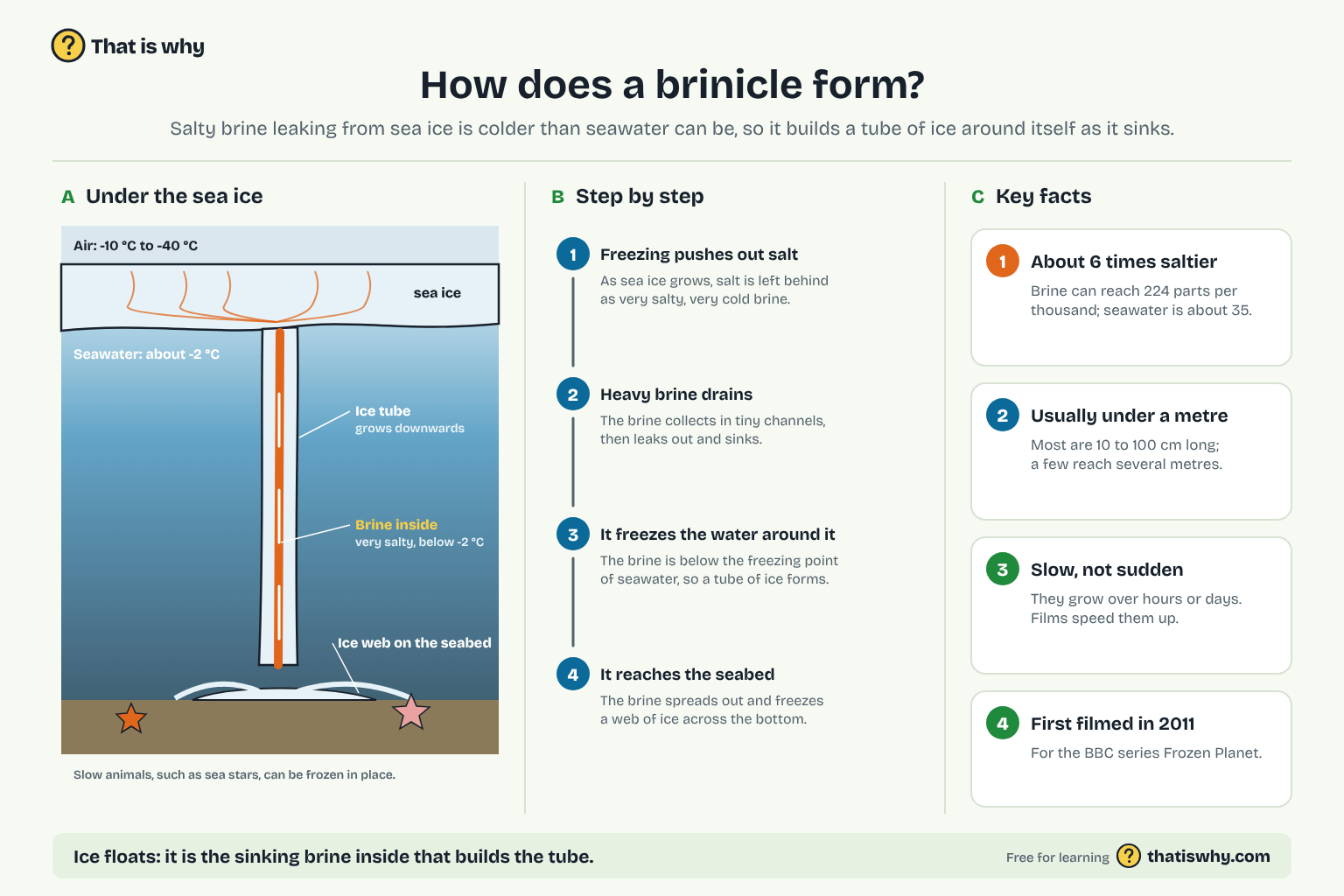
What the diagram shows
A. Under the sea ice. In polar winter the air above the sea can be −10 °C to −40 °C, while the seawater below stays near −2 °C. The cold drives the sea ice to keep growing from below. A brinicle hangs beneath it: a hollow tube of ice with a stream of very salty, very cold brine flowing down the middle. Where it touches the seabed, the brine spreads out and freezes a web of ice that can trap slow animals such as sea stars and urchins.
B. Step by step.
- Freezing pushes out salt. Ice crystals keep the water and reject the salt (brine rejection). The leftover liquid becomes brine.
- Heavy brine drains. The brine collects in tiny channels in the ice. Because salt lowers its freezing point (freezing point depression), it stays liquid even though it is colder than −2 °C. It is also denser than seawater, so it leaks out and sinks.
- It freezes the water around it. The sinking brine is colder than the freezing point of the seawater it passes, so a sleeve of ice forms around the stream and the tube grows downwards.
- It reaches the seabed. The brine spreads across the bottom and freezes a web of ice.
C. Key facts. Brine in sea ice can reach about 224 parts salt per thousand, against about 35 in seawater. Most brinicles are 10 to 100 cm long, though a few reach several meters. Their growth was first filmed in 2011, for the BBC series Frozen Planet, at Little Razorback Island in Antarctica.
Key numbers
| Fact | Value |
|---|---|
| Air temperature needed | about −10 °C to −40 °C |
| Seawater temperature | about −2 °C |
| Salt in brine vs seawater | up to about 224 vs 35 parts per thousand |
| Typical length | 10 to 100 cm |
| Growth time | hours to days |
Common misconceptions
Myth A brinicle is an icicle of sinking ice.
The truth Ice floats. The tube grows downwards because the heavy, salty brine flowing inside it sinks and freezes the water it touches.
Myth A brinicle shoots to the seabed in seconds.
The truth Brinicles grow over hours or days. The famous film is a time-lapse that speeds the process up.
Myth Brinicles form under all sea ice.
The truth They need polar winter, with very cold air above the ice, and calm water so the fragile tube is not broken off.
Questions to use in class
Tap a question to reveal a model answer.
1Why does freezing seawater leave behind very salty brine?
Ice crystals are made almost entirely of water molecules, so the salt is pushed out into the leftover liquid, which becomes saltier and saltier.
2How can the brine stay liquid below -2 °C?
Dissolved salt lowers the freezing point of water. The saltier the brine, the colder it can get without freezing.
3Why does the brine sink instead of spreading out at the top?
It is saltier and colder than the seawater around it, so it is denser, and denser liquid sinks.
4Why is the tube hollow?
Ice forms where the cold brine touches seawater, on the outside of the stream. The brine itself keeps flowing down the middle.
Key terms
- Brine rejection
- What happens when seawater freezes: the ice keeps the water and pushes the salt out, leaving pockets of very salty, very cold brine.
- Freezing point depression
- The lowering of a liquid's freezing point by dissolved substances. Salty water must get colder than fresh water before it freezes, which is why salt melts ice on roads.
- Sea ice
- Ice that forms when the surface of the sea freezes. It is much less salty than seawater because salt is pushed out as it freezes.
- Density
- How much mass is packed into a given volume. Denser liquids sink below less dense ones, so cold, salty water sinks beneath warmer, fresher water.
Sources
- Brinicles as a case of inverse chemical gardens (Cartwright et al., Langmuir 2013) arXiv
- Ice brinicles BBC Wildlife (Discover Wildlife)
- BBC Frozen Planet captures growth of brinicle Wetpixel