Free teaching diagram
Wood Frog Diagram: How a Frog Freezes Solid and Survives
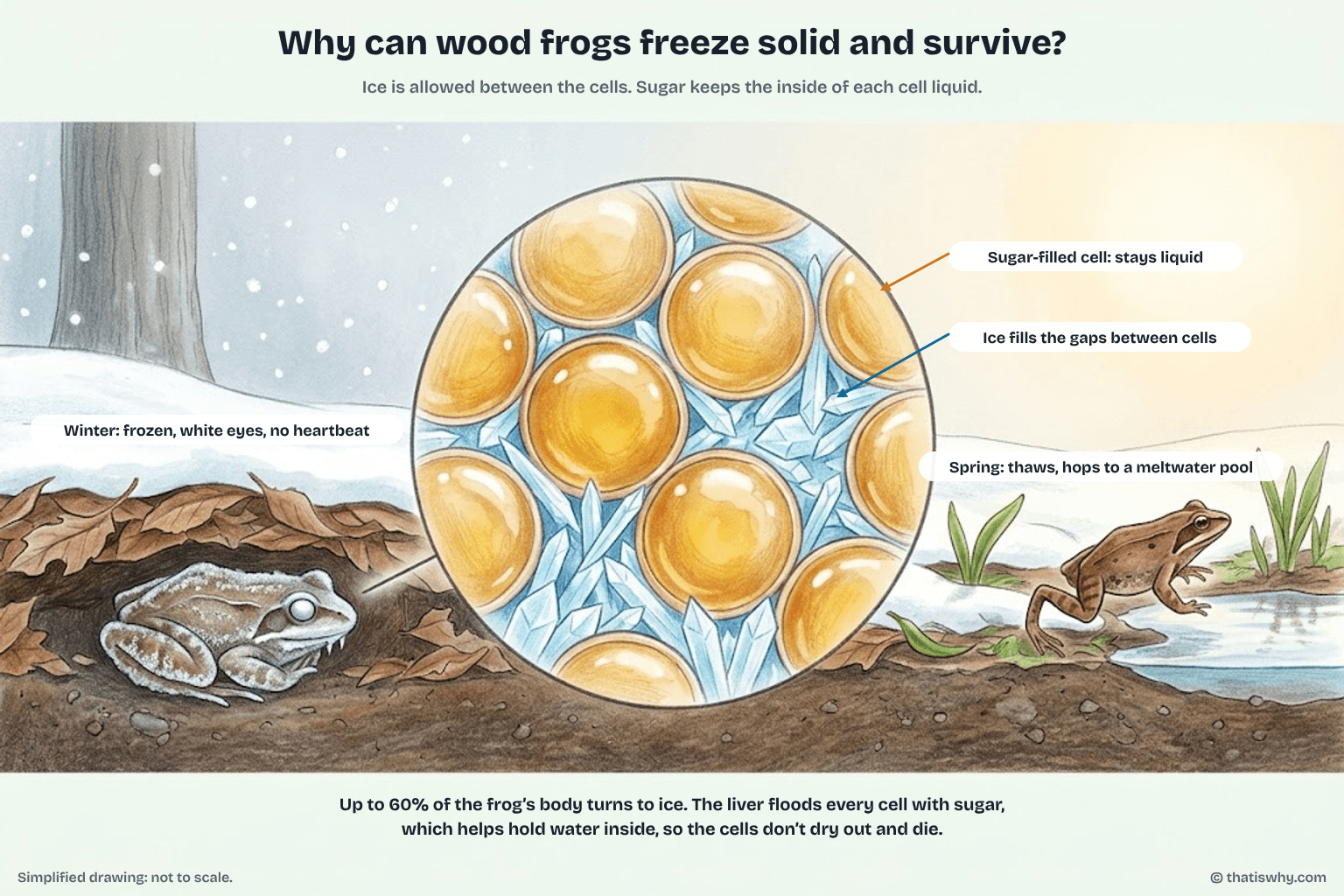
Ice between the cells, sugar inside them, and a frog hopping to its pool come spring.
The detailed teaching diagram
What the diagram shows
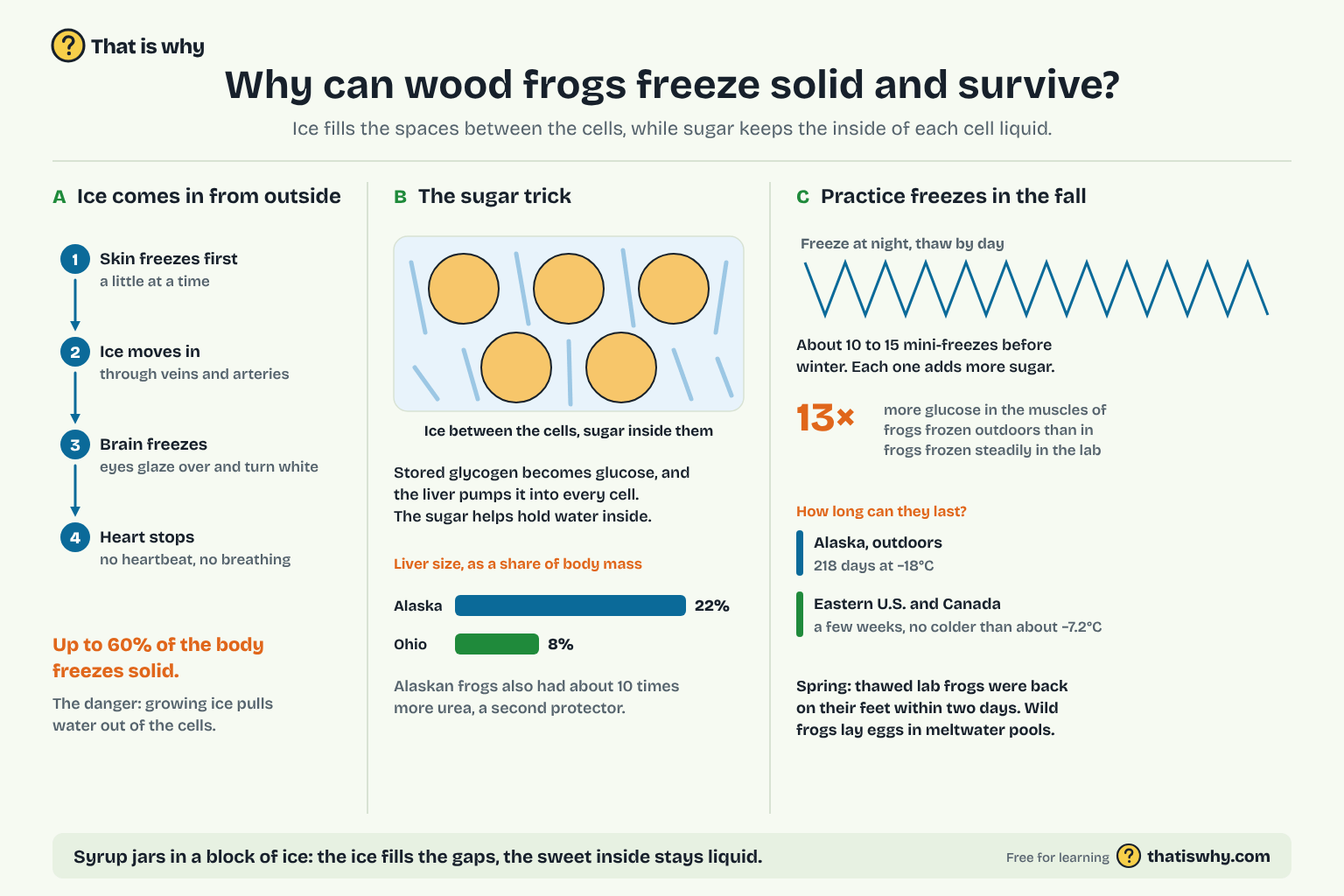
A. Ice comes in from outside. Freezing starts at the skin, and ice moves into the frog through its veins and arteries. Even the brain freezes, and the eyes glaze over and turn white. Then the heart stops and breathing stops. Up to 60% of the body freezes solid. The danger is that growing ice pulls water out of the cells, drying them out until they die.
B. The sugar trick. Before winter the frog stores glycogen. As its tissues freeze, that glycogen is turned into glucose, and the liver pumps it into every cell, where it helps hold water inside. Glucose and urea are cryoprotectants: substances that protect living tissue from freezing damage. In Alaskan frogs the liver makes up 22% of the body mass, compared with 8% in Ohio frogs, and urea is about 10 times higher. Surviving ice inside the body like this is called freeze tolerance.
C. Practice freezes in the fall. In the wild, frogs freeze at night and thaw by day about 10 to 15 times before winter. Each freeze adds more sugar, and frogs frozen outdoors had 13 times more glucose in their muscles than frogs frozen at a steady temperature in the lab. Alaskan frogs lasted 218 days at −18°C, while frogs from the eastern United States and Canada survive only a few weeks, no colder than about −7.2°C. In spring, thawed lab frogs were back on their feet within two days, and wild frogs head for small ponds and meltwater pools to lay their eggs.
Key numbers
| Fact | Value |
|---|---|
| Share of the body that can freeze | up to 60% |
| Liver size, Alaskan frogs | 22% of body mass |
| Liver size, Ohio frogs | 8% of body mass |
| Rise in urea, Alaskan frogs | about 10-fold |
| Fall freeze-thaw cycles | about 10 to 15 |
| Extra muscle glucose, frozen outdoors | 13 times |
| Longest survival, Alaska | 218 days at −18°C |
Common misconceptions
Myth A frozen wood frog is just very cold and sleepy.
The truth Its heart stops, its breathing stops and up to 60% of its body freezes into real ice.
Myth Wood frogs use antifreeze to stay unfrozen, like polar fish.
The truth Polar fish stop ice from forming. Wood frogs let ice form between their cells on purpose and use sugar to protect the cells.
Myth Every wood frog can survive the same cold.
The truth Alaskan frogs lasted 218 days at −18°C outdoors, while eastern frogs survive only a few weeks, no colder than about −7.2°C.
Questions to use in class
Tap a question to reveal a model answer.
1Where does the ice form in a frozen wood frog?
In the spaces between its cells. The inside of each cell stays liquid.
2Why is ice dangerous for cells?
As ice grows, it pulls water out of the cells, which can dry them out until they die.
3Where does the frog's sugar come from?
Stored glycogen is turned into glucose, and the liver pumps it out into every cell once the tissues start to freeze.
4Why do practice freezes in the fall help?
Each freeze makes the liver release more sugar, and it builds up. Frogs frozen outdoors had 13 times more glucose in their muscles than frogs frozen steadily in the lab.
Key terms
- Freeze tolerance
- The ability to survive ice forming inside the body. A freeze-tolerant wood frog lets ice fill the spaces between its cells while sugar keeps the cells themselves liquid.
- Cryoprotectant
- A substance that protects living tissue from freezing damage. Wood frogs load their blood and cells with glucose and urea, which lower the freezing point and reduce how much ice forms.
- Freezing point depression
- The lowering of a liquid's freezing point by dissolved substances. Salty water must get colder than fresh water before it freezes, which is why salt melts ice on roads.
- Osmosis
- The movement of water through a membrane from the side with fewer dissolved substances to the side with more. It is why cells packed with too much TMAO would draw in seawater, which sets a depth limit for fish.
Sources
- Alaska frogs reach record lows in extreme temperature survival University of Alaska Fairbanks (via ScienceDaily)
- Tiny Masters of Arctic Survival: Amphibian of the Arctic U.S. National Park Service
- Alaskan wood frogs stock up on solutes to survive (Inside JEB) Journal of Experimental Biology
- These animals can freeze solid in winter. Here's how they survive. National Geographic
- Frogs Freeze to Survive the Alaskan Winter National Audubon Society