Free teaching diagram
Betta Fish Labyrinth Organ: Labeled Diagram
A betta's labyrinth organ takes oxygen from air gulped at the surface, so the fish must be able to reach it.
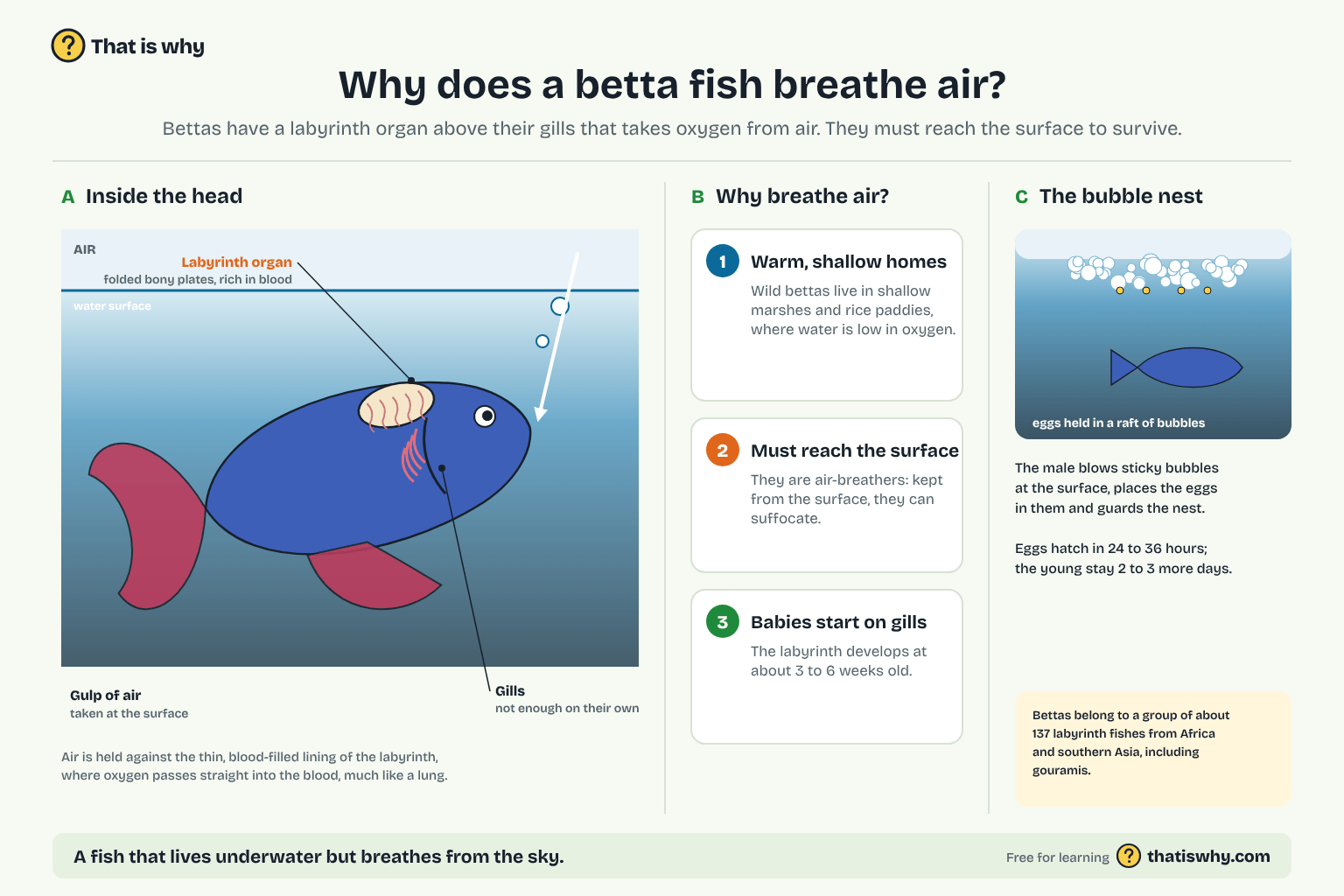
What the diagram shows
A. Inside the head. Above its gills, a betta has a pair of chambers that hold the labyrinth organ, a maze of folded bony plates covered in a thin lining packed with blood vessels. The fish rises to the surface, gulps air and holds it against that lining, where oxygen passes straight into the blood, much like a lung. Its gills still work, but on their own they cannot supply enough oxygen.
B. Why breathe air? Wild bettas live in shallow, plant-filled marshes, floodplains and rice paddies in Southeast Asia. In warm, shallow water, oxygen runs low (hypoxia), and breathing air lets the fish thrive where others struggle. The price is that bettas are air-breathers: if they cannot reach the surface, they can suffocate. Baby bettas start out on gills alone; the labyrinth develops at about 3 to 6 weeks old.
C. The bubble nest. Air-breathing shapes how bettas breed. The male blows sticky bubbles at the surface to make a floating bubble nest, places the eggs in it and guards them, repairing the nest as bubbles pop. Eggs hatch in 24 to 36 hours, and the young stay in the nest for another 2 to 3 days. Bettas belong to a group of about 137 labyrinth fishes from Africa and southern Asia, including gouramis.
Key numbers
| Fact | Value |
|---|---|
| Adult size | about 6 to 8 cm |
| Labyrinth organ develops | about 3 to 6 weeks after hatching |
| Eggs hatch | 24 to 36 hours |
| Young stay in nest | 2 to 3 more days |
| Labyrinth fish species | about 137 |
Common misconceptions
Myth All fish get all their oxygen from water.
The truth Bettas and their relatives, the labyrinth fishes, breathe air as well. A betta that cannot reach the surface can suffocate.
Myth A betta at the surface is sick or gasping.
The truth Rising to gulp air is normal betta behavior. It is how the labyrinth organ is refilled.
Myth Bettas come from muddy puddles.
The truth Wild bettas live in shallow, plant-filled marshes, floodplains and rice paddies, where warm water holds little oxygen.
Questions to use in class
Tap a question to reveal a model answer.
1Why does warm, shallow water often hold little oxygen?
Warm water dissolves less oxygen than cold water, and in shallow, still water the oxygen used up by plants and animals is not quickly replaced.
2How is the labyrinth organ like a lung?
Air is held against a thin, blood-rich lining, so oxygen passes from the air straight into the blood.
3Why must an aquarium for a betta leave space between the water and the lid?
The fish needs to reach the surface and breathe air, so the air above the water must be easy to reach.
4Why might building the nest at the surface help the eggs?
Water at the surface has the most oxygen, and the bubbles keep the eggs together where the male can guard them.
Key terms
- Labyrinth organ
- An air-breathing organ above the gills of bettas, gouramis and their relatives, made of folded bony plates covered in a thin, blood-rich lining.
- Gills
- Feathery organs that take oxygen from water into the blood and release carbon dioxide. Most fish depend on them entirely.
- Hypoxia
- A shortage of oxygen. In water, hypoxia is common in warm, shallow or still places where oxygen is used up faster than it is replaced.
- Bubble nest
- A floating raft of sticky bubbles that male bettas and some other fish blow at the water surface to hold and guard their eggs.
Sources
- Siamese fighting fish Wikipedia
- Life in a bubble: the role of the labyrinth organ in determining territory, mating and aggressive behaviours in anabantoid fishes (Tate et al., 2017) Journal of Fish Biology (Royal Holloway repository)