Free teaching diagram
Animal Group Names Diagram: Where Collective Nouns Come From
Most strange group names began as a medieval word game; a few describe real behavior, and a few stuck for good.
What the diagram shows
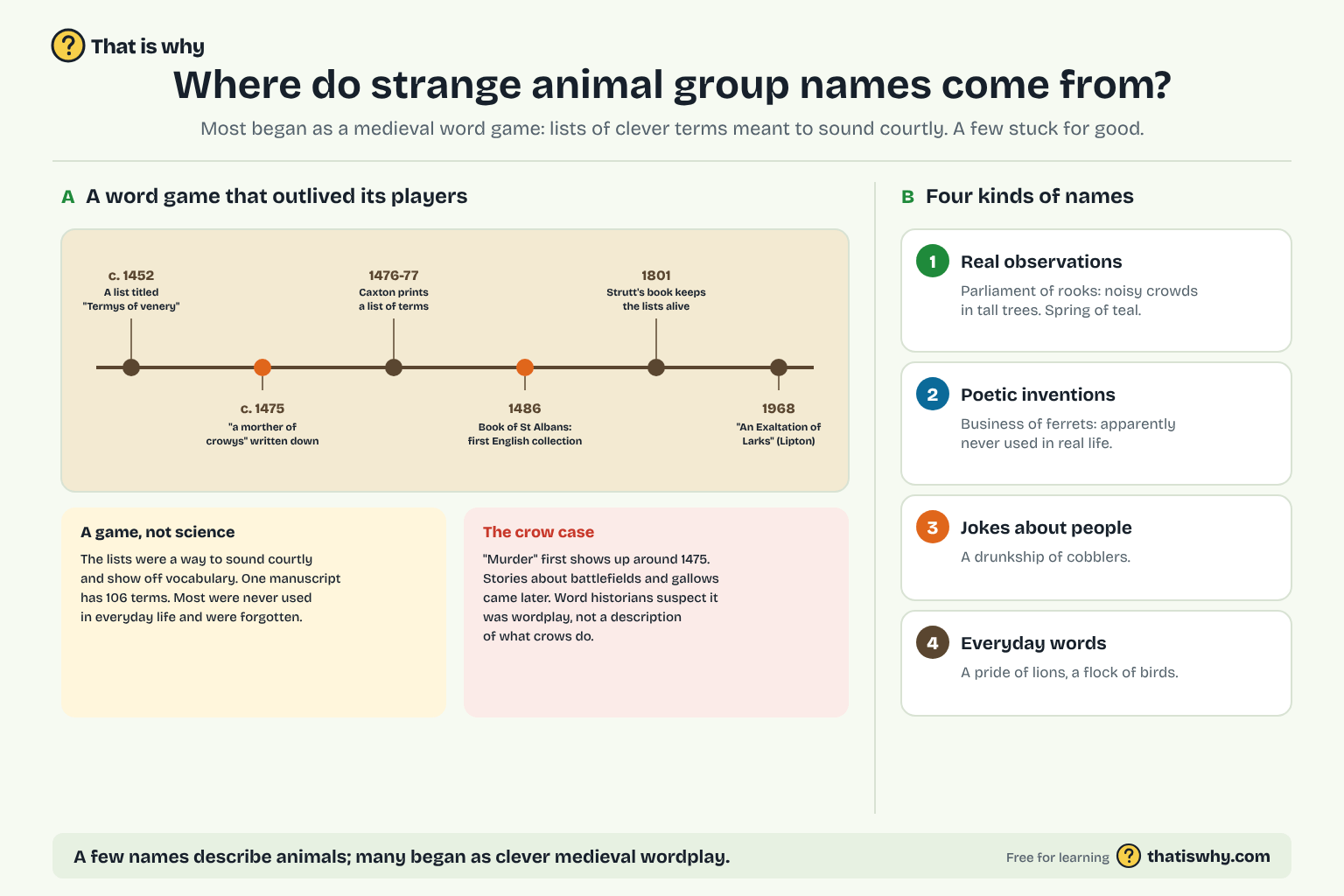
A. A word game that outlived its players. Lists of terms of venery, collective names for animals, were written down in the 1400s: one manuscript of about 1452 is titled "Termys of venery," "a morther of crowys" appears around 1475, and Caxton printed a list in 1476-77. The Book of St Albans of 1486, on hawking, hunting and heraldry, was the first such collection in English. Joseph Strutt's book of 1801 kept the lists alive, and James Lipton's 1968 book An Exaltation of Larks helped that name survive. The lists were a game for sounding courtly; one manuscript has 106 terms, and most were never used in everyday life. "Murder" of crows was probably wordplay; the battlefield stories came later.
B. Four kinds of names. Some collective nouns record real behavior, like a parliament of rooks (noisy gatherings in tall trees) or a spring of teal (leaping from the nest). Some were poetic inventions apparently never used, like a business of ferrets. Some were jokes about people, like a drunkship of cobblers. And some are everyday words, like a pride of lions or a flock of birds.
Key numbers
| Fact | Value |
|---|---|
| Early list titled "Termys of venery" | about 1452 |
| "A morther of crowys" first written | about 1475 |
| Caxton's printed list | 1476-77 |
| Book of St Albans | 1486 |
| Terms in the Egerton manuscript | 106 |
| An Exaltation of Larks (James Lipton) | 1968 |
Common misconceptions
Myth Animal group names are scientific terms.
The truth Most began as medieval word lists, a game for sounding courtly.
Myth A murder of crows comes from crows feeding on battlefields.
The truth The name first appears around 1475 in a word list; the battlefield stories came later, and it was probably wordplay.
Myth All the old names were really used.
The truth Many, like a business of ferrets, were poetic inventions apparently never used in real life.
Questions to use in class
Tap a question to reveal a model answer.
1Where do strange animal group names come from?
Mostly from medieval lists of terms of venery, written as a courtly word game in the 1400s.
2What is the Book of St Albans?
A 1486 book on hawking, hunting and heraldry, the first collection of these terms in English.
3When was a murder of crows first written down?
Around 1475, as a morther of crowys.
4Are any of the names based on real behavior?
Some are: a parliament of rooks fits their noisy gatherings in tall trees, and a spring of teal their leap from the nest.
Key terms
- Terms of venery
- Medieval collective names for animals, such as a murder of crows, written down in word lists from the 1400s as a courtly game.
- Collective noun
- A word for a group of things, such as a flock of birds or a pride of lions.
Sources
- Precision of lexicographers: animal group terms World Wide Words, Michael Quinion
- The murder that never happened 10,000 Birds