Why the Sperm Whale’s Head Works Like a Butter Engine : Spermaceti Function Explained
It is not a battering ram or a weapon. It is not a mistake of evolution.
The sperm whale carries nearly four tons of wax inside its massive, square head, and for centuries people assumed that bulk existed for violence. In reality, that wax works more like a giant block of temperature-controlled butter, hardening when chilled, softening when warmed, and quietly changing the whale’s density so it can sink or rise without wasting energy.
That enormous head is not for smashing ships. It is a phase-change engine.
The Big Square Head: Anatomy of the Butter Engine
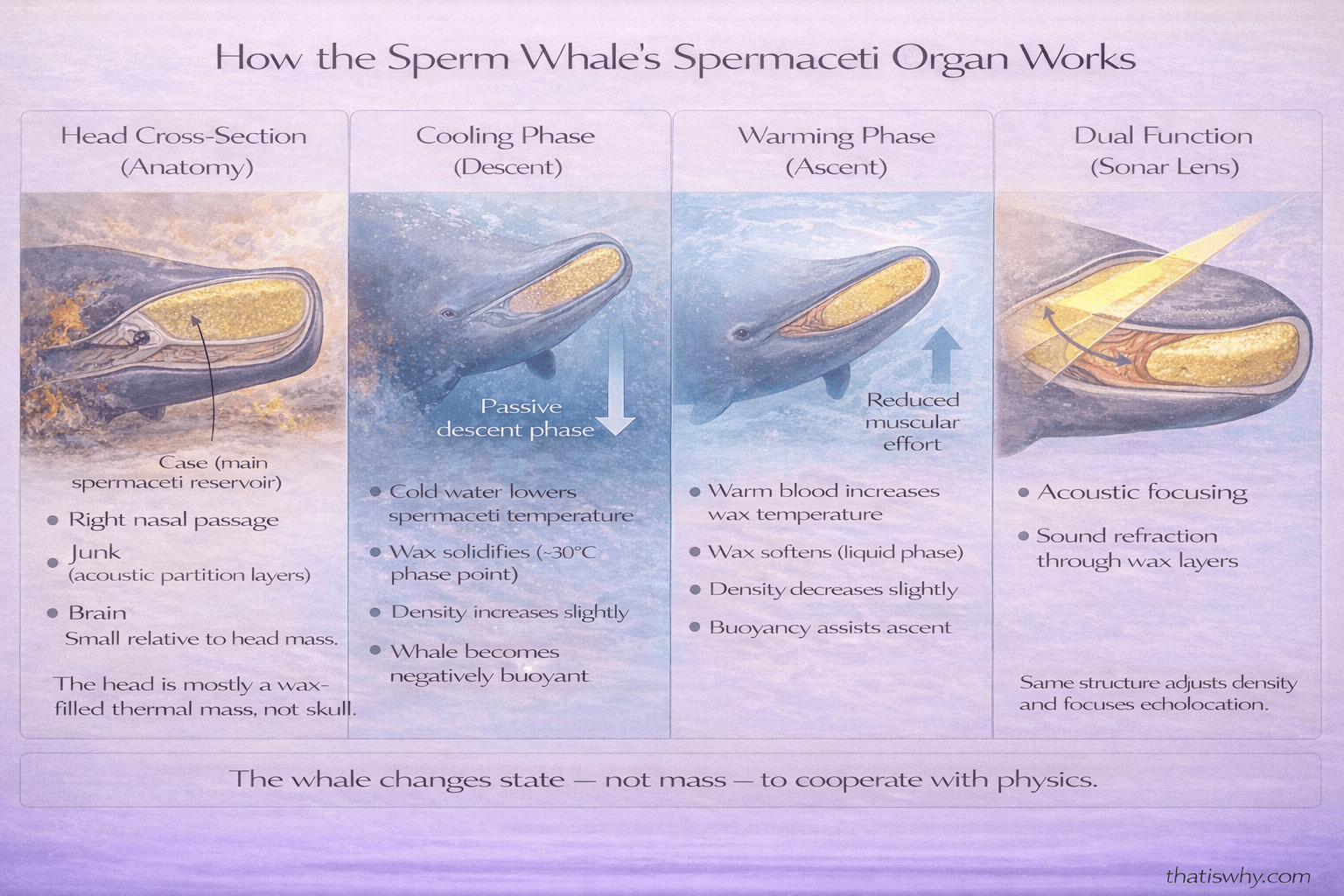
If you look at a sperm whale from the side, nearly a third of its body is just head. That massive block is not skull and brain. Most of it is a layered chamber filled with spermaceti, a waxy oil that behaves very much like butter does in your kitchen. Warm it and it softens into a lighter liquid. Cool it and it firms into a denser solid.
Inside that head, the wax is not sloshing around randomly. It is organized into two major structures: the case and the junk.
The case sits on top. Think of it as the main butter reservoir, a vast chamber holding hundreds of gallons of spermaceti oil. This is the portion that changes phase, shifting between liquid and solid depending on temperature.
Below it sits the junk, which is not junk at all. It is a layered system of connective tissue partitions, like internal walls dividing a block of butter into sections. These partitions stabilize the structure and later play a crucial role in shaping sound. For now, what matters is that this entire head is not dead weight. It is a carefully engineered thermal mass.
Running through this structure is the right nasal passage, which acts almost like a cooling conduit. Seawater and air move through channels that allow temperature exchange. When the whale wants to change the state of the wax, it can influence how heat flows through this massive chamber.
What you are looking at is not a skull designed for impact. It is a temperature-controlled tank filled with a substance that can switch states.
How Cooling Butter Makes a Whale Sink
To understand why the butter engine works, you only need one principle: when a material changes from liquid to solid, its density often changes with it. Spermaceti wax behaves very much like butter in a pan. When it is warm, it spreads and softens. When it cools, it firms up and becomes more compact.
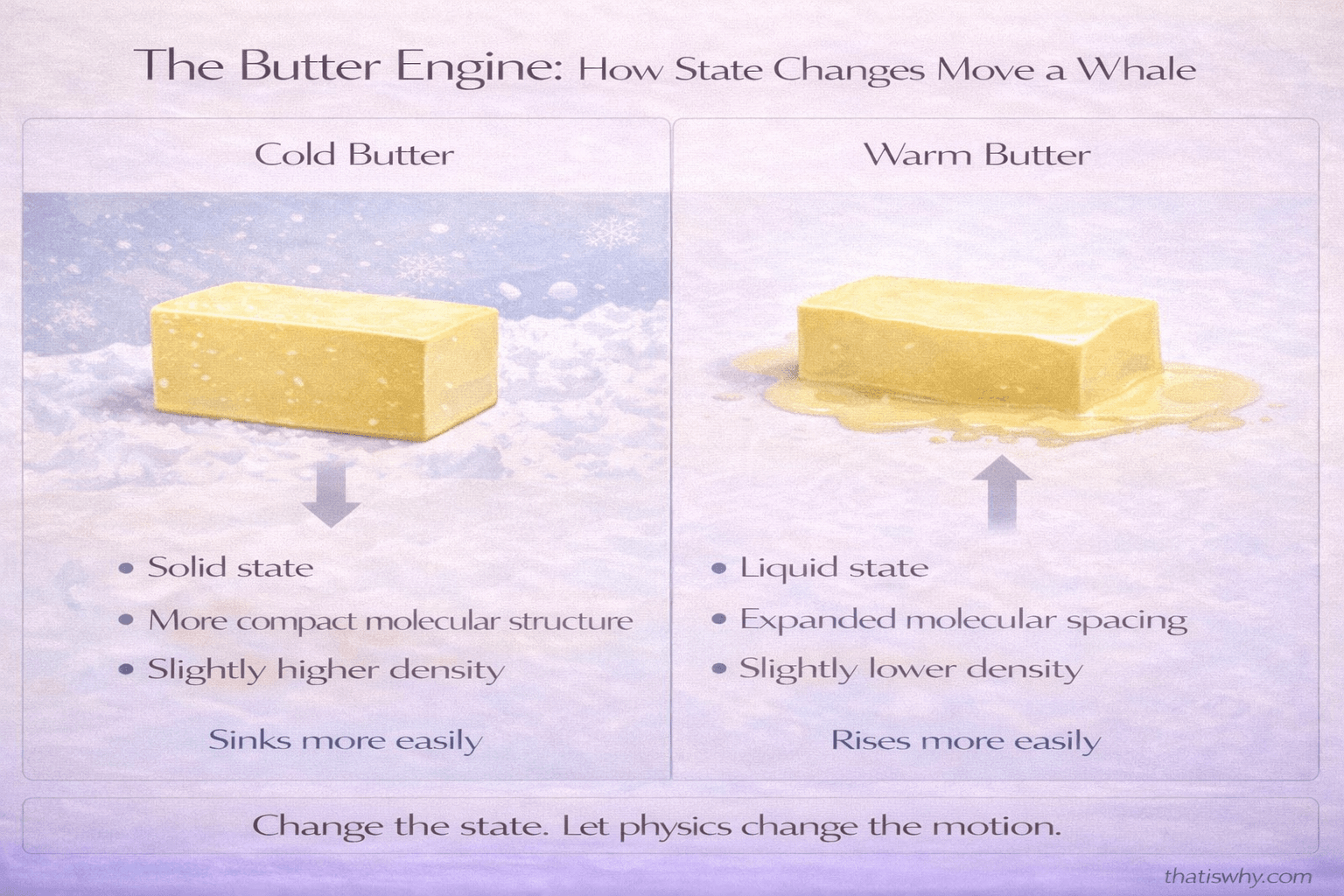
Spermaceti solidifies at roughly 30°C. That temperature matters because the deep ocean is cold, often just a few degrees above freezing. When the whale begins a dive, it allows cold seawater to circulate around the front of its head through vascular and nasal channels. That cooling lowers the temperature of the wax. As the wax hardens, its molecular structure tightens and its density increases.
Nothing has been added to the whale’s body. Nothing has been removed. The same mass is simply occupying less volume in its solid state. That subtle shift makes the whale slightly heavier relative to the surrounding water.
As the spermaceti firms, the whale becomes negatively buoyant. Instead of spending energy beating its tail downward, it can enter what researchers describe as a passive descent. Gravity contributes to the dive. The butter engine has shifted state, and physics begins sharing the workload.
For a creature that may dive to depths of two thousand meters in search of squid, conserving muscle energy is not optional. It is survival. By adjusting temperature instead of constantly swimming, the sperm whale turns thermodynamics into propulsion.
Heating the Butter: How the Whale Rises Without Struggling
A whale that sinks efficiently also still needs a reliable way to return.
As the dive ends and the whale prepares to ascend, it increases blood flow through an intricate network of capillaries surrounding the spermaceti organ. Warm blood circulating from the whale’s core muscles transfers heat into the wax. Gradually, the firm structure softens. The solid butter becomes liquid again.
As it melts, it expands and becomes slightly less dense. The whale becomes more buoyant relative to the surrounding seawater. Just as cooling allowed gravity to assist the descent, warming now allows buoyancy to assist the ascent.
The mass has not changed. Only its state has.
The whale still swims upward, but it is no longer fighting its full weight. Over repeated deep dives, that difference in energy expenditure matters enormously. Oxygen is limited at depth. Efficiency extends survival.
The butter engine does not explode into action. It shifts quietly, and the ocean responds.
The Acoustic Lens: When the Butter Shapes Sound
If the spermaceti organ only managed buoyancy, it would already be remarkable. But evolution rarely wastes large structures on a single task.
Sperm whales hunt in darkness where sunlight never reaches. At those depths, vision is irrelevant. Sound becomes sight.
The whale produces powerful clicks inside its nasal passages. Those clicks travel forward through the spermaceti organ before exiting the head. Sound behaves differently depending on the material it passes through. A warm, softer wax transmits and refracts acoustic energy differently than a cooler, firmer one.
The internal partitions of the junk guide and channel those vibrations. Together, the case and junk act like a biological acoustic lens, focusing outgoing clicks into a narrow, powerful beam. That beam allows the whale to detect prey at extraordinary distances and resolve detail in near-total darkness.
The same block of wax that shifts density also shapes sound. The butter engine manages weight and directs sonar using the same physical properties.
One structure, two systems and Physics serving biology twice.
When Butter Becomes Engineering
Once you understand the sperm whale’s head as a temperature-controlled wax system, it stops looking like biological excess and starts resembling a principle engineers now study deliberately.
Modern buildings use phase-change materials that melt during the day to absorb heat and solidify at night to release it gradually. Thermal batteries store energy through state changes rather than chemical reactions. Researchers have explored density-changing materials to assist buoyancy systems without constantly pumping mass in and out.
The sperm whale was using this idea long before we named it. If you can change your state instead of fighting the environment directly, you conserve energy. If gravity and buoyancy can share the workload, muscle becomes a supplement rather than the primary engine.
The whale does not overpower the ocean. It cooperates with thermodynamics.
Ramming Ships and Other Whale Head Myths
Myth #1: The square head evolved for ramming ships.
Truth: The ramming theory comes more from literature than anatomy.
While the skull is robust, the spermaceti organ is filled with wax and connective tissue, not reinforced impact structures. Surviving a collision does not mean evolving for repeated high-speed impact. The architecture of the case and junk is optimized for temperature control and acoustic precision, not violence.
Myth #2: The spermaceti organ is only for sonar.
Truth: It functions as both an acoustic lens and a buoyancy system.
Focusing solely on echolocation ignores thermodynamic modeling and dive data suggesting passive descent phases. The dual function emerges from the same physical properties of the wax.
Myth #3: Deep dives are mostly muscular effort.
Truth: Muscle is expensive, and physics is cheaper.
Dive profiles show glide phases consistent with buoyancy adjustments. Even modest density changes can alter vertical motion significantly in water.
The Animal That Changed State Instead of Fighting
For centuries, people looked at the sperm whale’s enormous head and assumed it must be built for force. The sheer scale invites that interpretation. Large structures feel like weapons.
The truth is quieter and more elegant. That head is a temperature-regulated block of wax that shifts between liquid and solid, subtly adjusting the whale’s relationship with gravity. Instead of constantly fighting the ocean through muscular effort, the whale alters its internal state and lets buoyancy and density share the work.
When the wax cools and firms, descent becomes easier. When it warms and softens, ascent requires less effort, mass never changes only the arrangement of molecules shifts, and that shift reshapes how a forty-ton animal moves through two kilometers of water.
Explanations like this fascinate me because they replace drama with cooperation. The whale is not conquering pressure. It is aligning itself with the rules of physics so those rules begin working in its favor.
We often assume survival means pushing harder against the world. The sperm whale suggests something subtler. Sometimes the most powerful strategy is not force at all. It is understanding the system deeply enough to change your own state instead of trying to overpower it.
That enormous square head does not break ships. It bends thermodynamics to its advantage.
How We Researched This :
To explain how the sperm whale’s spermaceti organ functions as a phase-change buoyancy system, we relied on anatomical and thermodynamic research, including Malcolm Clarke’s 1978 buoyancy hypothesis and later modeling work published in journals such as Deep-Sea Research and Marine Mammal Science examining dive profiles and passive descent behavior in Physeter macrocephalus. We also referenced acoustic studies in The Journal of the Acoustical Society of America describing how the case and junk structure focus echolocation clicks.
But we knew that density curves and vascular heat exchange data alone would not make the mechanism intuitive. Our real job began when we asked, “What does this feel like physically?” That question led us to the giant butter engine analogy—a simple way to visualize how warming and cooling the same wax can subtly change density, allowing a forty-ton animal to move through the ocean by cooperating with thermodynamics instead of fighting it.