Why the “Volcano Snail” Is Actually an Iron Knight
Often called the “volcano snail,” the scaly-foot snail doesn’t live in lava, and it isn’t fireproof. What it really does is far stranger: it builds real iron armor. It’s the only known animal on Earth that incorporates metal into its body, and it does so in one of the most hostile environments we know.
Two kilometers beneath the Indian Ocean, the seafloor cracks open.
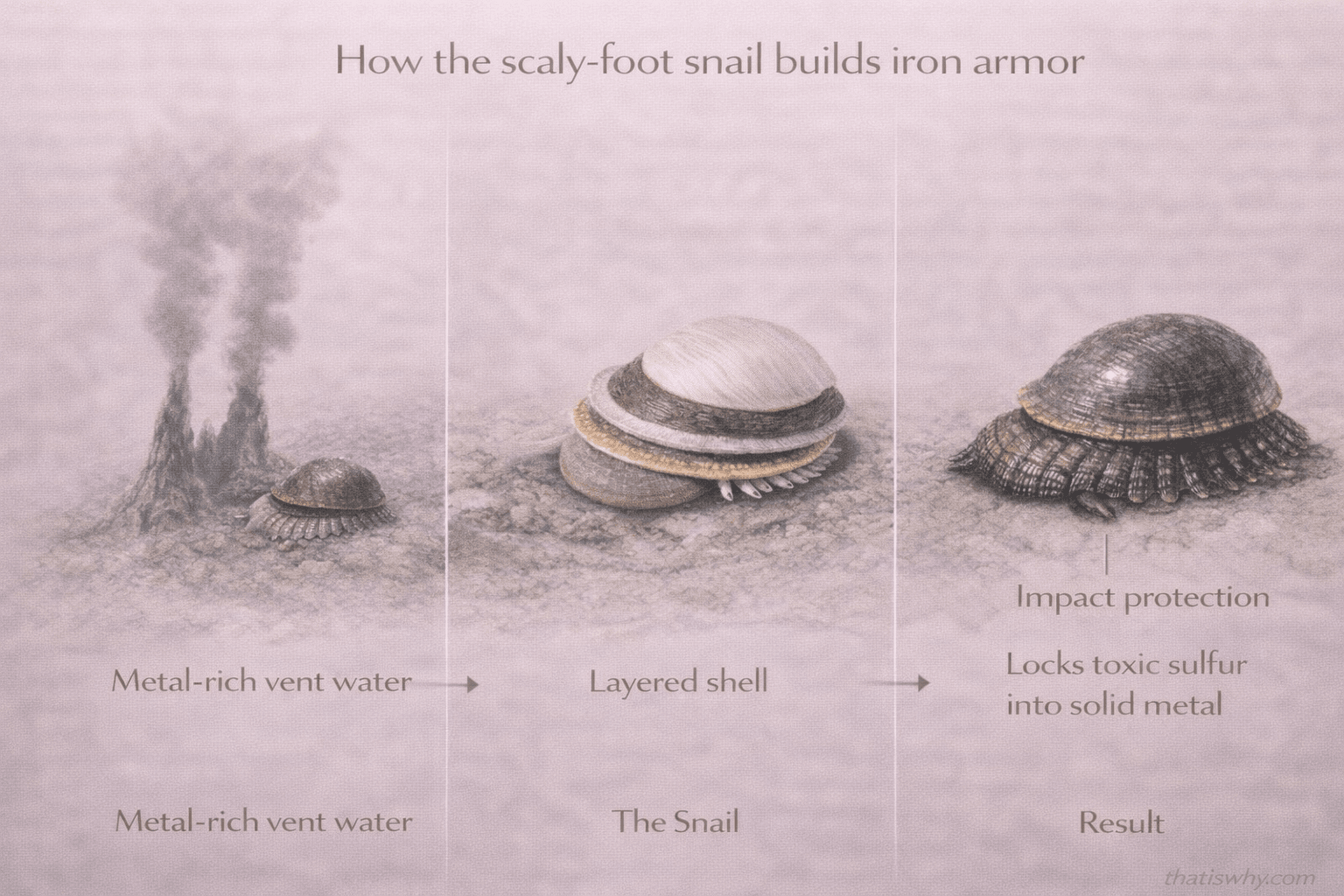
This is where hydrothermal vents form, essentially underwater geysers heated by magma below. They pump out water loaded with metals and sulfur, hot enough at the source to melt lead. Just a short distance away, that superheated fluid mixes with near-freezing seawater. The pressure is crushing, it’s one of the harshest environments on Earth.
And yet, right on the edge of that chaos, lives a snail.
If you bring one up in a tank and hold a strong magnet nearby, the snail doesn’t ignore it. It slowly shifts, drawn toward the field, until it sticks. Not because it senses the magnet, but because parts of its body are made of iron.
Life at the Edge of a Volcano (Without the Lava Myth)
The snail at the center of this story is the Chrysomallon squamiferum, often called the volcano snail. The nickname is catchy, and a little misleading.
It doesn’t live in lava. If it touched the 400 °C fluid pouring directly out of a vent, it would die instantly. What it actually does is more subtle. It lives nearby, in the mixing zone where superheated vent water blends with cold seawater. Temperatures here swing between a few degrees above freezing and something closer to a warm bath—still extreme, just survivable.
One of the best places to find it is the Kairei Field, a hydrothermal vent system rich in dissolved metals and sulfur.
Food, in the usual sense, doesn’t exist here. There are no plants, no algae nothing to graze on. So the snail solves the problem in an unusual way. Inside its body is a large gland packed with symbiotic bacteria. Those bacteria use the vent’s toxic chemicals, like hydrogen sulfide, iron, and other compounds, to produce energy through chemosynthesis.
The snail doesn’t really feed them. It gives them a place to live, and carries them wherever it goes.
The Armor: How an Animal Grows Metal
Most snails protect themselves with a shell.
This one doesn’t stop there.
What the scaly-foot snail builds is closer to armor, layered, reinforced, and designed for impact. Not metaphorically nut structurally.
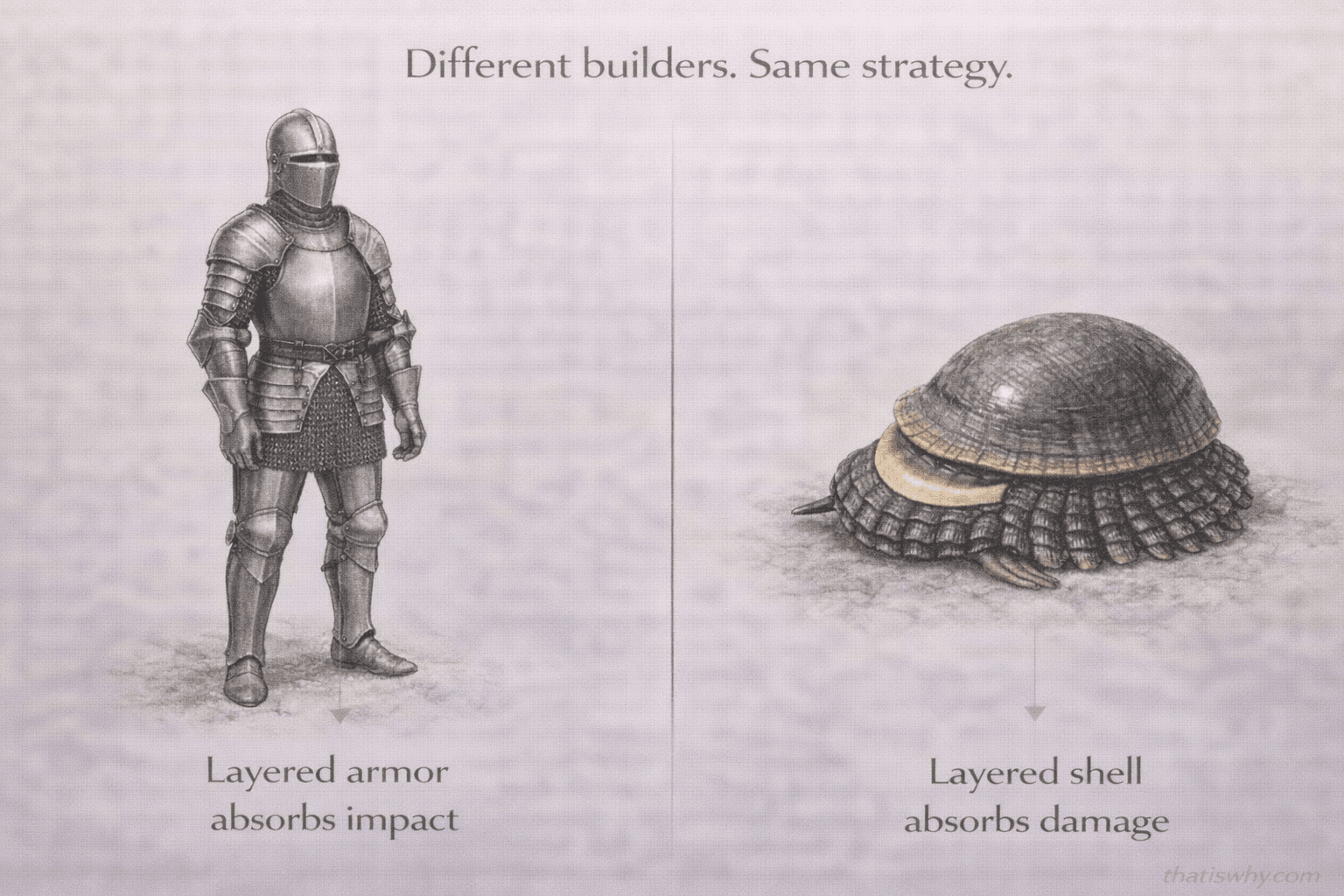
Its shell has three distinct layers. On the inside is calcium carbonate, the same basic material used by ordinary snails. That layer provides shape, but not much protection. On the outside is the part that makes this animal unique: a coating of iron sulfide, formed directly from the metal-rich water around the vents.
Between those two sits something unexpected, a thick, organic layer that behaves like padding. When a force hits the shell, the hard outer layer resists cracking, while the softer middle layer absorbs and spreads the shock. Instead of failing all at once, the structure dissipates damage.
And the shell is only half the story while most snails hide their soft foot while this one plates it.
The scaly-foot snail’s foot is covered in hundreds of overlapping scales, called sclerites. They’re arranged like roof tiles or chainmail, flexible enough to move, but rigid enough to take a hit. Each scale is mineralized with iron sulfide, turning what should be the most vulnerable part of the body into its most protected.
At this point, calling it a shell stops making sense.
This animal isn’t just wearing protection.
It’s wearing a suit.
Why Metal? (Defense vs. Detox)
Building iron armor is expensive. It takes energy, time, and access to the right chemistry. An animal wouldn’t do it unless the payoff was significant.
For the scaly-foot snail, there are two leading explanations, and they aren’t mutually exclusive.
The first is defense.
Hydrothermal vents aren’t empty. Crabs patrol these fields with claws built to crack shells. Tests on the scaly-foot snail’s armor show that its layered structure resists fractures far better than ordinary shells. When force is applied, cracks don’t spread cleanly. They stall, deflect, or die out entirely.
That design caught human attention. Researchers at Massachusetts Institute of Technology have studied the shell as a model for impact-resistant materials—not because it’s thick, but because it’s smart. Hard where it needs to be and soft where it has to be.
Living at hydrothermal vents means bathing in toxic chemistry. The bacteria inside the snail rely on sulfur compounds to make energy, but sulfur waste is dangerous if it builds up inside tissues. The surrounding water, meanwhile, is loaded with dissolved iron.
Put those two together and something interesting happens.
Iron binds with sulfur to form iron sulfide, a stable, insoluble mineral. Instead of storing poison inside its body, the snail may be pushing the problem outward, locking sulfur into solid metal and depositing it on its shell and scales.
In other words, the armor may also be a disposal system.
The Iron Knight doesn’t just wear protection.
It moves its waste outside the body, and turns it into armor.
The Magnetic Snail
There’s one more detail that makes the scaly-foot snail’s armor hard to dismiss as metaphor.
Some of the iron minerals embedded in its shell and scales, particularly a form called greigite are magnetic. Not symbolically but purely physically.
In laboratory tanks, scaly-foot snails will slowly clump together when exposed to a strong magnetic field. They aren’t sensing the magnet or reacting to it behaviorally. They’re being pulled.
At that point, calling this animal “metallic” stops being poetic : it’s literal.
Armor Myths: What the “Volcano Snail” Is Not
Myth #1: The “volcano snail” lives in lava
Truth: It lives near hydrothermal vents, not in them. If the scaly-foot snail touched the superheated fluid pouring directly out of a vent, it would die instantly. It survives in the surrounding plume, where hot vent water mixes with cold seawater and temperatures drop to survivable levels.
Myth #2 : The armor makes it fireproof
Truth: The armor is chemical, not thermal. The snail doesn’t survive because it tolerates extreme heat. It survives because it manages chemistry, layering minerals in a way that blocks damage and isolates toxins rather than resisting temperature directly.
Myth #3: The iron armor is decorative
Truth: The iron armor is functional, and costly. Growing iron takes energy. In an environment where energy is scarce, nothing is added for show. If the metal didn’t improve survival, the snail wouldn’t maintain it.
Myth #4: All scaly-foot snails wear iron armor
Truth: Only snails in iron-rich vents do. Populations living in vents with lower dissolved iron develop a pale, “white” form with little to no metal in their shells. Same species. Different chemistry. Clear evidence that the armor is an adaptation to local conditions.
The Cost of Wearing Armor
Armor solves problems, but it creates constraints.
The scaly-foot snail is not a generalist. It can only survive in places where the chemistry is just right: enough iron in the water, enough sulfur for its bacteria, and stable vent conditions that don’t shift too far in either direction. Take away any one of those, and the armor stops being an advantage.
That specialization comes with a trade-off.
The snail lives in only a handful of hydrothermal vent fields worldwide. Each one is a narrow battlefield, defined by chemistry rather than geography. And many of those same metal-rich sites are now targets for deep-sea mining.
Removing those deposits doesn’t just scrape away habitat. It changes the chemical conditions that allow the armor to form in the first place. Without the right materials, the Iron Knight can’t suit up.
In a quiet irony, an animal that mastered metal by working with its environment is now threatened by our attempt to extract it. The scaly-foot snail was recently listed as endangered, not because its strategy failed, but because it was too precise.
A Different Kind of Armorer
When humans want armor, we mine ore, build furnaces, and force materials into shape with heat and pressure. We overpower chemistry.
The scaly-foot snail takes the opposite approach.
It doesn’t smelt or forge. It lets chemistry settle where it wants to. Iron precipitates out of the water, sulfur binds, layers form slowly, exactly where protection is needed. No fire tools or excess.
In other words, the Iron Knight isn’t built in a workshop : it’s assembled in place.
We’re still learning how to build materials that absorb damage instead of shattering, how to manage toxic waste without spreading it, and how to use metals without poisoning ourselves. The snail solved those problems long ago, not by dominating its environment, but by aligning with it.
Once you see that, the nickname “volcano snail” feels shallow.
That name focuses on where it lives while Iron Knight explains how it survives.
How We Researched This :
To explain how an animal can grow real metal, we looked at research on biomineralization, hydrothermal vent chemistry, and the biology of Chrysomallon squamiferum, including studies on iron sulfide formation, magnetic minerals like greigite, and symbiotic chemosynthetic bacteria.
But we knew that listing minerals and reactions wasn’t enough. Our real job began when we asked, “What does this feel like?” That question led us to the “Iron Knight” analogy, a way to frame metal armor, detoxification, and survival strategy as a single, coherent system, and to make extreme deep-sea chemistry feel intuitive rather than abstract.