Why The Chameleon Vine Is The Only Plant That Can See – The Plant With Eyes
How does the chameleon vine change its leaves? The Chameleon Vine (Boquila trifoliolata) is capable of “mimetic polymorphism,” meaning it can change the size, shape, and color of its leaves to match the plant it is climbing. While scientists originally believed it used chemical signals or horizontal gene transfer to copy its host, a 2022 study suggests a more radical theory: the plant may possess a form of primitive vision, allowing it to “see” and copy the leaves around it.
If you saw this in person, you will not see it’s a different leaf.
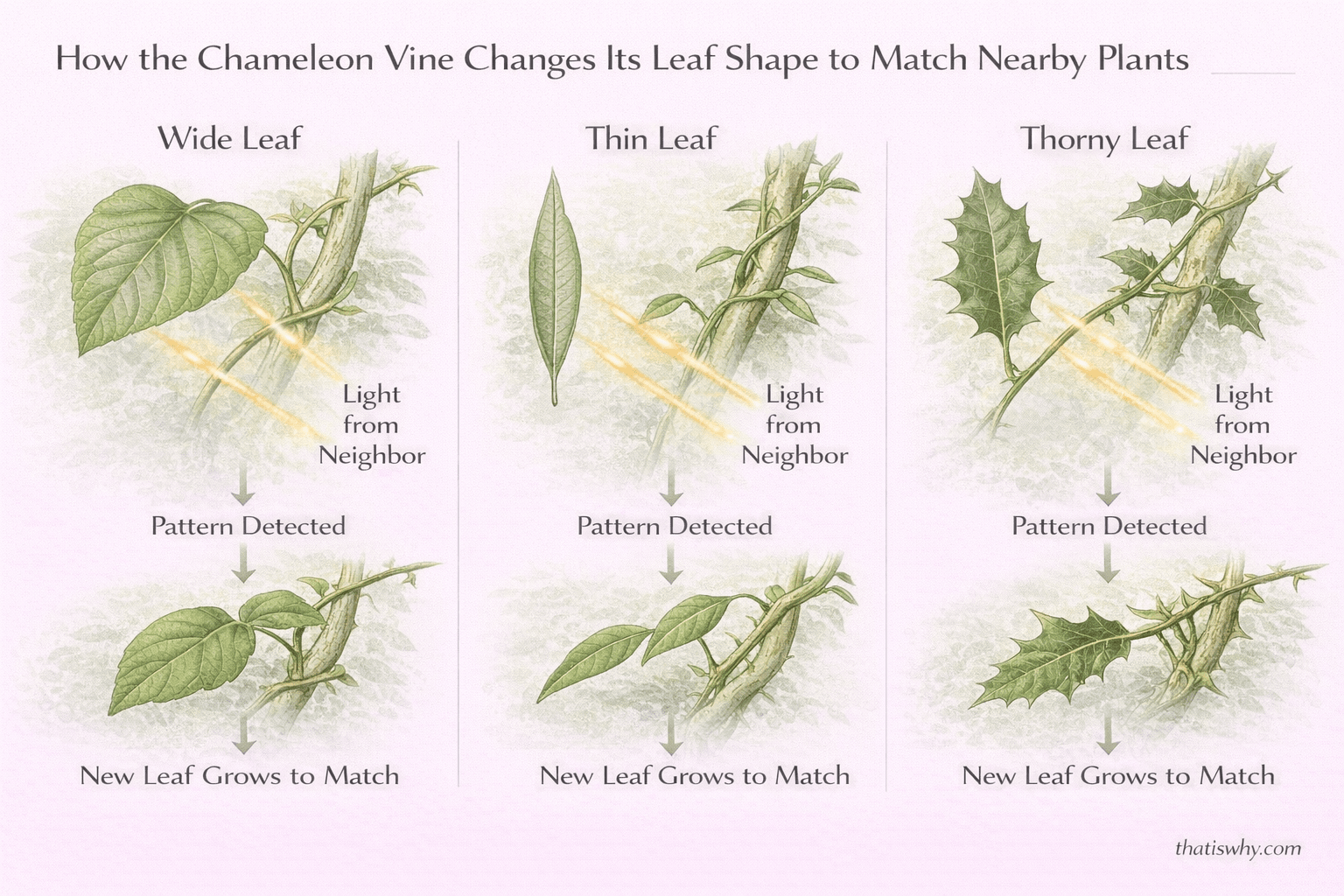
Deep in the rainforests of Chile, there is a vine that has no identity of its own. It’s a biological shapeshifter adapting based on its surrounding. When it climbs a tree with wide, flat leaves, the vine grows wide, flat leaves. If it jumps to a bush with thin, pointy leaves, the vine instantly switches its DNA expression and grows thin, pointy leaves. If it climbs a plant with nasty thorns, the vine grows soft, harmless tips that look exactly like thorns.
A single vine has three different leaf shapes on the same stem, perfectly matching three different neighbors. It is the ultimate spy for decades, it drove botanists absolutely crazy because no one could figure out how a blind plant was pulling off a visual magic trick.
The Funhouse Mirror
To understand why this is so bizarre, you have to realize that most mimicry is frozen in time. A stick bug looks like a twig because its ancestors evolved that way over millions of years. It can’t wake up tomorrow and decide to look like a rock. Its disguise is permanent.
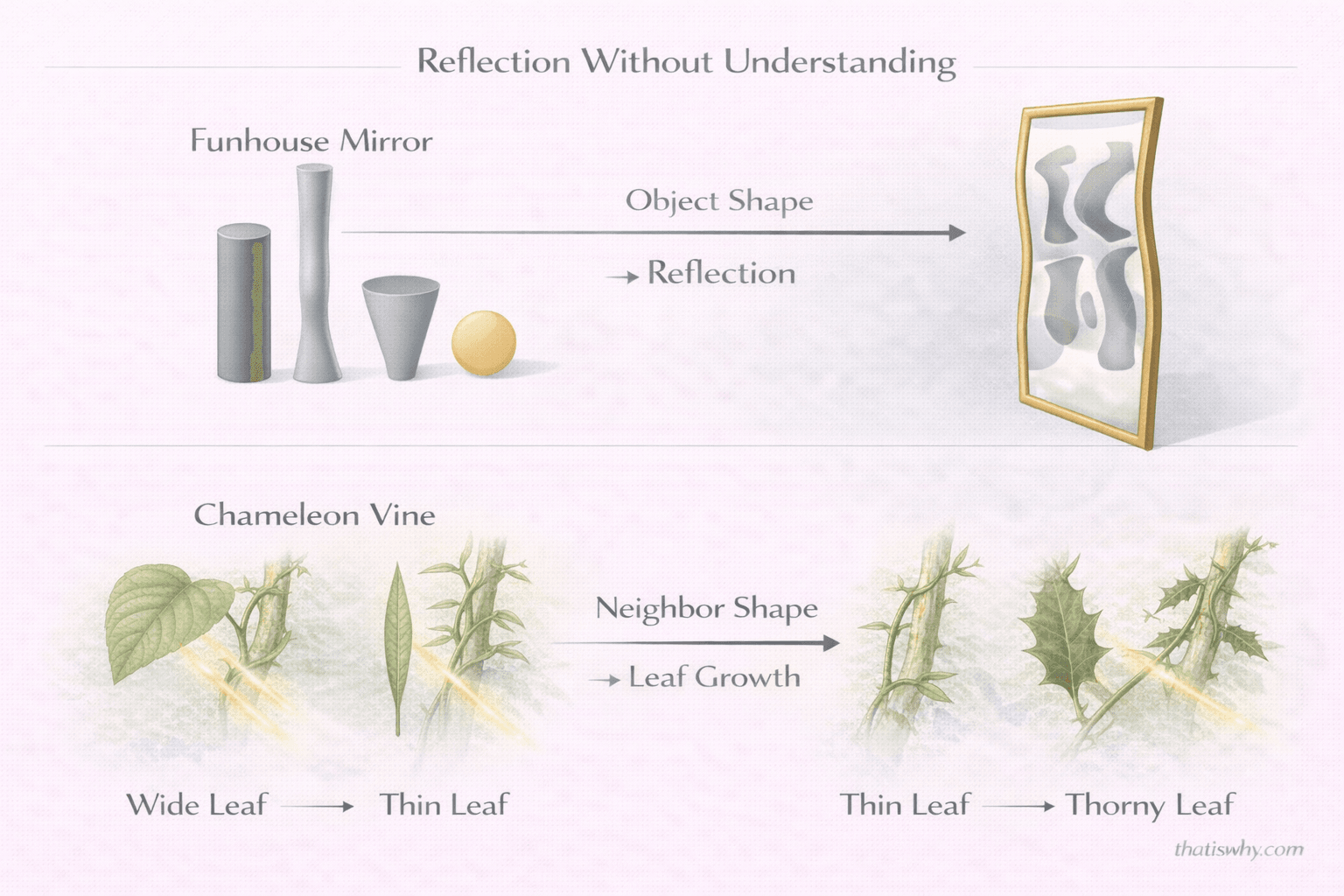
The Chameleon Vine is different, its disguise is fluid. Think of it as a Funhouse Mirror.
Imagine a mirror walking down the street. If it stands next to a tall person, it stretches out. If it stands next to a round object, it expands sideways. It actively reshapes itself to match whatever is standing closest to it.
The vine does the exact same thing. It doesn’t have a fixed “self.” It has Phenotypic Plasticity, the ability to physically rewrite its own growth pattern on the fly. It reflects its neighbors to hide from herbivores. If a bug is looking for a tasty vine to eat, it won’t find one. It will just see more of the boring, inedible tree it’s already ignoring.
The Plastic Plant Experiment
For a long time, botanists had two safe, boring theories about how the vine did this. Theory A: It “sniffs” chemicals from the host tree. Theory B: It steals DNA from the host (Horizontal Gene Transfer).
Both theories made sense. Until 2022. That year, researchers White and Yamashita decided to break the rules. They put the Chameleon Vine next to a fake plastic plant.
Plastic has no smell and no DNA, it is biologically inert. If the vine relied on chemicals or genes, it should have ignored the plastic entirely. It should have grown its normal leaves.
But it didn’t. The vine mimicked the plastic leaves perfectly. It copied the shape, the size, and even the color.
This was the smoking gun. By eliminating smell and touch, the researchers were left with only one terrifying possibility: The plant wasn’t tasting its neighbor : it was looking at it.
Eyes Made of Glass
How can a plant see without eyes? How does the Funhouse Mirror know what to reflect?
It turns out, the mirror itself is made of lenses. The theory is called the “Ocelli Hypothesis.” In insects, “Ocelli” are simple eyes—basically just clear lenses that detect light and dark.
The upper epidermal cells of the Chameleon Vine are convex, curved outward like a magnifying glass. These cells act like thousands of tiny eyeglasses. They capture light and focus it onto the sensitive photosynthetic layer below.
The plant isn’t seeing a crisp HD image. It’s seeing a blurry, low-resolution shadow. It senses that the object standing next to it is “Round” or “Pointy” based on how the light is filtered. It then directs its growth hormones to twist its own cells into that shape. It is literally bending its own body to match the reflection it sees in the mirror.
The Scientific Fight
Now, I have to be a responsible scientist here: This theory is a war zone.
Many botanists absolutely hate the “Plant Vision” idea. They argue that plants cannot see because they don’t have brains to process the image. They are searching for any other explanation, maybe there was a chemical on the plastic? Maybe it was just a coincidence?
But the Plastic Leaf experiment is hard to kill. If it’s true, it shatters our entire understanding of biology. It means plants aren’t just passive decorations sitting in the dirt. They are active observers. They are watching the world, watching us, and watching each other. And that is a terrifying thought for a salad eater.
Adaptive Camouflage
If plants can see, it changes everything. We aren’t just talking about biology; we are talking about the future of technology.
The Invisible Suit Military engineers are obsessed with “Adaptive Camouflage“, materials that change texture and color to match the background. Right now, we use cameras and screens. But the Chameleon Vine does it with biological cells. If we can unlock that code, we could grow invisibility cloaks.
Smart Farming If a plant can see a shape, can it see a threat? Could we breed crops that “see” a beetle coming and harden their leaves before it bites? It could end the need for pesticides.
Living Architecture Imagine a building that changes its skin based on the weather, just by looking at the sky. We are trying to build smart cities; nature already built smart forests.
Debunking the Spy
Because this plant is so weird, the internet tends to exaggerate. Let’s keep it real.
Myth #1: “It steals DNA.” People think it’s a genetic vampire sucking code out of trees.
The Truth: The plastic experiment killed this theory. It doesn’t need to steal genes; it just needs to change how it uses its own. It’s a software update, not a hardware swap.
Myth #2: “It changes instantly.” We imagine it shifting colors like an octopus or a cuttlefish.
The Truth: It’s a plant, not a TV screen. It takes weeks for a new leaf to grow and match the host. It’s a slow-motion shapeshifter, playing the long game.
Myth #3: “It has eyeballs.” We imagine a plant staring at us with pupils.
The Truth: It definitely doesn’t have a retina or a brain. If it “sees,” it sees like a cheap motion sensor, detecting simple patches of light and dark. It’s primitive vision, but in the jungle, even a blurry picture is better than blindness.
The Forest Has Eyes
When you walk into a forest, you think you are alone. You think the plants are just background decoration.
But the Chameleon Vine proves that the forest is watching. It suggests that the “Green Static” isn’t static at all. It is a room full of funhouse mirrors, constantly shifting and warping to reflect the world around them.
The plants are watching their neighbors, learning their shapes, and putting on costumes to blend in. It turns the woods from a landscape into a masquerade ball. And the scariest part? You never know which plant is real, and which one is just a reflection of something else.
How We Researched This :
To explain this mystery, we analyzed the 2014 study by Ernesto Gianoli, which first documented the vine’s ability to mimic multiple hosts. We then contrasted this with the controversial 2022 study by White & Yamashita, which used artificial plants to test the “Vision” hypothesis.
But we knew that just citing experimental data isn’t helpful. Our real job began when we asked, “What does this feel like?” That question led us to the “Funhouse Mirror” analogy—a simple story to make the complex concept of an organism physically reflecting its environment feel intuitive.