Why Trees Produce Sap (and How It Differs from Resin)
Sap is the tree’s bloodstream, a nutrient-rich fluid that transports water and sugar through two distinct vascular systems: Xylem (water up) and Phloem (sugar down). Crucially, sap acts as a natural antifreeze, using dissolved sugars to lower the freezing point of water and prevent cell damage in winter. This is chemically distinct from Resin, which is a sticky, insoluble defense mechanism used to seal wounds and trap insects.
That distinction—between a nutrient transport system and a defense mechanism—is where most of us get lost. Because in casual conversation, we tend to lump every sticky fluid that comes out of a tree under the same label.
Here is the question: Are those two fluids the same thing?
Most of us call them both “sap.” But if you ask a botanist, they will tell you that’s like confusing blood with a scab.
One of them (the syrup) is indeed Sap. It is the fluid running on the tree’s internal Superhighway. It flows constantly, moving fuel and water up and down the trunk to keep the city running.
The other (the windshield goo) is Resin. It has nothing to do with traffic. It is a chemical weapon stored in defensive bunkers, waiting to be deployed against invaders.
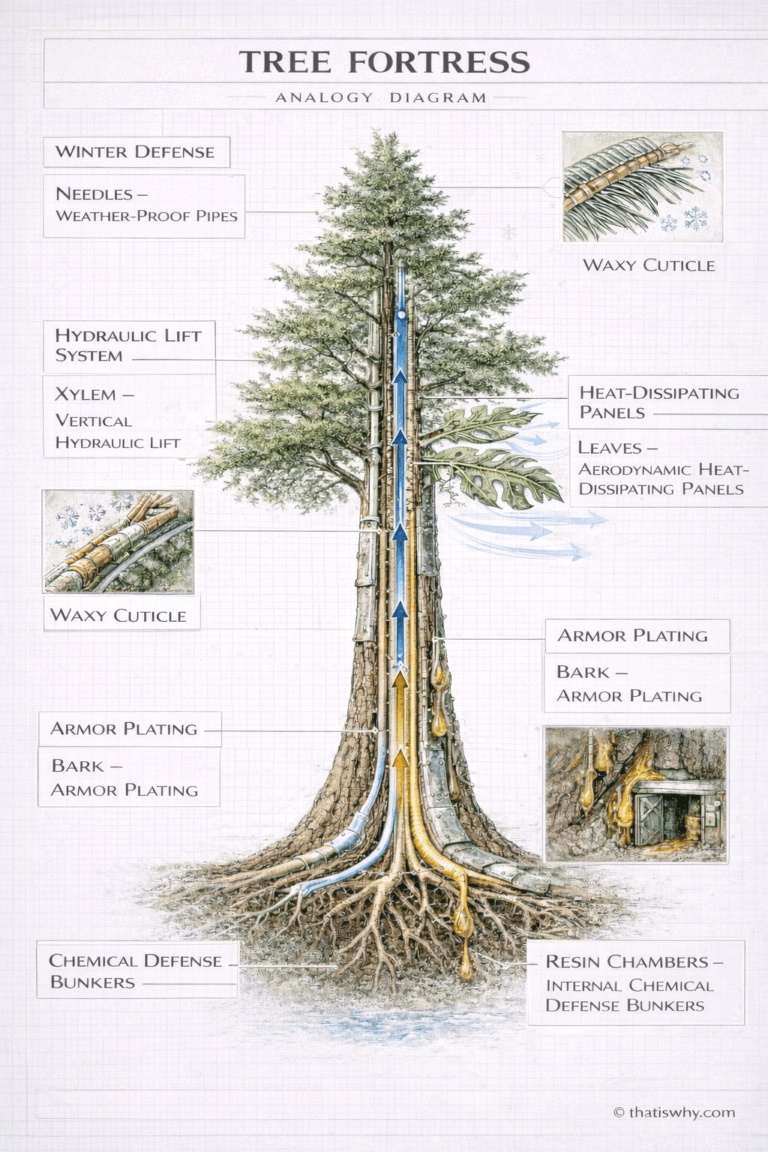
The confusion between these two fluids is one of the biggest mix-ups in nature. To understand what is really happening inside that trunk, we have to stop looking at the tree as a block of wood. Instead, see it as a bustling city with a complex highway system—and a military defense budget.
The Two-Lane Highway
To really understand what “Sap” is, we have to look under the hood at the tree’s plumbing.
In our previous deep dive on Why Do Trees Grow Tall ?, we talked about how trees suck water up from the roots. But that is only half the story.
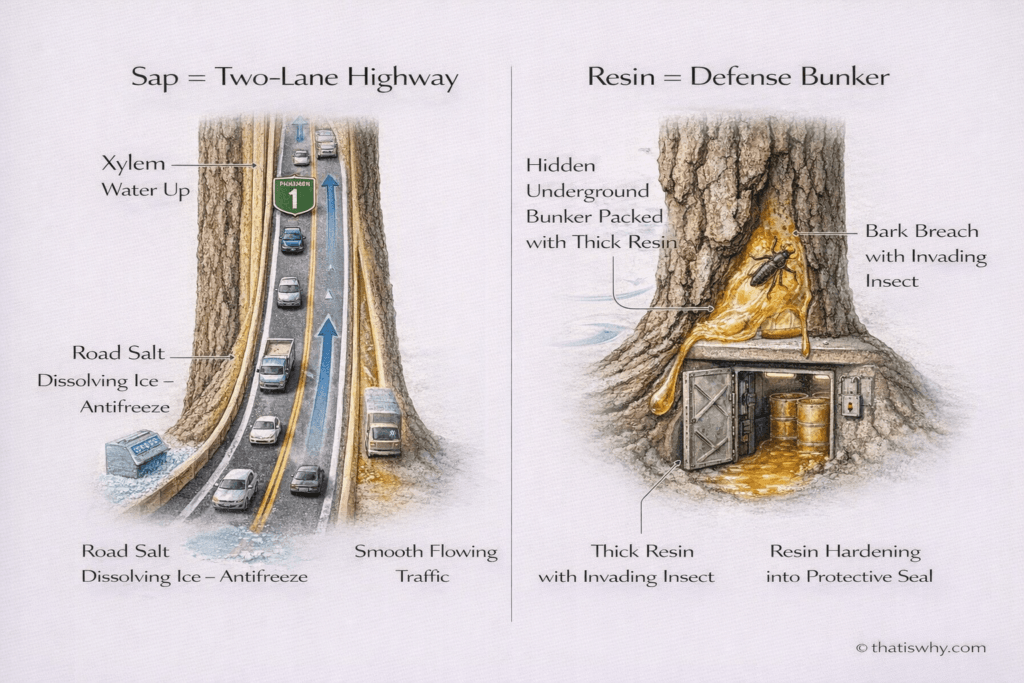
A tree is essentially a vertical city with a Two-Lane Highway running through its trunk.
Lane One is the “Water Main.” Scientists call this the Xylem. This lane flows strictly UP. It carries water and raw minerals from the roots all the way to the leaves in the canopy. The fluid in this lane is thin and mostly water—botanists call it “Crude Sap.”
Lane Two is the “Food Truck.” This is the Phloem. Once the leaves (the factory) use sunlight to turn that water into sugar, they need to ship that food down to feed the rest of the tree. This lane flows DOWN. The fluid here is thick, sugary, and energy-dense—botanists call it “Elaborated Sap.”
This distinction is huge. When you tap a Maple tree for syrup, you aren’t just drilling a random hole. You are specifically hijacking Lane One. You are intercepting the sweet water-and-sugar mix as it rushes up the tree in the spring to wake up the branches.
Sap as Antifreeze: Salting the Roads
So, why is the sap on that highway so sweet? Why pump sugar through your veins?
It isn’t just for food; it’s for survival.
Think about winter driving. Before a snowstorm, trucks dump salt on the highway. Why? Because salt lowers the freezing point of water, keeping the roads liquid even when it’s freezing outside.
Trees do the exact same thing, but they use sugar.
By dumping sugar into the “Water Main” (Lane One), the tree lowers the freezing point of its blood. It turns the sap into a sugary slush that can flow through the pipes without freezing solid and bursting the cells. So, when you eat maple syrup, you are literally eating the tree’s version of road salt.
Resin: The Chemical Weapon
Now, let’s talk about the sticky goo on your car.
This is Resin. And unlike sap, it has nothing to do with the highway.
Resin doesn’t flow through the pipes; it is stored in defensive bunkers.
Think of the tree like a castle under siege. If a beetle tries to drill a hole through the bark, the tree detects the breach and deploys the weapon. It pumps high-pressure resin into the tunnel, drowning the beetle and pushing it out.
Then, the resin hardens. It creates a waterproof “scab” over the wound to keep fungus and bacteria out. That mosquito in Jurassic Park? It wasn’t a commuter on the highway. It was an invader, trapped by the tree’s defensive system which eventually turned into amber.
The High Cost of Antifreeze
Understanding the chemistry explains why real Maple Syrup is so expensive compared to the fake stuff.
To make just one gallon of maple syrup, you have to boil down 40 gallons of raw sap.
That ratio tells you just how dilute the sugar is on the tree’s highway. The sap flowing up the trunk is 98% water and only 2% sugar. It’s perfect for the tree’s hydration and “road salting” needs, but to make it into a pancake topping, we have to boil away almost all the water to concentrate that antifreeze into a syrup.
The Trade of Scabs
Once you know the difference between Sap (Blood) and Resin (Scab), you start seeing the history of human trade differently.
Take Frankincense and Myrrh, for example. These famous ancient gifts weren’t fruits or woods; they were dried resins. Ancient cultures harvested the hardened “scabs” of specialized trees because those defensive chemicals smell incredible when burned. Or think about Turpentine, the solvent used to thin paint. It is made by distilling the resin of pine trees. It’s essentially concentrated chemical warfare in a can.
The “Pine Sap” Myth
Let’s clear up the terminology once and for all.
Myth: “I got pine sap on my hands.”
Truth: You probably got pine resin on your hands.
If it’s clear, watery, and tastes sweet, it’s sap. If it’s sticky, smells like Pine-Sol, and won’t wash off with water, it’s resin. Remember: Sap is for the tree’s friends (cells); Resin is for the tree’s enemies (bugs).
Myth: All trees produce the same kind of sap.
Truth: Every species brews its own specific fuel.
While all trees use water and sugar, the specific chemical cocktail varies wildly. Maples are famous for high sugar content, while Birch sap tastes more like savory water. Rubber trees produce latex, which is neither simple sap nor resin, but a completely different defense fluid.
Respect the Chemistry
Next time you are scrubbing that stubborn spot off your car hood, don’t get mad at the tree.
Respect the chemistry. You are looking at a millions-year-old defense system designed to drown beetles and seal wounds.
And the next time you pour syrup on your waffles, remember that you aren’t just eating sugar. You are eating the biological antifreeze that allowed a Maple tree to survive a freezing winter so it could wake up in the spring.
How We Researched This :
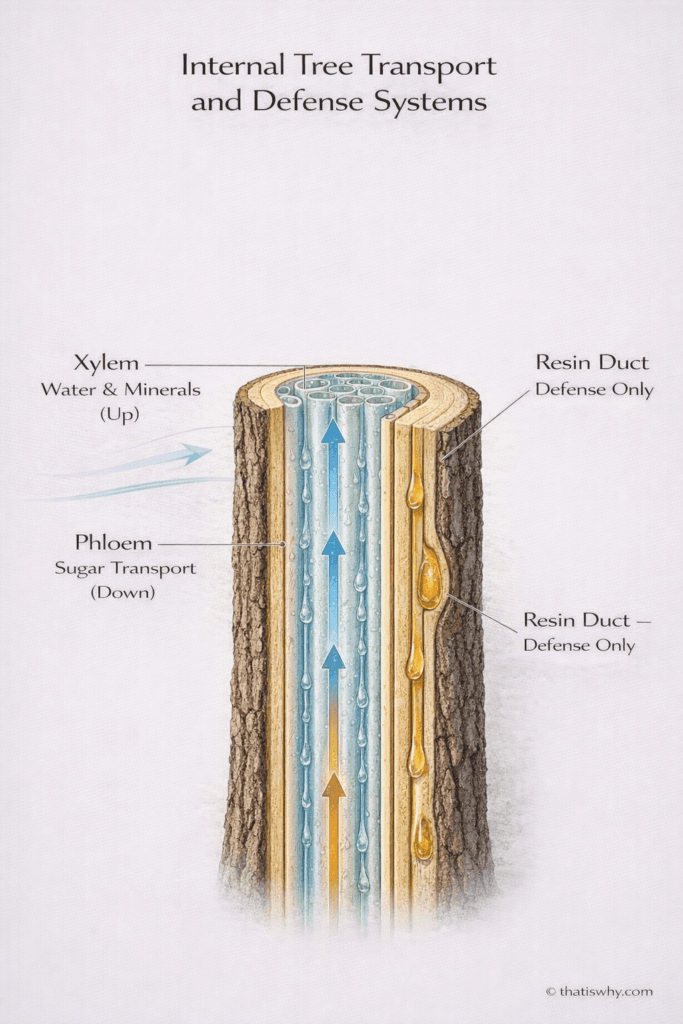
To clearly distinguish between the vascular transport of sap and the secretory ducts of resin, we consulted plant physiology texts focusing on gymnosperm defense mechanisms. We also verified the Freezing Point Depression physics to ensure the “antifreeze” analogy was scientifically accurate regarding cryoprotection in plant cells.
We knew that just listing chemical compounds wasn’t helpful. Our real job began when we asked, “What does this feel like?” That question led us to the “Two-Lane Highway” analogy to explain the plumbing, and the “Road Salt” comparison to make the physics of antifreeze feel intuitive.