Why There Are No Insects in the Ocean
The Invisible Wall
Stand on the shoreline of any beach in the world, and you are standing on one of the strangest borders in nature.
Turn around and look at the dunes behind you. The sand is alive—flies buzzing, ants marching, beetles scurrying under driftwood. Insects are the undisputed rulers of the land, making up nearly 80% of all animal life on Earth. They are everywhere.
Now turn back toward the waves. You’ll see fish, crabs, maybe a dolphin—but you will never see a fly swimming beside a tuna or a bee diving into a coral reef. Insects cannot survive in the ocean because their air-filled bodies collapse under water pressure, their exoskeleton chemistry fails underwater, and marine ecosystems are already dominated by crustaceans built for life at depth.
For a biologist, this is maddening. Insects are the ultimate survivors. They’ve conquered scorching deserts, frozen tundras, and humid jungles. Yet, the moment they hit the saltwater line, they stop dead. It’s as if there’s an invisible force field keeping them out.
For years, I assumed it was just the salt. That seems like the obvious answer, right? But a breakthrough study in 2023 revealed that the real reason is far more fundamental. To see it, we have to stop looking at insects as animals, and start looking at them as engineering.
The Drone vs. The Submarine
Insects and crustaceans are basically cousins. They are both Arthropods, sharing the same family tree. But somewhere down the line, they committed to two opposite design philosophies.
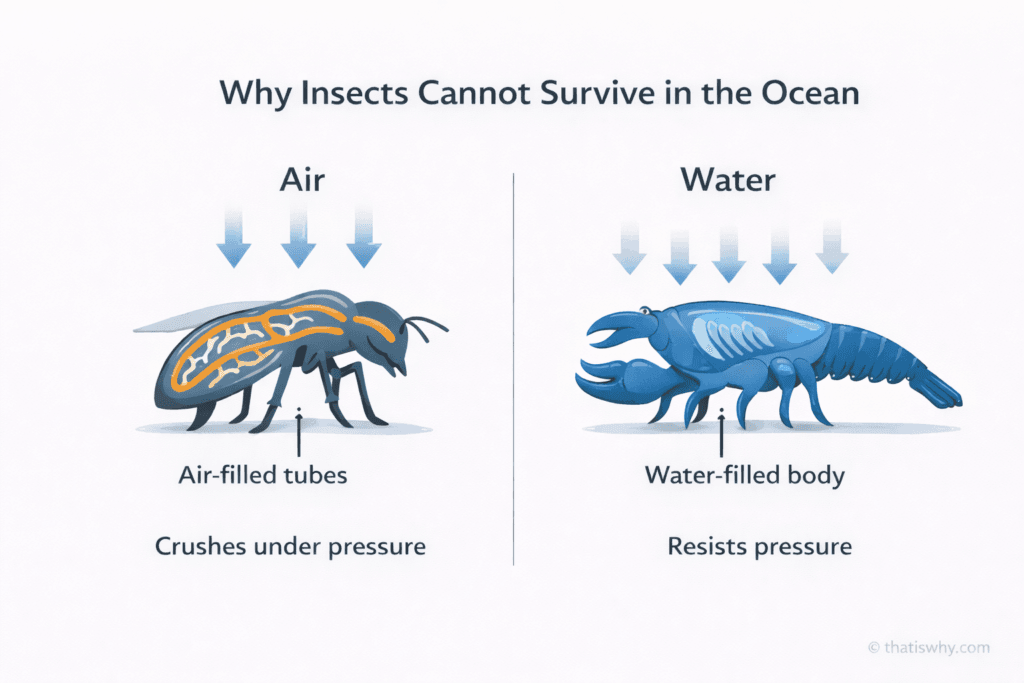
Think of an insect as a high-performance Drone. Look at a fly. It’s a marvel of aerodynamics—incredibly lightweight, twitchy, and built for speed. Every microgram of its body is designed to exploit the air.
Now, look at a lobster. It’s a Submarine. It’s a tank. It’s dense, heavily armored, and built to withstand crushing pressure. It doesn’t care about being light; it cares about being indestructible.
The issue is that you can’t just waterproof a drone and expect it to work as a submarine.
This same mismatch between air-based and water-based physics is one of the core reasons the deep ocean operates under a completely different set of rules, as explored in our guide on Why the Ocean Is an Alien World.
If you toss a high-end drone into the Atlantic, you don’t get an underwater explorer. You get a wreck. The pressure snaps its lightweight frame, and its air-intake systems choke instantly.
That is exactly what happens to insects. Evolution spent millions of years stripping away their heavy armor to make them the masters of the air. Returning to the ocean isn’t just a matter of holding their breath; it would require them to un-invent everything that makes them insects.
The Triple Lock
So, let’s drop our “Insect Drone” into the Pacific and see what actually breaks. It turns out, the failure happens in a cascade.
First, the frame crushes.
Remember, a drone is built to be light, which means it’s mostly hollow. Insects are the same; they don’t have lungs. They run on a Tracheal System—a massive network of empty, air-filled tubes running through their bodies. On land, this is a brilliant, lightweight cooling system. But underwater, it’s a structural liability.
Because those tubes are hollow, they are compressible. The deeper our insect dives, the more the water pressure squeezes those tubes shut—like crushing an empty soda can. A “Submarine” (Crustacean) doesn’t have this problem because it uses gills and solid fluids to push back against the pressure. The insect’s frame simply buckles under the weight of the water.
Then, the armor fails.
This is the part that blows my mind. It’s the “smoking gun” scientists at Tokyo Metropolitan University only found in 2023. Insects need to harden their shells to protect their soft guts, and they do this using a specific enzyme called MCO2. Think of it like high-end industrial epoxy: you apply the glue, expose it to the air, and it snaps hard into a suit of armor.
But here is the glitch: The MCO2 “glue” only works with oxygen from the air. Since the ocean holds about 30 times less oxygen, the chemical reaction stalls. The “glue” never cures. The drone’s armor stays soft, rubbery, and useless—like trying to build a tank out of wet cardboard.
Finally, the enemy fleet arrives.
Even if you could reinforce the drone’s frame and invent a new glue for its armor, you face a brutal reality: The ocean is already a war zone.
Crustaceans—crabs, shrimp, krill—are the “Submarines” of this world. They occupy the exact same jobs: scavengers, grazers, and hunters. If an insect tried to invade the ocean today, it wouldn’t be entering empty territory. It would be flying a fragile, soft-shelled drone directly into a fleet of armored submarines that have had 500 million years to master the terrain. It wouldn’t stand a chance.
The First Mover Advantage
This leads us to a massive realization about how life actually works. Biologists call it Niche Entrenchment, but you can just think of it as the “First Mover Advantage.”
Evolution is often described as a war, but it’s actually more like a game of musical chairs.
When the oceans were first forming hundreds of millions of years ago, the “Submarines” (Crustaceans) sat down in all the best chairs. They took the scavenger chair, the predator chair, and the filter-feeder chair. They evolved perfectly to fit those spots.
By the time insects evolved on land and looked back at the water, the game was already over. The chairs were full.
Nature is ruthlessly efficient. It rarely wastes energy trying to reinvent the wheel. For an insect to survive in the ocean, it would have to evolve gills, heavy armor, and calcium-based shells from scratch. That is a massive energy cost. And why bother paying it when the ocean is already full of animals that do those things perfectly?
Basically, insects didn’t lose the battle for the ocean. They just arrived too late to the party.
The Ripple Effect
The fascinating thing about “Niche Entrenchment” is that it doesn’t stop at the waterline. The same rule that keeps bugs out of the ocean dictates winners and losers in completely different worlds.
The “Google” Effect Look at the tech industry. Why is it nearly impossible for a new search engine to displace Google? It’s the exact same dynamic. Google is the “Crustacean” of search. It got there first, it adapted perfectly, and it filled every corner of the market. Any new “insect” startup isn’t just fighting for users; it’s fighting against an incumbent that has effectively become the environment.
The Pine Forest Paradox You can even see it on a hike. Walk into a dense pine forest and look down. The ground is almost completely bare—no grass, no weeds, just pine needles. The pine trees didn’t just grow there; they entrenched themselves. They locked up the sunlight and acidified the soil to suit their own roots. Like the crustaceans in the ocean, they created a fortress that makes it physically impossible for “invaders” to move in.
Clearing the Air
Now that we’ve cracked the main mystery, we have to address the two biggest questions that always come up. One is a myth we need to bust, and the other is a rebel we need to meet.
The Myth: “It’s just the salt, right?” If you ask most people why insects hate the ocean, they’ll say, “Saltwater kills them.” It sounds logical. We know salt dries things out. But here is the kicker: That is completely wrong. Insects are actually surprisingly tough. There are “Brine Flies” (Ephydridae) that live in inland salt lakes—like the Great Salt Lake in Utah—which are nearly ten times saltier than the ocean. If salt were the only barrier, the ocean would be swarming with flies. The problem isn’t the salt; it’s the deep water itself.
The Rebel: The Sea Skater (Halobates) “But wait,” I can hear you asking, “aren’t there some bugs in the sea?” Yes. There is exactly one group that broke the rule: the Sea Skaters. These guys are the exceptions that prove the rule. They spend their entire lives on the open ocean, hundreds of miles from land.
But how do they survive the “Triple Lock” we just talked about? They cheat. Sea Skaters never actually go underwater. They have microscopic hairs on their legs that trap tiny bubbles of air, making them so water-repellent that they can stand on the surface tension. They don’t dive, they don’t swim, and they never submerge. They are the surfers of the insect world—conquering the ocean by refusing to go under it.
The Full Circle
So, why are there no insects in the ocean?
It’s not because they failed. It’s because they chose a different path.
The boundary between the land and the sea isn’t just a physical line; it’s a genetic border between two incompatible engineering masterpieces. Evolution had to make a choice: do you want to fly, or do you want to dive? Do you want to be light as a feather, or tough as a tank?
On one side of the beach, you have the “Drones”—the insects, masters of the air, built for speed. On the other side, you have the “Submarines”—the crustaceans, masters of the deep, built for power.
Nature didn’t forget to put insects in the ocean. It simply didn’t need to. It already had a perfect machine for that environment. The ocean isn’t empty; it’s just ruled by a different kind of king. And honestly? I think that elegance is even cooler than the mystery we started with.
How We Researched This
To answer this question, we didn’t just rely on old textbooks. We went straight to the cutting edge, analyzing the breakthrough 2023 study from Tokyo Metropolitan University (Asano et al.) which finally identified the MCO2 gene—the missing puzzle piece scientists had been hunting for.
But we knew that just citing a dense academic paper isn’t helpful. Our real job began when we asked, “What does this actually feel like?” That question led us to the “Drone vs. Submarine” analogy—a simple story to make the complex evolutionary mechanics feel intuitive.