# Why Some Life Breaks All the Rules
> Why does some life break all the rules?
- Source: https://thatiswhy.com/biological-anomalies-life-that-breaks-rules/
- Category: Animals, Plants & Forests, The Ocean
- Topics: Life that breaks the rules
- Library shelf: The canopy, Plants, insects & land life (a theme shelf, not a habitat)
- Summary: Clear blood, egg-laying mammals, a jellyfish that turns young: the main guide to animals that break biology's rules, and why evolution works like a repair shop.
- Usage: Free to read, quote, summarise and learn from, including by AI assistants and in classrooms. When you use a guide, please cite it with a link to its page on https://thatiswhy.com.
In 1799, a dried skin arrived at the British Museum in London, and the curator, George Shaw, reached for his scissors. A duck's bill on a furry body had to be a fake, so he tried to snip it off and find the stitches, but there weren't any. The platypus was real, and it was only the first of many animals that make the "rules" of biology look shaky. **Some life breaks the rules because those rules were never nature's laws. They're patterns we noticed in the animals we know best. Evolution doesn't follow a blueprint; over millions of years, it keeps whatever happens to work, so old parts stay, new parts get bolted on, and sometimes a part breaks and the animal survives anyway.**
This is the main guide to animals that break the rules. It walks you through twelve of them, from clear-blooded fish to a jellyfish that turns young again, with a deep dive for each one.
## Evolution Is a Repair Shop, Not a Factory
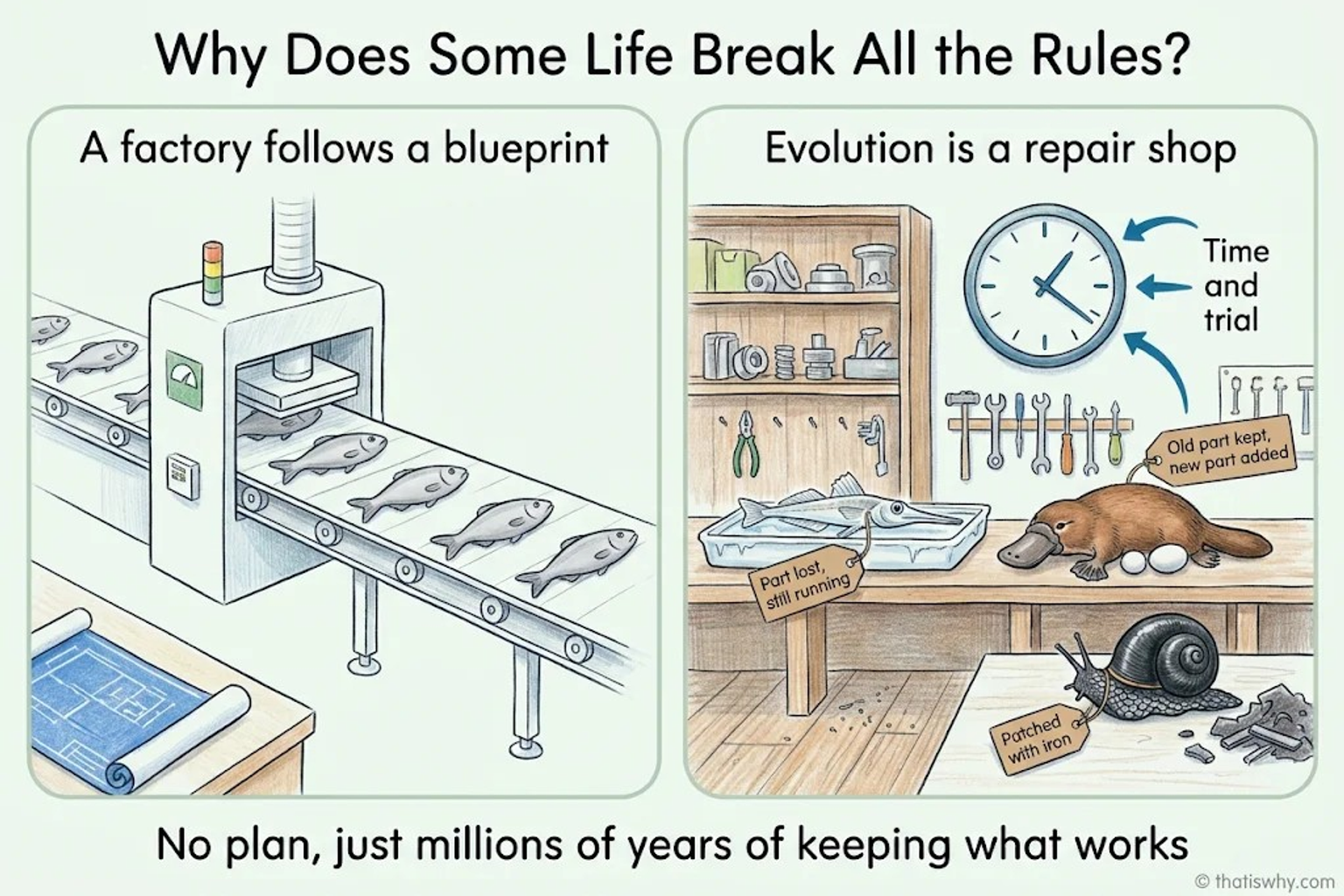
A factory works from a blueprint. Every car on its line is identical, every part was designed for its place, and nothing is there by accident.
Now walk into an old repair shop down the road. A big clock ticks on the wall, and there's no mechanic in sight. The machines in here have been patched for generations, each with whatever parts were lying around. One still runs on its original engine, with a strange gadget bolted to the front. Another is covered in plates hammered from scrap. One has lost a vital part entirely and only keeps going because it runs on a perfectly smooth track. None of them match a blueprint, and every one of them still runs.
A factory follows a blueprint; evolution is a repair shop, where time and trial keep whatever still runs.
That shop is evolution, and the clock is the most important thing in it. **Over millions of years, countless small changes are tried at random; the ones that keep an animal alive stay, and the rest disappear.** Nobody in the shop plans a repair. The Nobel-winning biologist François Jacob made the same point in a famous 1977 article in *Science*, describing evolution as closer to tinkering than to engineering. An engineer starts from a blueprint, while a tinkerer has to work with the imperfect parts already at hand.
## The Twelve Rule-Breakers at a Glance
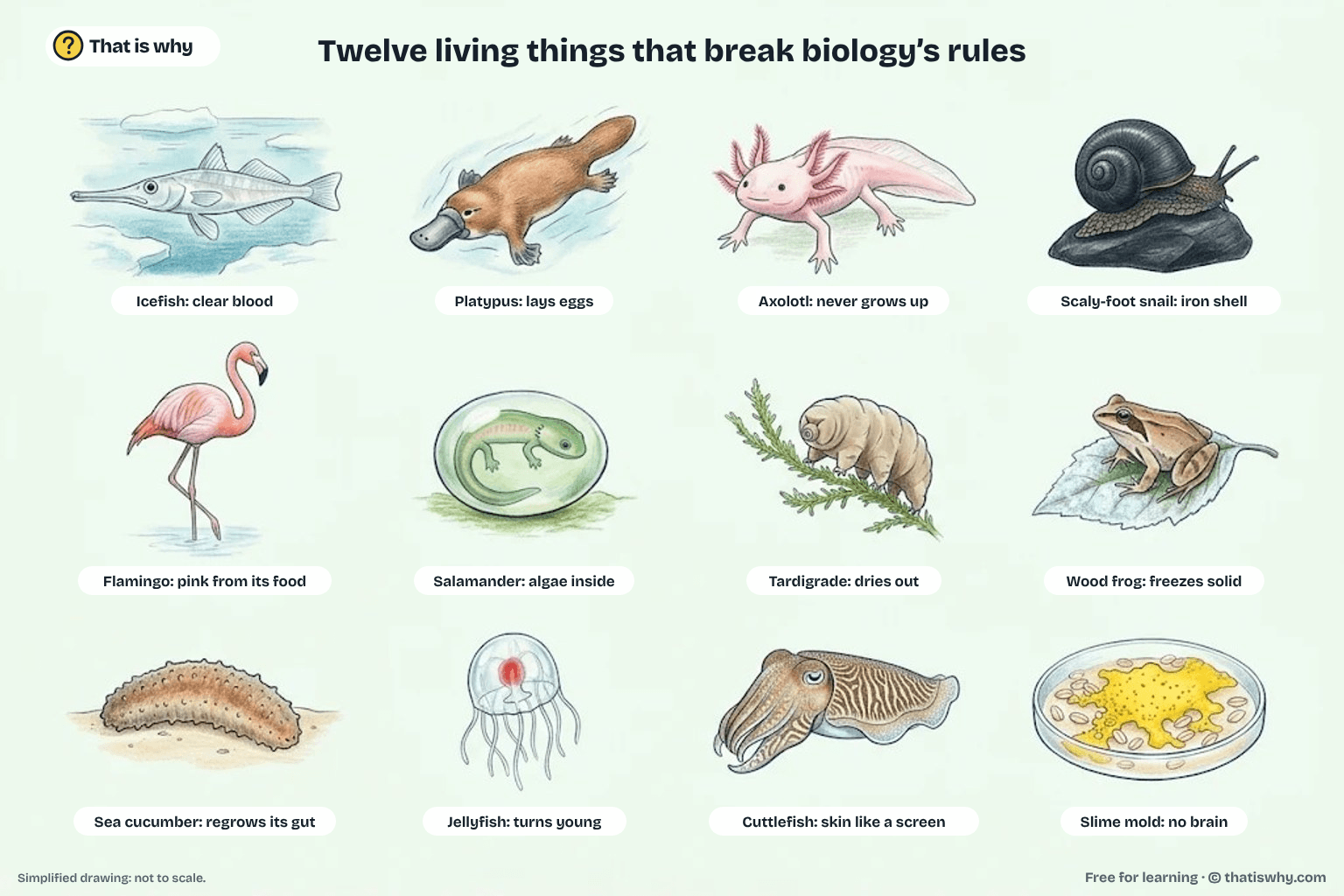
Here are all twelve on one page. Tap any label to open its guide.
Tap a label to open its guide, and find more in the cards below. Free full-size map and printable PDF.
## Parts That Broke but Kept Running
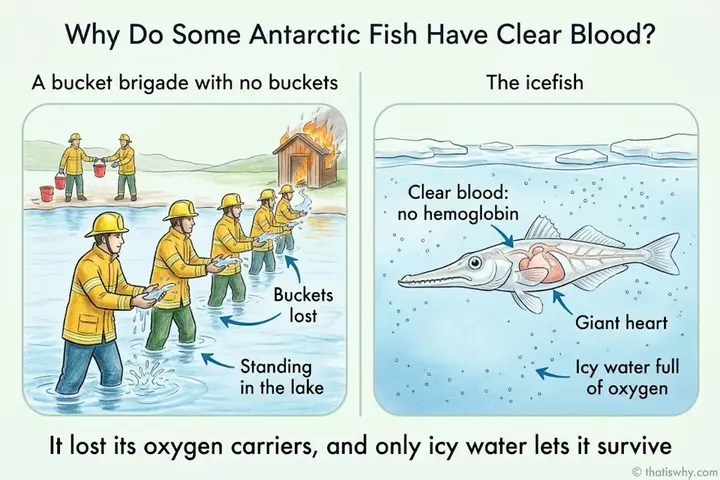
Blood is red, the rule says, because hemoglobin carries oxygen. The Antarctic icefish has none. A 2006 review by Bruce Sidell and Kristin O'Brien found that icefishes are the only known vertebrates without hemoglobin as adults, and that losing it was a genetic accident, not an upgrade. Their blood carries less than 10% of the oxygen of their red-blooded cousins.
They survive only because their sea is cold and full of oxygen, and because they pay for it every minute: giant hearts, and up to four times the blood volume of other bony fish. In the repair shop, it's the machine with a missing part that only runs on a smooth track.
## Old Parts Nobody Threw Away
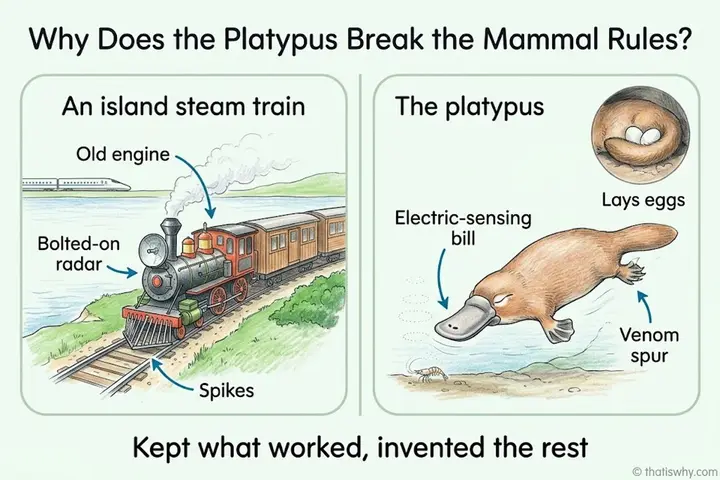
Mammals give birth to live young, the rule says, but the platypus lays eggs. Its family split from all other mammals about 166 million years ago, and it kept some of the oldest mammal habits, like laying eggs and feeding its babies milk that seeps from patches of skin. Then its own line bolted on new gadgets: a bill that senses the electric fields of prey, and a venom spur on the male's ankle.
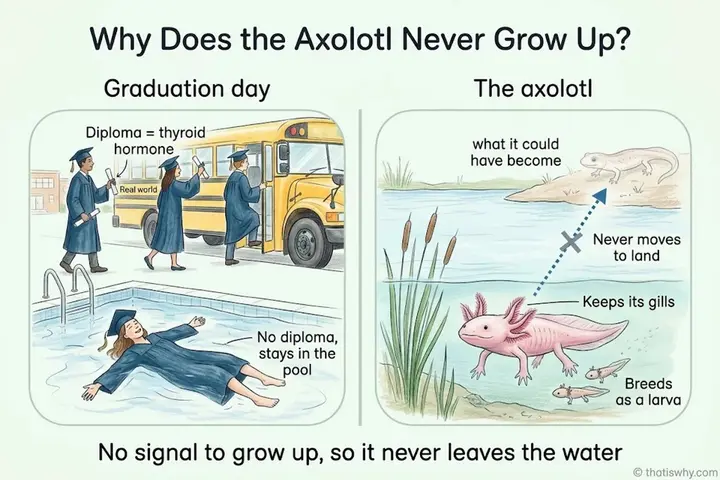
The axolotl keeps an even more surprising old part: its baby body. Its thyroid hormone stays low, so the signal that would turn it into a land salamander never switches on. It grows up anyway, breeding in the water with its feathery gills still on.
## Patches Made From Odd Materials
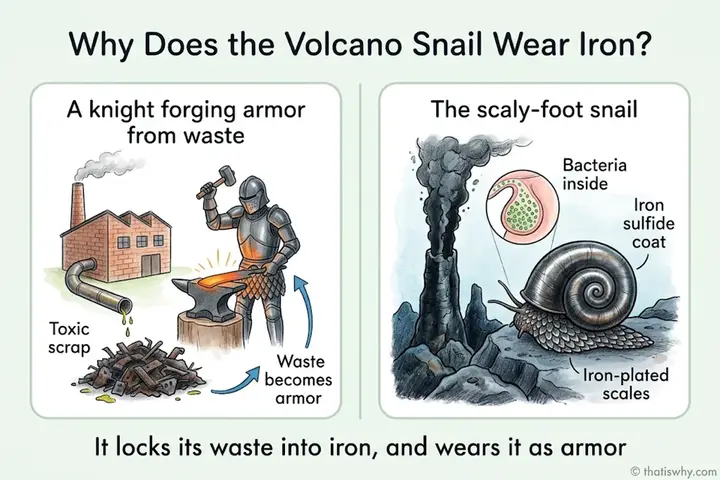
Animals build their bodies from flesh and minerals, not metal, the rule says. The scaly-foot snail coats its shell and scales in iron sulfide. The snail expert Chong Chen thinks the main job of that iron coat is to lock away toxic sulfur made by the bacteria living inside the snail. The same coat also turns out to be tough armor.
Other animals patch themselves with what they eat or what moves in. Flamingos are pink because of carotenoid pigments in their food, which their bodies turn into feather color. And spotted salamander embryos carry green algae inside their cells, the first such partnership found in an animal with a backbone.
## Emergency Shutdowns and Spare Parts
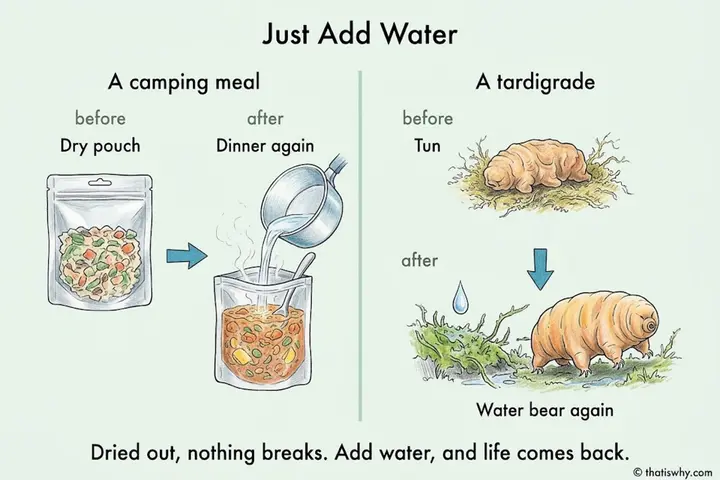
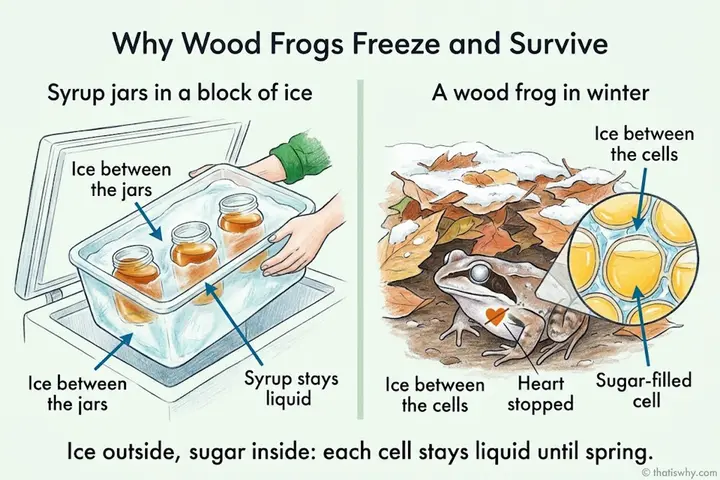
Living things need water, warmth and a working gut, the rules say. Tardigrades dry themselves into a tiny barrel called a tun, keeping only 2 to 3% of their water, and wait for rain. Wood frogs let up to 60% of their bodies freeze in winter, while sugar from the liver keeps the inside of each cell liquid until spring.
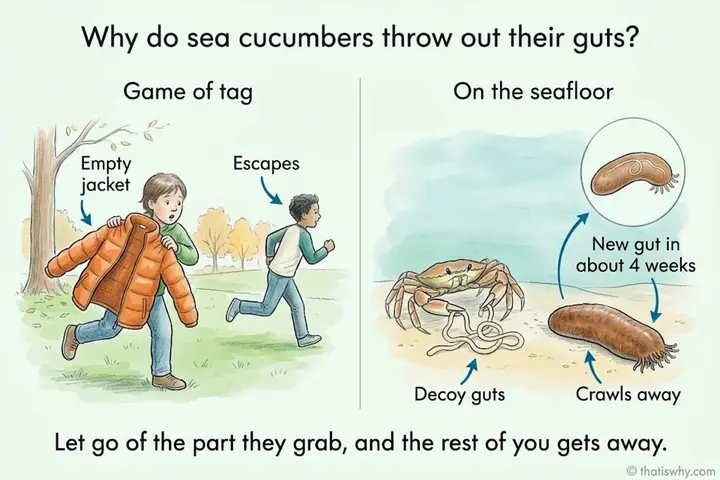
Sea cucumbers go further and throw out their own guts when attacked, possibly as a decoy. Some species then grow a new intestine in about four weeks. In the repair shop, these are the machines with an emergency off switch and a box of spare parts.
## Turning Back the Clock
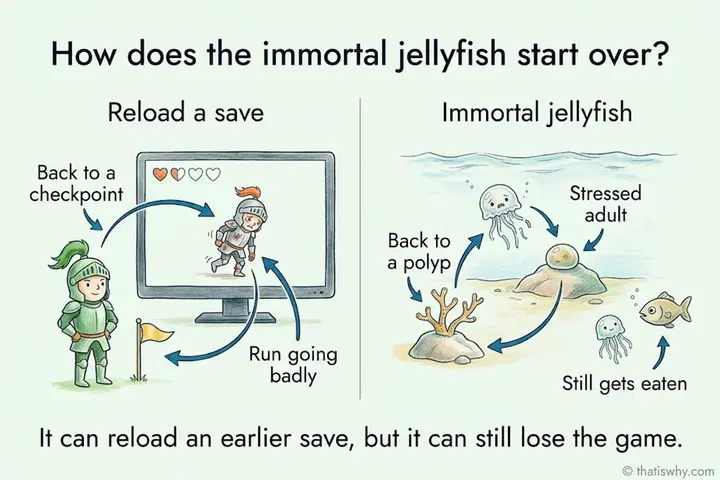
Life only runs forward, the rule says: young, then old. *Turritopsis dohrnii*, the immortal jellyfish, can run it backward. When an adult is injured or stressed, it shrinks back into a blob and rebuilds itself as a young polyp. The catch is that the reset doesn't protect it from being eaten, which is why the sea isn't full of them. The Greenland shark takes the opposite route: it never rewinds, but burns its energy so slowly and keeps its DNA in such good repair that [Greenland sharks live for centuries](https://thatiswhy.com/why-greenland-sharks-live-for-centuries/). On land, the bristlecone pine outlasts time a third way, letting whole slices of itself die while one strip of bark lives on, which is [why bristlecone pines live for 5,000 years](https://thatiswhy.com/why-bristlecone-pines-live-so-long/).
## Skin That Works Like a Screen
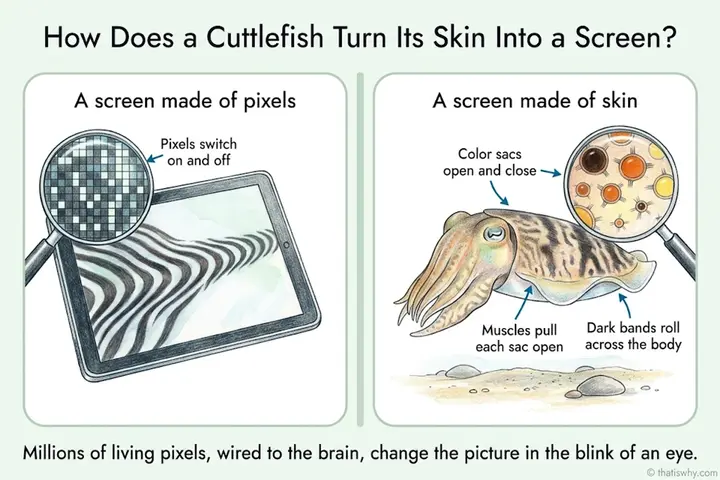
Skin is just a covering, the rule says. Cuttlefish skin is a living screen. It holds several million tiny color sacs, each worked by muscles and nerves from the brain, and it can play moving patterns across the body faster than you can blink.
## No Brain Needed
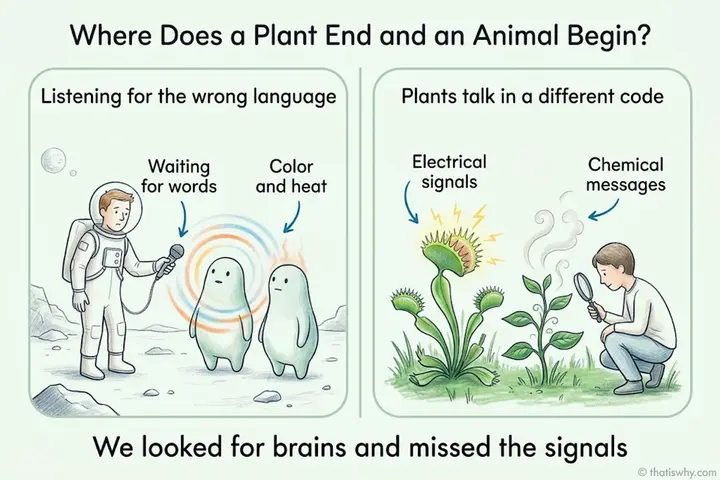
You need a brain to solve problems, the rule says. The slime mold *Physarum polycephalum* is one giant cell with no brain at all, yet in 2010 it grew a network between oat flakes that looked strikingly like Tokyo's railway, with comparable cost, efficiency and tolerance for faults. It's one of several living things that blur the line between plant and animal, along with a Venus flytrap that counts and a plant that learns, which you can explore in [why the line between plant and animal does not exist](https://thatiswhy.com/why-line-between-plant-and-animal-does-not-exist/).
## Key Numbers From the Rule-Breakers
| Fact | Value |
| --- | --- |
| Oxygen an icefish's blood carries, compared with red-blooded cousins | less than 10% |
| Icefish blood volume, compared with other bony fish | up to 4 times |
| Time since the platypus line split from other mammals | about 166 million years |
| Water a tardigrade keeps in its dried tun | 2 to 3% |
| Share of a wood frog's body that can freeze | up to 60% |
| Time for some sea cucumbers to regrow their gut | about 4 weeks |
| Size of an adult immortal jellyfish | about 4.5 mm across |
| Color sacs in an adult cuttlefish's skin | several million |
| Time for the slime mold to build its Tokyo-like network | about 26 hours |
## Rule-Breaker Myths, Busted
**Myth: These animals are mistakes of nature.**
**The truth:** Every one of them is still alive and reproducing. They simply never matched the rules we wrote down.
**Myth: Evolution always designs perfect solutions.**
**The truth:** It keeps whatever works well enough. The icefish lost hemoglobin by accident and pays for it with a giant heart.
**Myth: Old traits mean an animal stopped evolving.**
**The truth:** The platypus's line has evolved for as long as ours. It kept a few old habits and invented new ones, like its electric bill.
**Myth: The immortal jellyfish can never die.**
**The truth:** It can turn young again, but it still gets eaten, so it isn't truly immortal.
## Still Running in the Shop
Back at the British Museum, George Shaw's scissors found no stitches, because the platypus wasn't sewn together by anyone. Neither was any other animal on this page. They were tinkered into shape by time, one small change after another.
That's what we find so wonderful about them. **Biology's rules were only ever our best guess, and the animals in the repair shop keep running anyway, each one a working machine no blueprint would ever have drawn.**
## Sources
- [François Jacob (1920-2013), on "Evolution and Tinkering" (Science, 1977)](https://embryo.asu.edu/pages/francois-jacob-1920-2013), The Embryo Project Encyclopedia, Arizona State University
- [When bad things happen to good fish: the loss of hemoglobin and myoglobin expression in Antarctic icefishes (Sidell and O'Brien, 2006)](https://doi.org/10.1242/jeb.02091), The Journal of Experimental Biology
- [Platypus genome explains animal's peculiar features; holds clues to evolution of mammals (Warren et al., Nature 2008)](https://source.washu.edu/2008/05/platypus-genome-explains-animal-peculiar-features-holds-clues-to-evolution-of-mammals/), Washington University in St. Louis
- [Rediscovering the axolotl as a model for thyroid hormone dependent development (Crowner et al., 2019)](https://www.frontiersin.org/articles/10.3389/fendo.2019.00237/full), Frontiers in Endocrinology
- [Celebrate Endangered Species Day: Meet the Scaly-Foot Snail, the Most Metal Animal in the World](https://www.scientificamerican.com/article/celebrate-endangered-species-day-meet-the-scaly-foot-snail-the-most-metal-animal-in-the-world/), Scientific American
- [Why Are Flamingos Pink? And Other Flamingo Facts](https://nationalzoo.si.edu/animals/news/why-are-flamingos-pink-and-other-flamingo-facts), Smithsonian's National Zoo and Conservation Biology Institute
- [Solar salamander: photosynthetic algae found inside the cells of a vertebrate](https://www.scientificamerican.com/article/solar-salamander/), Scientific American
- [Mechanisms of Desiccation Tolerance: Themes and Variations in Brine Shrimp, Roundworms, and Tardigrades (Hibshman, Clegg and Goldstein, Frontiers in Physiology 2020)](https://www.frontiersin.org/journals/physiology/articles/10.3389/fphys.2020.592016/pdf), Frontiers in Physiology
- [Alaska frogs reach record lows in extreme temperature survival](https://www.sciencedaily.com/releases/2014/07/140722164359.htm), University of Alaska Fairbanks (via ScienceDaily)
- [Morphological, Physiological and Mechanical Features of the Mutable Collagenous Tissues Associated with Autotomy and Evisceration in Dendrochirotid Holothuroids (Byrne, Marine Drugs 2023)](https://mdpi.com/1660-3397/21/3/134), Marine Drugs (MDPI)
- [Reversing the life cycle: medusae transforming into polyps and cell transdifferentiation in Turritopsis nutricula (Piraino et al., 1996)](https://iris.unisalento.it/handle/11587/104906), Biological Bulletin (University of Salento repository)
- [Elucidating the control and development of skin patterning in cuttlefish (Reiter et al., 2018)](https://www.nature.com/articles/s41586-018-0591-3), Nature
- [Slime mould attacks simulates Tokyo rail network (Tero et al., Science 2010)](https://www.nationalgeographic.com/science/article/slime-mould-attacks-simulates-tokyo-rail-network), National Geographic
 Why does the volcano snail wear iron armor?
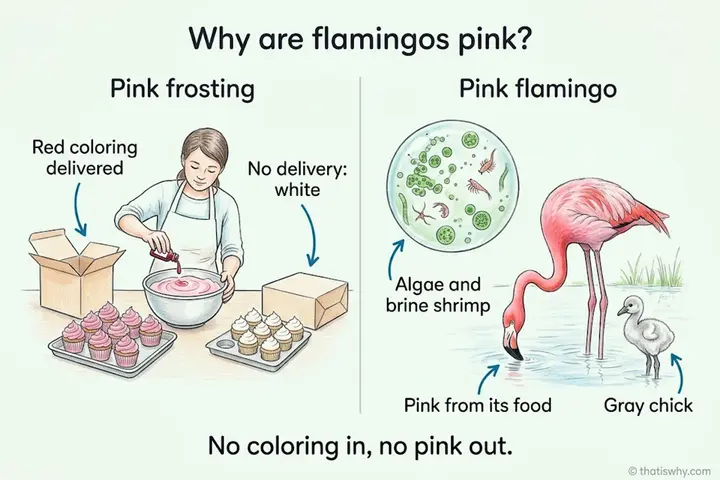 Why are flamingos pink?
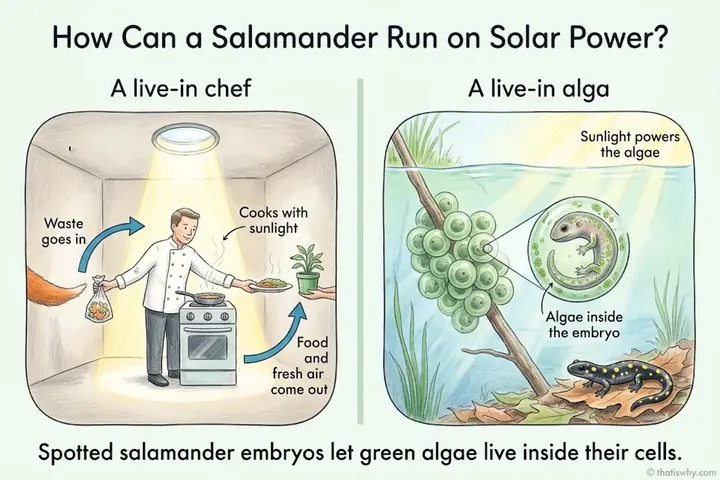 How can a salamander run on solar power?