Free teaching diagram
Zombie Snail Diagram: The Parasite Life Cycle
The parasite's loop: a bird tears out a brood sac, eggs leave in its droppings, a snail eats them, and new brood sacs pulse in the snail's eye stalks.
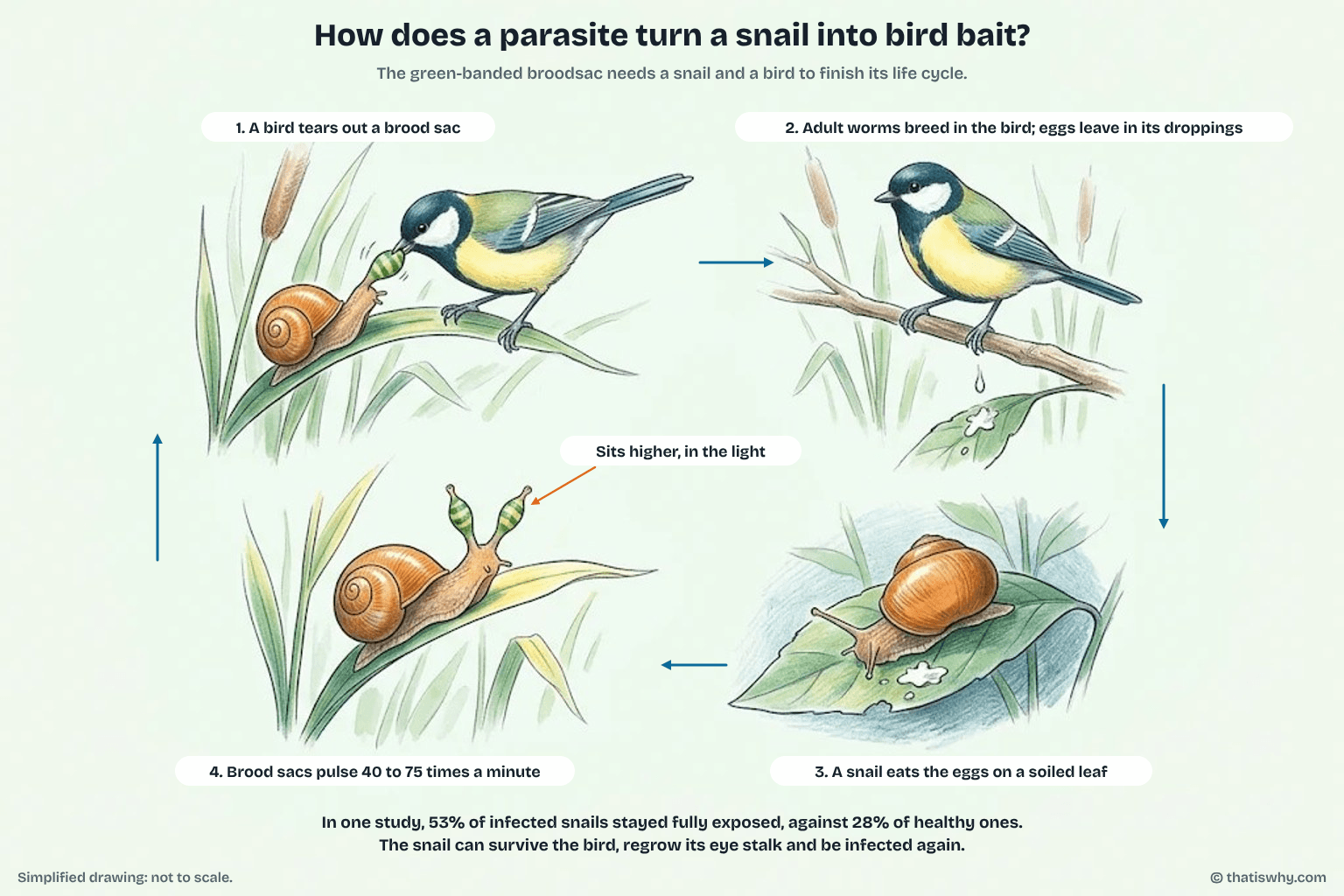
The detailed teaching diagram
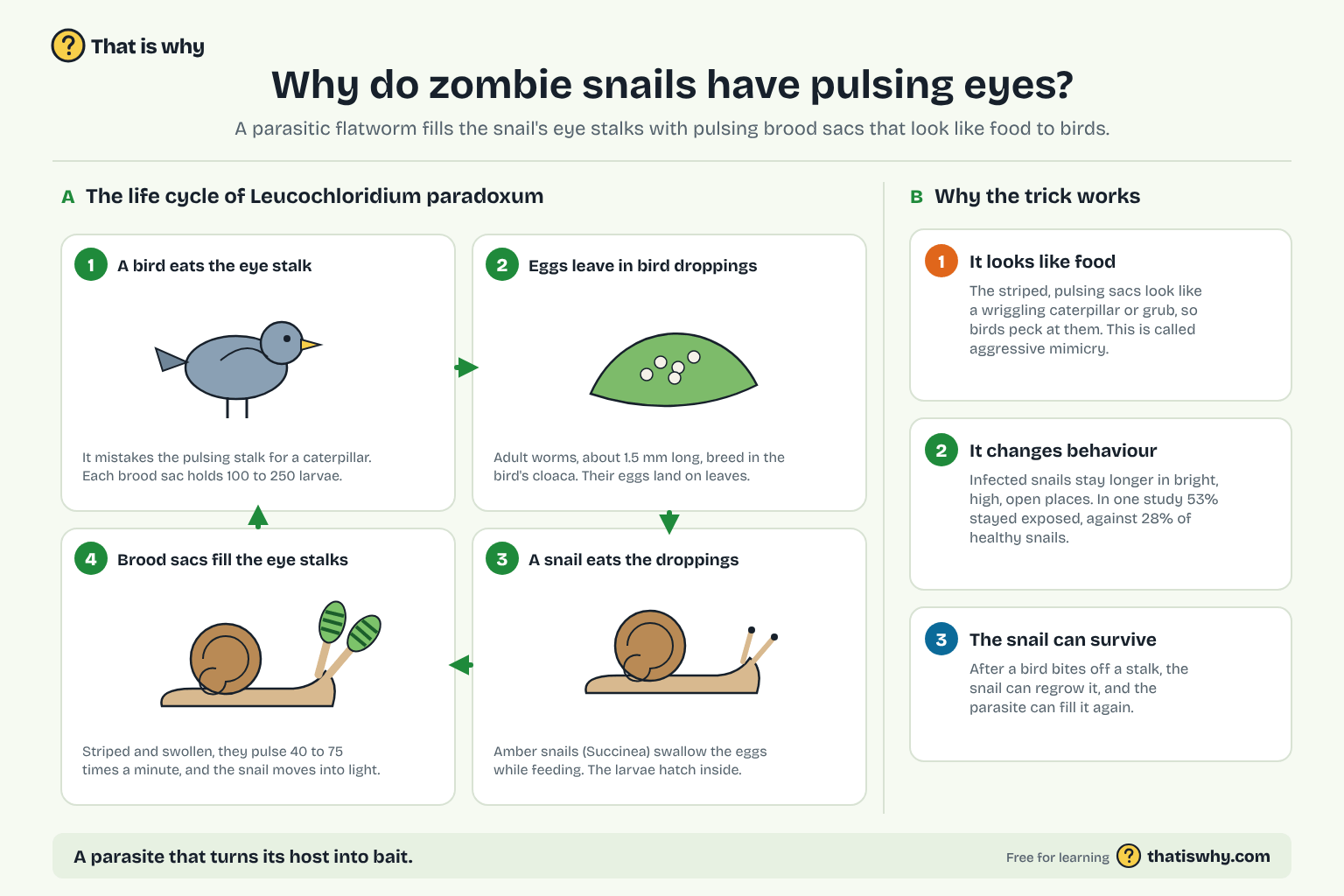
What the diagram shows
The parasitic flatworm Leucochloridium paradoxum needs two hosts, and the diagram follows its life cycle in four steps.
- A bird eats the eye stalk. The bird mistakes the snail's swollen, pulsing eye stalk for a caterpillar and pecks it off. Each brood sac inside holds 100 to 250 larvae.
- Eggs leave in bird droppings. In the bird, the larvae become adult worms only about 1.5 mm long, which live and breed in the bird's cloaca. Their eggs leave the bird in its droppings and land on leaves.
- A snail eats the droppings. Amber snails (Succinea) swallow the eggs while feeding. The larvae hatch inside the snail and grow into a branching sporocyst.
- Brood sacs fill the eye stalks. The sporocyst pushes swollen, green-and-yellow banded brood sacs into the snail's eye stalks. They pulse about 40 to 75 times a minute, depending on the temperature, and stop in the dark.
Why the trick works. The pulsing, striped sacs look like a wriggling caterpillar, a classic case of aggressive mimicry. The parasite also changes the snail's behavior: infected snails spend more time in brighter, higher and more exposed places. In one study, 53% of infected snails stayed fully exposed over 45 minutes, against 28% of healthy ones. After losing a stalk, the snail can regrow it, and the parasite can fill it again.
Key numbers
| Fact | Value |
|---|---|
| Larvae per brood sac | 100 to 250 |
| Pulses per minute | about 40 to 75, depending on temperature |
| Adult worm length | about 1.5 mm |
| Snails staying fully exposed (one study) | 53% infected vs 28% healthy |
Common misconceptions
Myth The bird eats the whole snail.
The truth In captivity, birds tore out the swollen brood sac rather than eating the whole snail. The snail can survive and regrow its eye stalk.
Myth The snail's eyes are glowing.
The truth They are not glowing. The parasite's brood sacs are brightly banded in green and yellow, and they pulse, which makes them look like a moving caterpillar.
Myth Scientists have watched many wild birds attack zombie snails.
The truth Surprisingly, a 2013 review found no study documenting wild songbirds attacking snails with brood sacs. Most of that evidence comes from captive birds.
Questions to use in class
Tap a question to reveal a model answer.
1Why does the parasite need both a snail and a bird?
It can only become an adult and breed inside a bird (the definitive host), but it develops its larvae inside a snail (the intermediate host). It needs to pass from one to the other to complete its life cycle.
2How do the parasite's eggs get into a snail?
The eggs leave the bird in its droppings, which land on leaves. A snail feeding on those leaves swallows the eggs.
3Why might making the snail move into bright, open places help the parasite?
Birds hunt by sight. A snail sitting in the open, with pulsing, striped eye stalks, is much more likely to be spotted and pecked.
4What is aggressive mimicry? Give this example.
When something copies an attractive signal to lure another animal. The parasite's brood sacs look like caterpillars, so birds treat them as food.
Key terms
- Brood sac
- A swollen, often brightly banded tube made by the parasite Leucochloridium inside a snail's eye stalk. Each one holds 100 to 250 larvae.
- Sporocyst
- A stage in the life cycle of some parasitic flatworms that grows inside the host and produces many larvae. In zombie snails it branches out into the brood sacs.
- Intermediate host
- An animal a parasite lives in while it develops, but where it does not breed. For Leucochloridium, the snail is the intermediate host.
- Definitive host
- The animal in which a parasite becomes an adult and breeds. For Leucochloridium, the definitive host is a bird.
- Aggressive mimicry
- When a predator or parasite copies something attractive, such as food, to lure another animal. Zombie snail brood sacs look like caterpillars to birds.
- Cloaca
- The single rear opening in birds, reptiles and amphibians used for waste and reproduction. Adult Leucochloridium worms live in a bird's cloaca.
Sources
- Crazy eyes and mind control: the power of parasites Smithsonian Science
- New study upholds reputation of classic parasite (Wesołowska and Wesołowski, Journal of Zoology) National Geographic
- Green-banded broodsac: The brain-hijacking parasite that creates disco zombie snails Live Science
- Leucochloridium paradoxum Wikipedia