Free teaching diagram
Woodpecker Diagram: Why Woodpeckers Don't Get Concussions
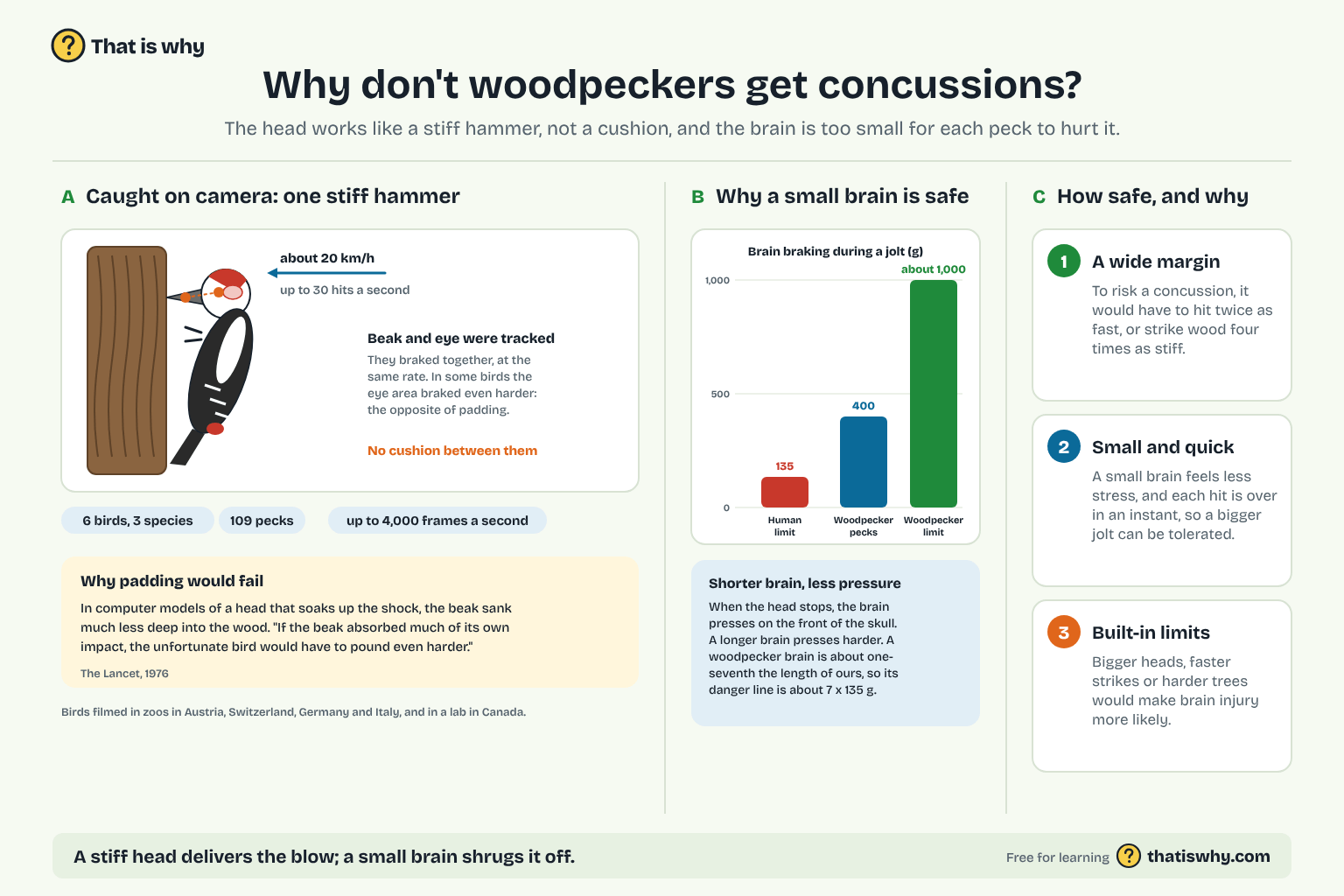
The woodpecker's head stops as one stiff piece, and its small brain keeps each peck well below its own danger line.
What the diagram shows
A. Caught on camera: one stiff hammer. A woodpecker strikes at about 20 km/h, and when it drums it can hit up to 30 times a second. Researchers filmed 6 birds from 3 species (black, pileated and great spotted woodpeckers) at up to 4,000 frames a second, in zoos in Austria, Switzerland, Germany and Italy and in a lab in Canada. Tracking the beak and the eye across 109 pecks, they found the two braked together at the same rate; in some birds the area around the eye braked even harder, the opposite of padding. Computer models of a head that soaks up the shock showed the beak would sink much less deep into the wood. As a 1976 paper in The Lancet put it: "If the beak absorbed much of its own impact, the unfortunate bird would have to pound even harder."
B. Why a small brain is safe. The woodpecker's brain brakes at up to 400 g (400 times the pull of gravity), while the estimated concussion line for a human brain is about 135 g. When the head stops, the brain presses on the front of the skull, and the pressure grows with how hard the head stops, how dense the brain is and how long the brain is in the direction of the hit. A woodpecker's brain is about one-seventh the length of ours, so its own danger line is about 7 × 135 g, or about 1,000 g.
C. How safe, and why. A woodpecker would risk a concussion only if it hit twice as fast or struck wood four times as stiff. A small brain feels less stress for the same jolt, and each impact is over in an instant, which raises the jolt a brain can tolerate. Bigger heads, faster strikes or harder trees would make brain injury more likely, which may set limits on woodpecker design.
Key numbers
| Fact | Value |
|---|---|
| Pecking speed | about 20 km/h |
| Drumming rate | up to 30 hits a second |
| Birds, species and pecks filmed | 6 birds, 3 species, 109 pecks |
| Fastest camera | up to 4,000 frames a second |
| Woodpecker brain braking | up to 400 g |
| Estimated human concussion line | about 135 g |
| Woodpecker brain length compared with ours | about one-seventh |
| Woodpecker danger line | about 1,000 g |
Common misconceptions
Myth The woodpecker's skull works as a shock absorber.
The truth High-speed video shows the beak and head stopping together as one stiff piece; padding would make the beak sink less deep into the wood.
Myth Woodpecker pecks are too gentle to cause a concussion.
The truth The brain brakes at up to 400 g, nearly three times the estimated human concussion line of 135 g. The bird is safe because its brain is small.
Myth A woodpecker could hammer at any speed safely.
The truth It would risk a concussion if it hit twice as fast, or struck wood four times as stiff.
Questions to use in class
Tap a question to reveal a model answer.
1How did scientists test the shock-absorber idea?
They filmed 6 woodpeckers from 3 species at up to 4,000 frames a second and tracked the beak and eye in 109 pecks. The two braked together, like one stiff piece.
2How hard does a woodpecker's brain brake?
Up to 400 g, about three times the estimated human concussion line of 135 g.
3Why does a small brain help?
When the head stops, the brain presses on the front of the skull, and a longer brain presses harder. A woodpecker brain is about one-seventh the length of ours, so its limit is about 1,000 g.
4Why not just have a padded head?
Padding would soak up the blow, so the beak would go less deep into the wood and the bird would have to pound even harder.
Key terms
- Concussion
- A brain injury caused when a sudden jolt makes the brain press against the inside of the skull. In people, it is estimated to start at a deceleration of about 135 g.
- G-force
- A way of measuring a speed-up or slowdown in multiples of the pull of gravity. A woodpecker's brain brakes at up to 400 g when its beak hits a tree.
- Spongy bone
- Light bone with an open, honeycomb-like inner structure. Woodpeckers have a zone of it at the front of the skull, long thought to be a shock absorber.
Sources
- Why woodpeckers don't get concussions (Van Wassenbergh and Mielke, Physics Today) Physics Today, American Institute of Physics
- Woodpeckers minimize cranial absorption of shocks (Van Wassenbergh et al., Current Biology 2022) University of Antwerp
- Woodpecker pecking: how woodpeckers avoid brain injury (Gibson, Journal of Zoology 2006) DSpace@MIT, Massachusetts Institute of Technology