Free teaching diagram
Tardigrade Diagram: Why Tardigrades Survive Almost Anything
A tardigrade dries into a tun, locks its cells in glass, shields its DNA and switches off, then waits for water.
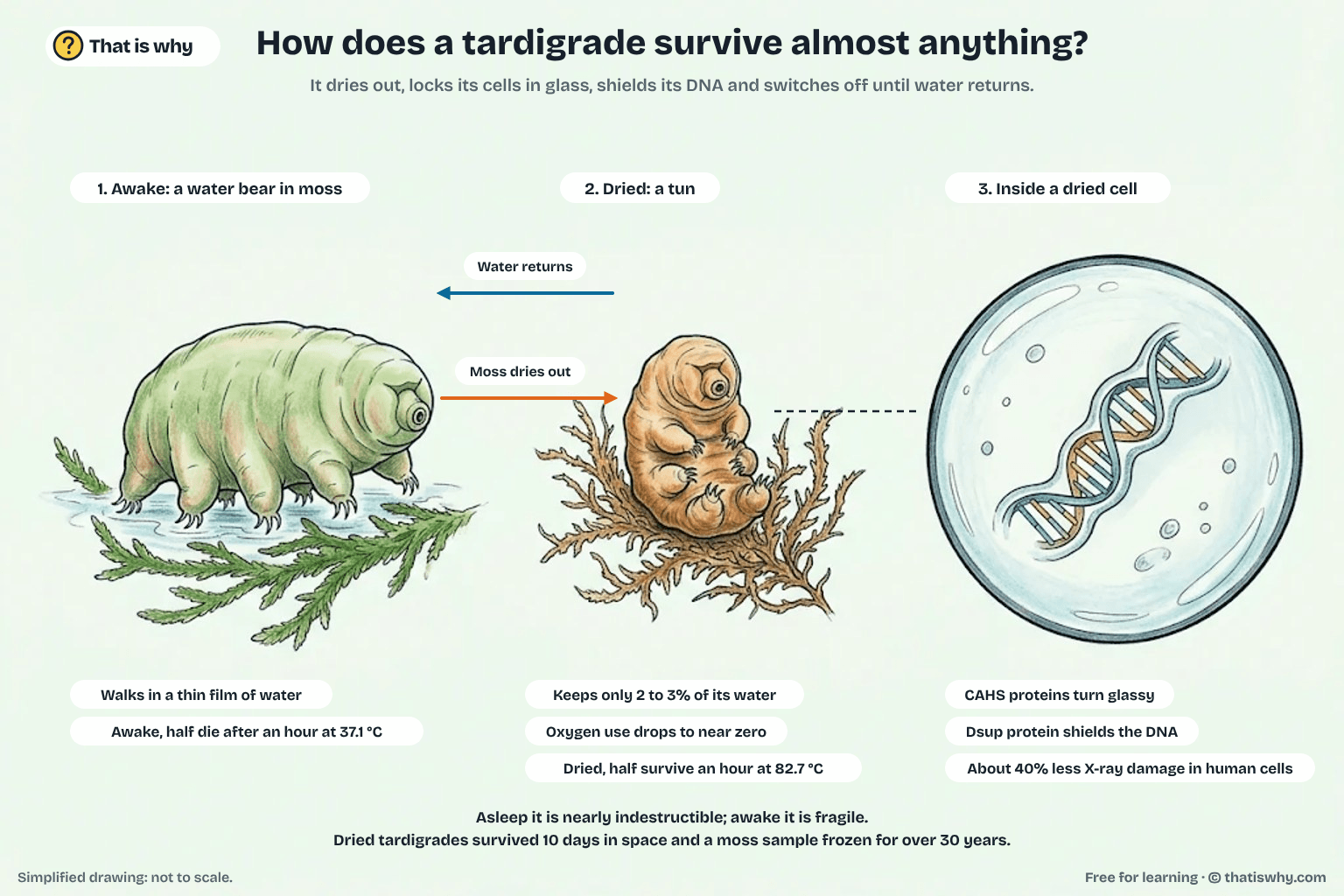
The detailed teaching diagram
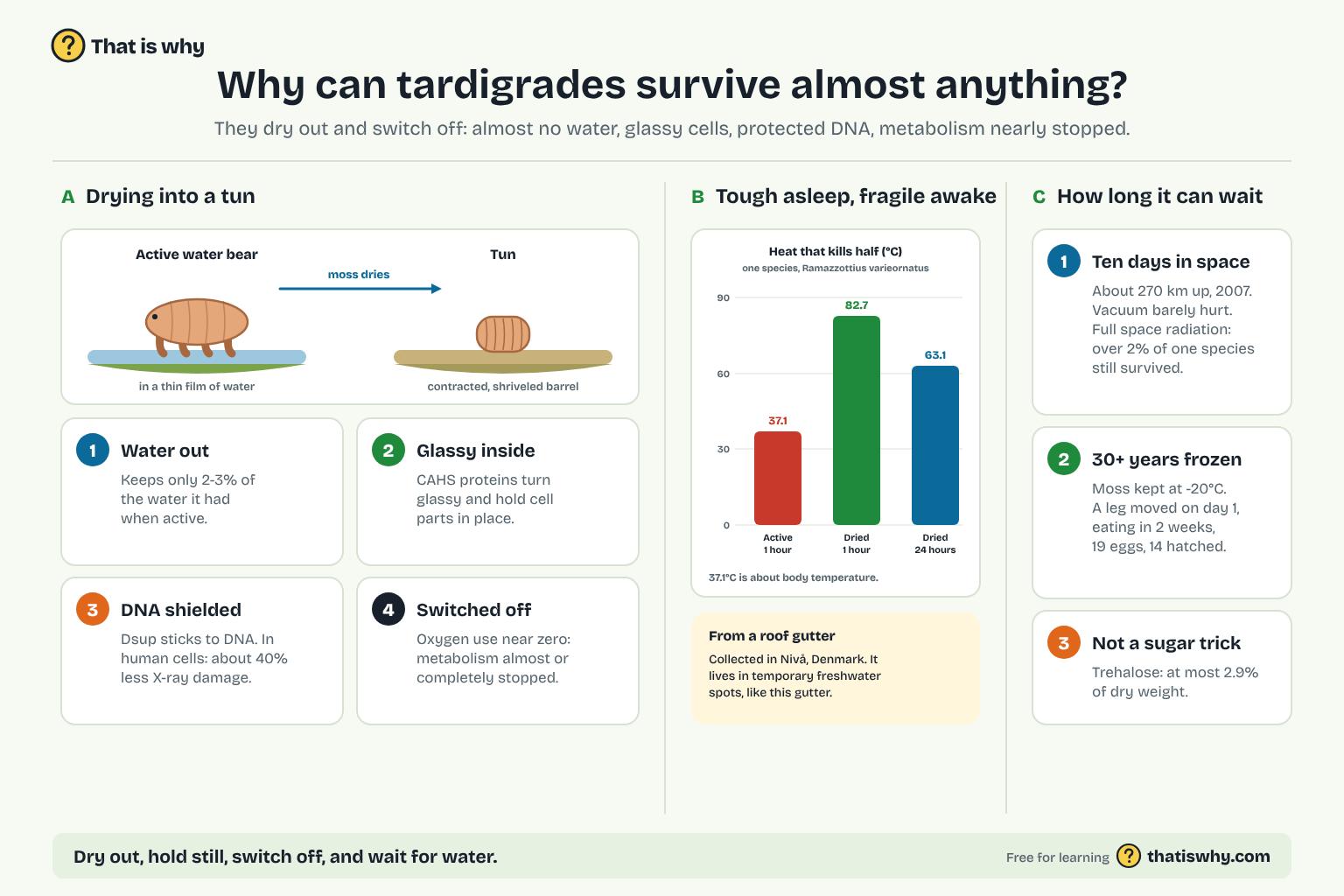
What the diagram shows
A. Drying into a tun. When the moss dries, an active tardigrade contracts into a shriveled barrel called a tun, which may slow water loss. This survival without water is called anhydrobiosis. The tun keeps only 2-3% of the water the animal had when active. CAHS proteins take on a glass form as the cells dry, a process called vitrification, holding the cell's parts in place. A tardigrade-only protein, Dsup, attaches to DNA; put into human cells, it cut X-ray damage to DNA by about 40%. Oxygen use drops to near zero, pointing to a complete or nearly complete stop of metabolism. The drawing is simplified, not to scale.
B. Tough asleep, fragile awake. In Ramazzottius varieornatus, collected from a roof gutter in Nivå, Denmark, half of the dried animals survived an hour at 82.7°C, but over 24 hours that limit fell to 63.1°C. Active animals were far more fragile: an hour at 37.1°C killed half of them.
C. How long it can wait. In 2007, dried tardigrades spent ten days in space about 270 km up. The vacuum caused no significant losses, and even with the full mix of space radiation over 2% of one species survived, then ate and laid eggs. A tardigrade from Antarctic moss kept at -20°C for over 30 years moved a leg on its first day back, was eating within two weeks and laid 19 eggs, of which 14 hatched. A sugar called trehalose is not the main trick: the most ever found in a tardigrade is 2.9% of its dry weight.
Key numbers
| Fact | Value |
|---|---|
| Water kept in the tun | 2-3% of active water |
| X-ray DNA damage in human cells with Dsup | about 40% less |
| Heat that kills half, active, 1 hour | 37.1°C |
| Heat that kills half, dried, 1 hour | 82.7°C |
| Heat that kills half, dried, 24 hours | 63.1°C |
| Space test | 10 days, about 270 km up |
| Longest frozen wait (moss at -20°C) | over 30 years |
| Most trehalose found | 2.9% of dry weight |
Common misconceptions
Myth Tardigrades are indestructible.
The truth Only the dried tun is extraordinarily tough. In one species, 37.1°C kills half of the active animals within an hour.
Myth Tardigrades love extreme places.
The truth They endure extremes but don't seek them out. The species in the heat study is typically found in temporary freshwater spots, like a roof gutter.
Myth Their secret is a special sugar.
The truth The highest amount of trehalose reported in a tardigrade is 2.9% of its dry weight, and some species produce none at all.
Questions to use in class
Tap a question to reveal a model answer.
1What is a tardigrade tun?
The dried resting form: the body contracts and shrivels into a small barrel, which may slow water loss.
2How much water does a dried tardigrade keep?
Only 2-3% of the water it had when active.
3What does the protein Dsup do?
It is found only in tardigrades and attaches to DNA. In human cells it cut X-ray damage to DNA by about 40%.
4Are active tardigrades tough too?
No. In one species, half of the active animals died after an hour at 37.1°C, while dried ones survived 82.7°C.
Key terms
- Tun
- The dried, contracted resting form of a tardigrade: its body contracted and shriveled into a small barrel, waiting for water to return.
- Anhydrobiosis
- "Life without water": surviving almost complete drying out, with metabolism nearly stopped, and coming back to life when water returns.
- Vitrification
- Turning into a glassy solid instead of forming crystals. In drying tardigrade cells, special proteins vitrify and hold delicate cell parts in place.
- Dsup
- A protein found only in tardigrades that attaches to DNA and helps suppress damage to it, for example from X-rays.
Sources
- Mechanisms of Desiccation Tolerance: Themes and Variations in Brine Shrimp, Roundworms, and Tardigrades (Hibshman, Clegg and Goldstein, Frontiers in Physiology 2020) Frontiers in Physiology
- Extremotolerant tardigrade genome and improved radiotolerance of human cultured cells by tardigrade-unique protein (Hashimoto et al., Nature Communications 2016) Nature Communications (abstract via NBRP RRC)
- Even Tardigrades Will Feel the Heat of Climate Change Eos (American Geophysical Union)
- Recovery and reproduction of an Antarctic tardigrade retrieved from a moss sample frozen for over 30 years National Institute of Polar Research, Japan
- Bärtierchen überleben Spaziergang im All (Tardigrades survive a walk in space) University of Stuttgart (via idw)