Free teaching diagram
Sunflower Diagram: Why Sunflowers Follow the Sun
By day the east side of a young stem grows faster and bends the bud west; at night it swings back; a grown flower stays facing east for the bees.
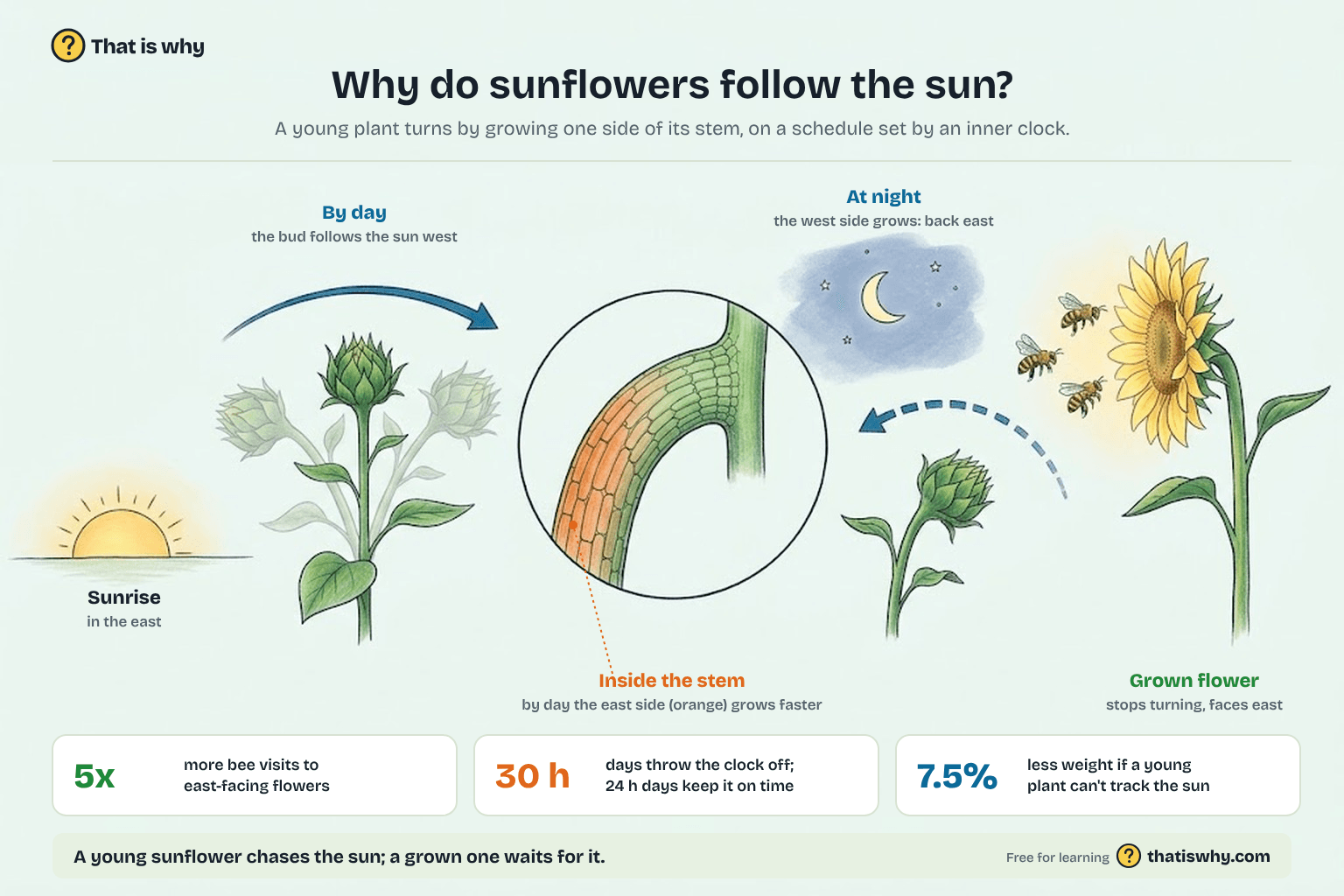
The detailed teaching diagram
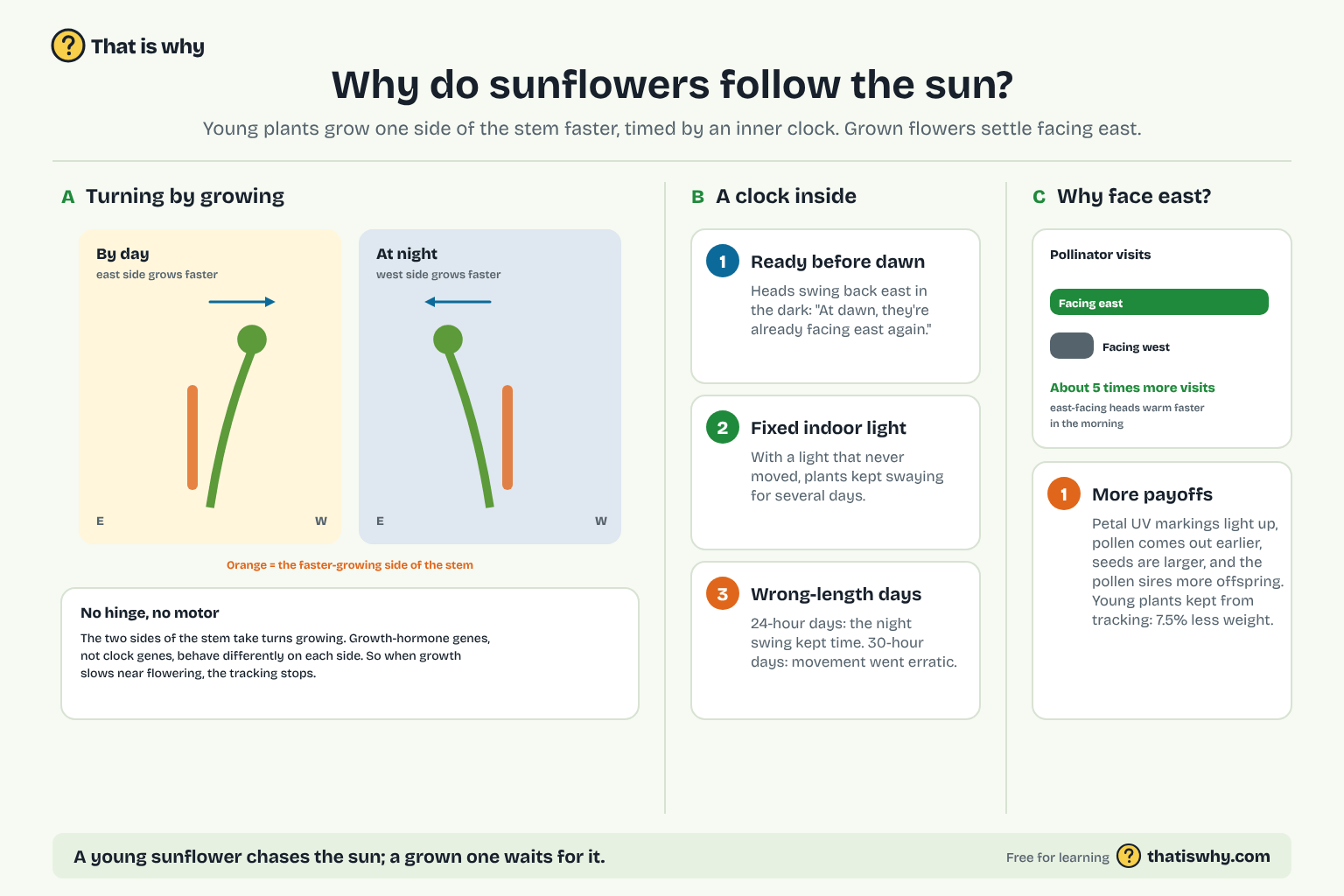
What the diagram shows
A. Turning by growing. A young sunflower has no hinge. By day, the east side of its stem grows faster and bends the bud west, after the sun. At night, the west side grows faster and swings it back east. This sun-following is called heliotropism. The genes that differ between the two sides are growth-hormone genes, not clock genes, and the researchers think the plant's clock works with its phototropism system, its habit of growing toward light. When growth slows near flowering, the tracking stops. The drawing is simplified.
B. A clock inside. The head swings back east in the dark, so "At dawn, they're already facing east again." Under a fixed indoor light, plants kept swaying for several days. In 24-hour days the nighttime swing kept time; in 30-hour days it went erratic. That points to a circadian clock, an inner timer that runs on about 24 hours.
C. Why face east? East-facing heads warm up faster in the morning and get about five times more pollinator visits than west-facing heads. A follow-up study found they also light up ultraviolet petal markings, release pollen earlier, make larger, heavier seeds, and their pollen sires more offspring. Young plants kept from tracking had about 7.5% less dry weight and 11% less leaf area.
Key numbers
| Fact | Value |
|---|---|
| First described | 1898 |
| Pollinator visits, east vs west | about 5 times more |
| Lost by plants kept from tracking | 7.5% dry weight, 11% leaf area |
| Day length that threw the clock off | 30 hours |
Common misconceptions
Myth Sunflowers follow the sun their whole lives.
The truth Only young, growing sunflowers track the sun. Near flowering they stop and stay facing east.
Myth The flower head swivels on a hinge.
The truth The stem bends because its east side grows faster by day and its west side faster at night.
Questions to use in class
Tap a question to reveal a model answer.
1How does a young sunflower turn without muscles?
By growing one side of its stem faster than the other: the east side by day, the west side at night.
2How do we know sunflowers have an inner clock?
Under a fixed indoor light they kept swaying for several days, and on 30-hour days their nighttime swing went erratic.
3Why do grown sunflowers face east?
East-facing heads warm up faster in the morning and get about five times more pollinator visits than west-facing heads.
Key terms
- Heliotropism
- A plant movement that follows the sun across the sky. Young sunflowers do it by growing the east side of the stem faster by day and the west side faster at night.
- Phototropism
- A plant's habit of growing toward light. Plants sense the direction of light with blue-light detectors called phototropins.
- Circadian clock
- An internal timer that runs on a roughly 24-hour cycle. Monarch butterflies keep one in their antennae and use it to correct for the sun's movement across the sky.
Sources
- Circadian regulation of sunflower heliotropism, floral orientation, and pollinator visits (Atamian et al., Science 2016) Science (copy hosted by UC Berkeley)
- How sunflowers follow the sun: Circadian clock and growth hormones combine to guide sunflowers' growth UC Davis (via ScienceDaily)
- Why Sunflowers Face East (Creux et al., New Phytologist) UC Davis College of Biological Sciences
- Young sunflowers keep time Science News Explores