Free teaching diagram
Sea Cucumber Evisceration Diagram: How Guts Break Free and Regrow
Grabbed, guts out, and a new gut about four weeks later.
The detailed teaching diagram
What the diagram shows
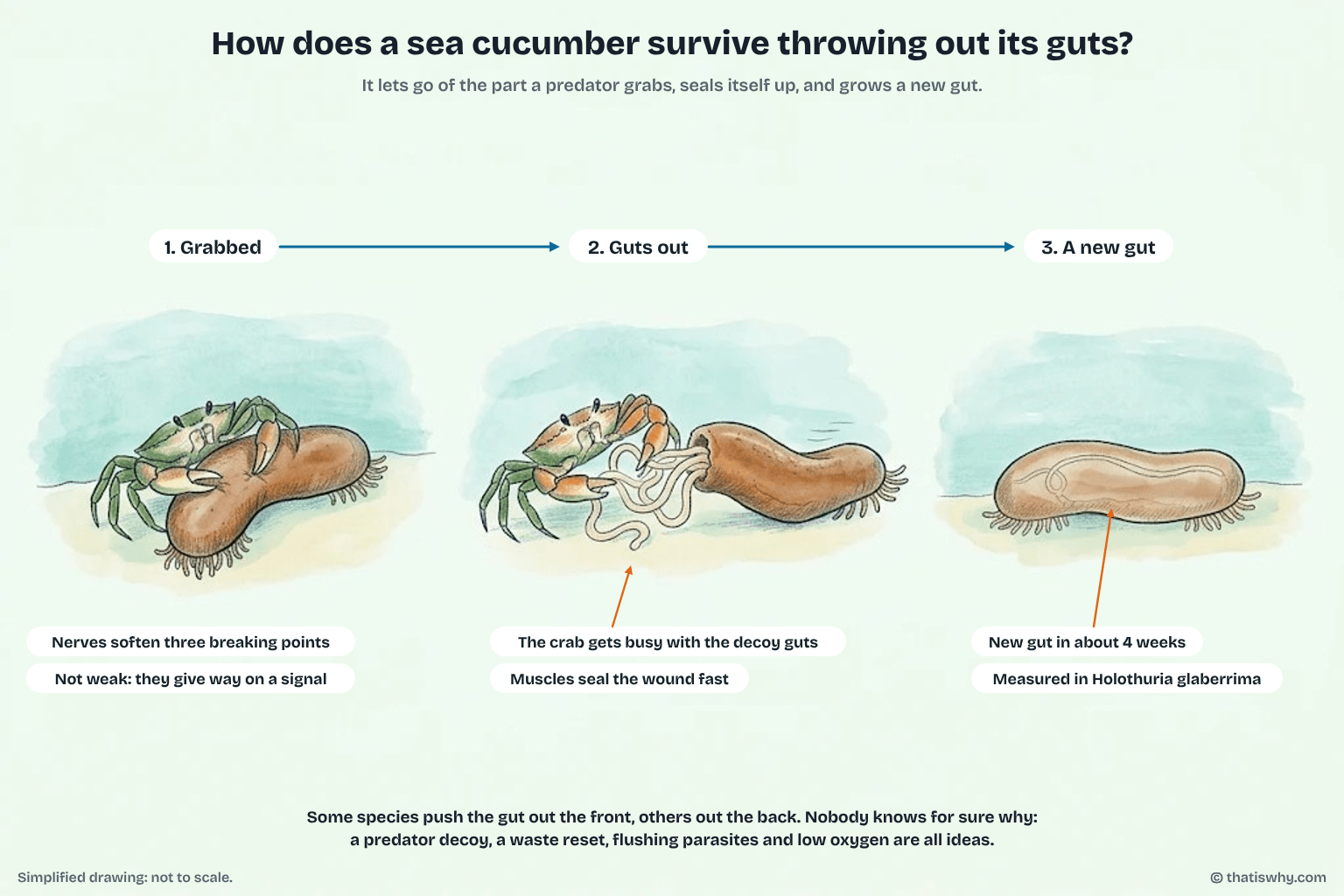
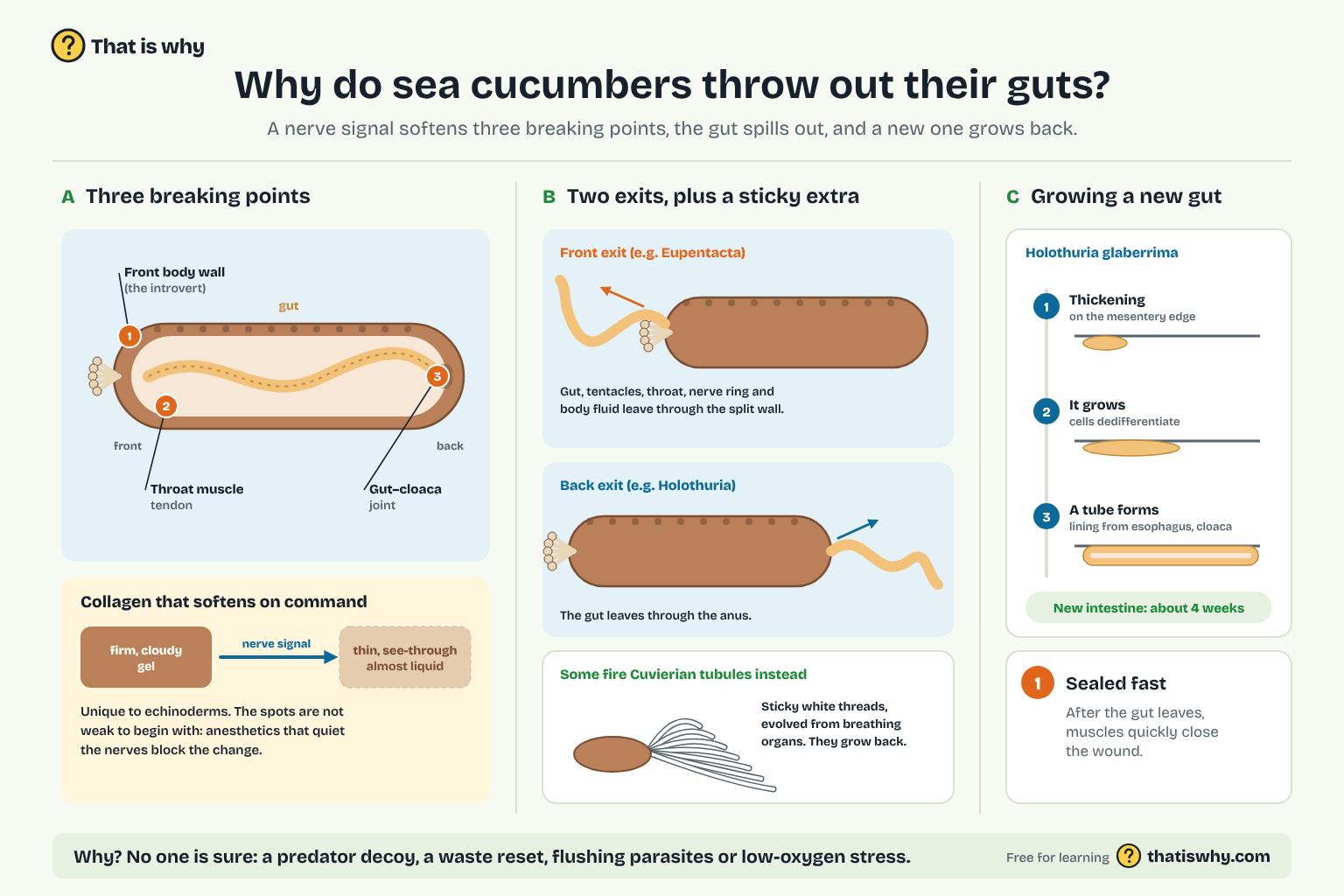
1. Grabbed. When a predator such as a crab holds on, a nerve signal softens mutable collagenous tissue at three built-in breaking points. Tests reviewed by Maria Byrne show these points are not weak; they give way only on a signal, and anesthetics block it.
2. Guts out. The body wall or rear opens, and the gut spills out while the predator is busy with it. Muscles seal the wound fast. Some species lose the gut through the front, others through the back.
3. A new gut. In Holothuria glaberrima, a thickening on the edge of the mesentery grows into a new intestine in about four weeks. This kind of self-amputation to escape is called autotomy.
Key numbers
| Fact | Value |
|---|---|
| Built-in breaking points (in Eupentacta-type sea cucumbers) | 3 |
| Time to grow a new intestine (Holothuria glaberrima) | about 4 weeks |
| Giant sea cucumber species seen on one deep Pacific expedition | at least 10 |
Common misconceptions
Myth A sea cucumber that throws out its guts is dying.
The truth It is built to survive: muscles seal the wound, and in Holothuria glaberrima a new intestine forms in about four weeks.
Myth The guts burst out because the body is weak.
The truth Tests show the breaking points are not inherently weak. Nerves soften them on purpose, and anesthetics can block it.
Myth Scientists know exactly why they do it.
The truth No one is sure. A predator decoy, a waste reset, flushing parasites and low-oxygen stress are all ideas.
Questions to use in class
Tap a question to reveal a model answer.
1What makes the sea cucumber's body come apart?
A nerve signal softens special collagen-based tissue at three breaking points, which then give way.
2Do all sea cucumbers eject their guts the same way?
No. Some push them out the front through a split in the body wall, others out the back through the anus.
3How long does it take to grow a new gut?
About four weeks in the species Holothuria glaberrima.
Key terms
- Autotomy
- Shedding part of your own body on purpose, usually to escape danger. Some lizards drop their tails, and many sea cucumbers throw out their guts and later regrow them.
- Mutable collagenous tissue
- Connective tissue that echinoderms can stiffen or soften quickly through their nerves. In sea cucumbers it can turn from firm to almost liquid, letting the body open up and release the gut.
- Cuvierian tubules
- A tangle of sticky tubes that some sea cucumbers shoot out of their rear end when attacked. They evolved from the breathing organs, can stop fish, crabs and starfish, and grow back after use.
Sources
- Morphological, Physiological and Mechanical Features of the Mutable Collagenous Tissues Associated with Autotomy and Evisceration in Dendrochirotid Holothuroids (Byrne, Marine Drugs 2023) Marine Drugs (MDPI)
- Sea Cucumber Evisceration (Anna Rothschild) NOVA, PBS
- Characterization of proteolytic activities during intestinal regeneration of the sea cucumber, Holothuria glaberrima (Pasten et al., Int. J. Dev. Biol. 2012) The International Journal of Developmental Biology
- This sea cucumber shoots sticky tubes out of its butt. Its genes hint at how (Darren Incorvaia) Science News
- The Weird and Wonderful Megafauna of the Abyssal CCZ (Craig Smith, DeepCCZ expedition log) NOAA Ocean Exploration