Free teaching diagram
Poinsettia Diagram: Why the Leaves Turn Red
Short nights keep the plant green; long nights turn its top leaves into a red sign for its tiny flowers.
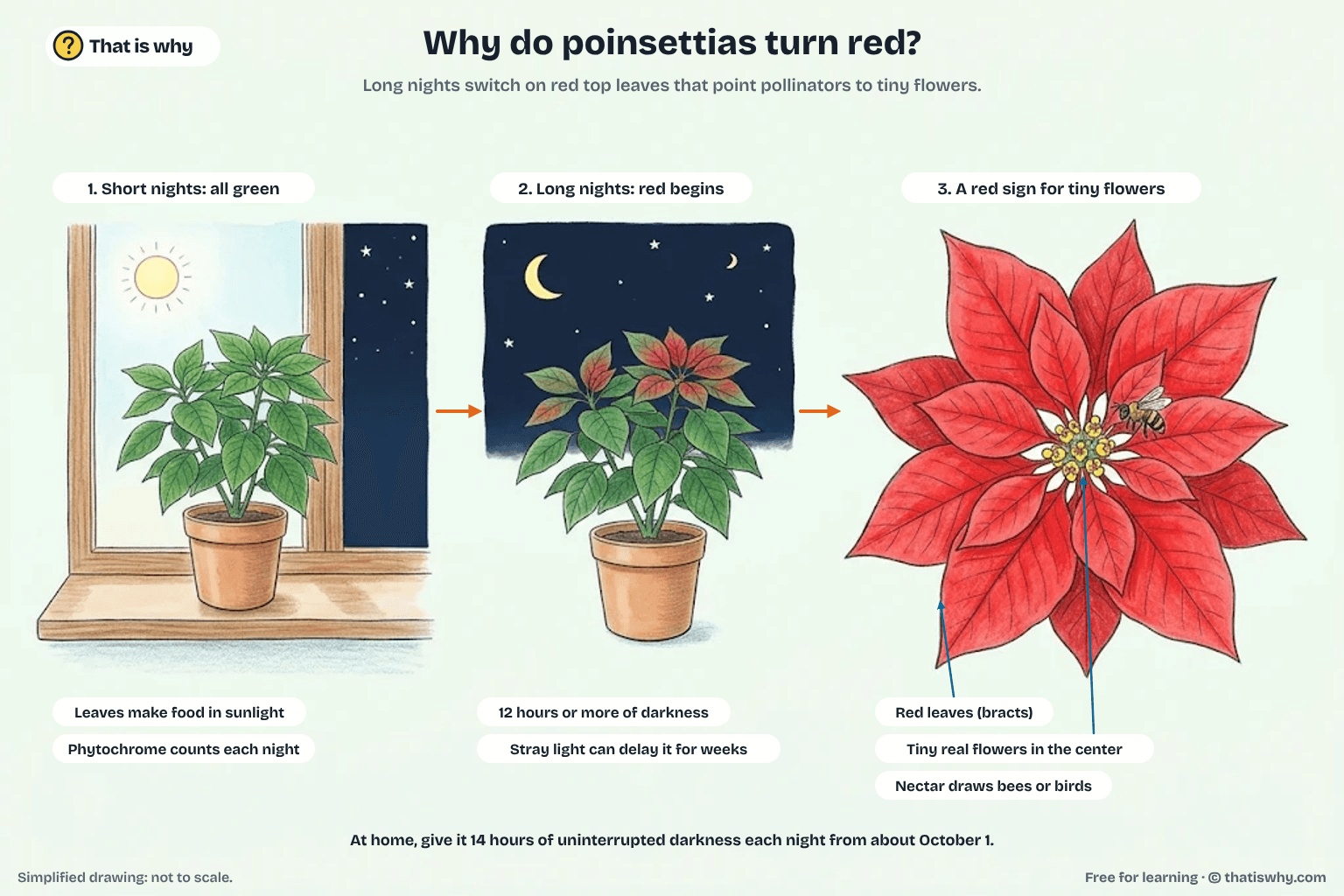
The detailed teaching diagram
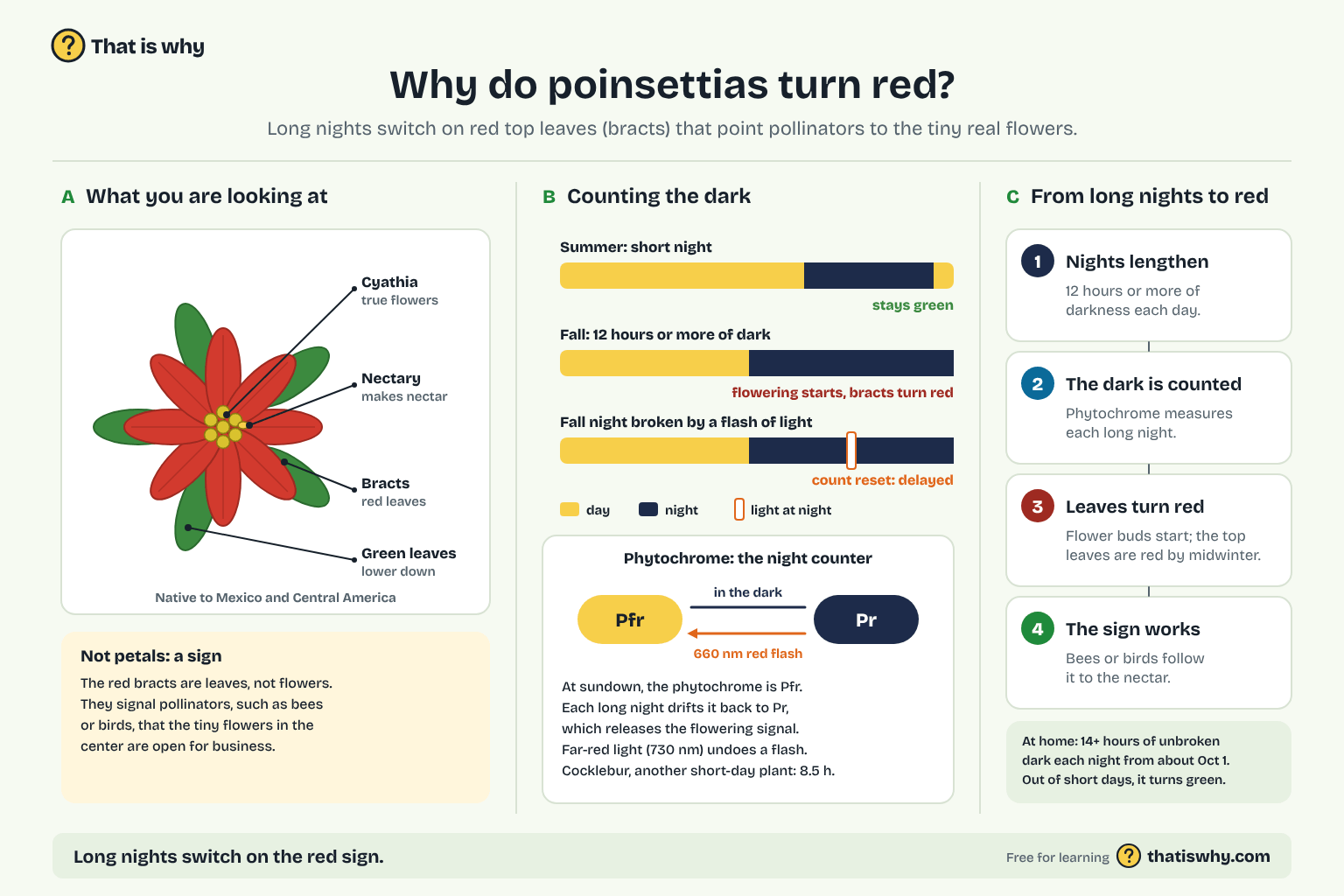
What the diagram shows
1. Short nights: all green. In summer, the poinsettia's leaves are green and busy making food from sunlight. A light-sensing pigment called phytochrome keeps track of each night, which makes the plant photoperiodic: it times its life by the length of the dark.
2. Long nights: red begins. Once nights reach about 12 hours or more, the plant starts its flower buds and turns its top leaves red. A flash of light in the middle of the night can reset the count, which is why stray light can delay a greenhouse crop for weeks.
3. A red sign for tiny flowers. The red "petals" are bracts, modified leaves. The real flowers are the tiny cyathia in the center, with glands that make nectar. The red bracts guide a pollinator, such as a bee or a bird, to that nectar.
Key numbers
| Fact | Value |
|---|---|
| Darkness that triggers the color change | about 12 hours or more each day |
| Darkness for reblooming at home | at least 14 hours a night, from about October 1 |
| Red light that resets the night | 660 nm |
| Far-red light that undoes the reset | 730 nm |
| Possible crop delay from stray light | several weeks |
Common misconceptions
Myth The red parts of a poinsettia are its flowers.
The truth They are bracts, which are modified leaves. The minute true flowers, called cyathia, sit in the center.
Myth More sunshine makes a poinsettia turn red.
The truth Darkness does it: about 12 hours or more each day, or at least 14 hours of uninterrupted darkness for a home plant from about October 1.
Myth Once a poinsettia turns red, it stays red.
The truth Once it is out of short days, the bracts eventually turn back to green.
Questions to use in class
Tap a question to reveal a model answer.
1What are poinsettia bracts?
Modified leaves that turn red and act as a sign pointing pollinators to the tiny flowers in the center.
2How does a poinsettia know the nights are long?
A light-sensing pigment called phytochrome drifts from one form to another in the dark, letting the plant measure the length of each night.
3Why can a flashlight delay a poinsettia crop?
A flash of light at night switches phytochrome back, undoing the night's count. Stray light can delay a greenhouse crop for several weeks.
4How do you get a poinsettia to turn red again at home?
From about October 1, give it at least 14 hours of uninterrupted darkness every night.
Key terms
- Bract
- A modified leaf that grows next to a flower. A poinsettia's big red bracts are often mistaken for petals; they act as a sign that draws pollinators to the tiny real flowers.
- Cyathium
- The minute true flower of a poinsettia and its relatives in the spurge family, held above the colored bracts, with a yellow nectary that makes sweet nectar.
- Photoperiodism
- A plant's ability to time things like flowering by the length of the day or night. So-called short-day plants, such as poinsettias and chrysanthemums, really respond to long nights.
- Phytochrome
- A light-sensing pigment in plants that switches between two forms: red light turns it into Pfr, and in the dark it drifts back to Pr. Plants use it to measure how long the night is.
- Pollinator
- An animal, such as a bee or a fly, that visits flowers and carries pollen between them. The orchid mantis lures pollinators in order to eat them.
Sources
- The poinsettia: taking cues from daylight University of Alaska Fairbanks
- Selecting and Planting Poinsettias (Newman, Edmunds & Goldsberry, Fact Sheet 7.412) Colorado State University Extension
- Are You Photoperiodic? Poinsettias Are: An Explanation of This Unique Plant Process South Dakota State University Extension
- 16.4E: Photoperiodism and Phytochrome (John W. Kimball) Biology LibreTexts
- Poinsettia Progression: The Origin, Growth, and Care of Euphorbia pulcherrima Alaska Master Gardener Blog, University of Alaska Fairbanks