Free teaching diagram
Opossum Playing Dead Diagram: What Happens in Tonic Immobility
A predator's grab flips an automatic switch: the body fakes death while the opossum stays aware.
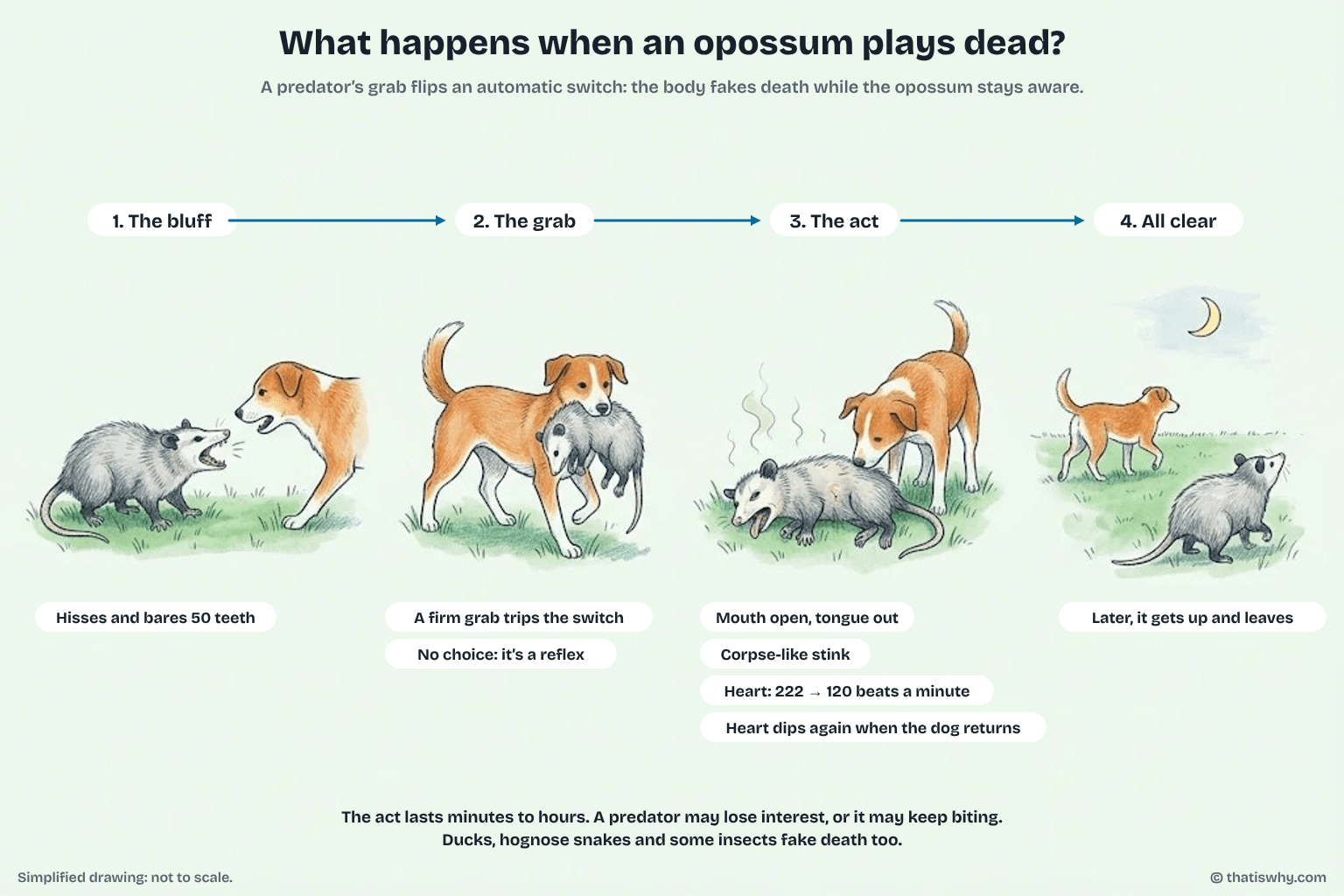
The detailed teaching diagram
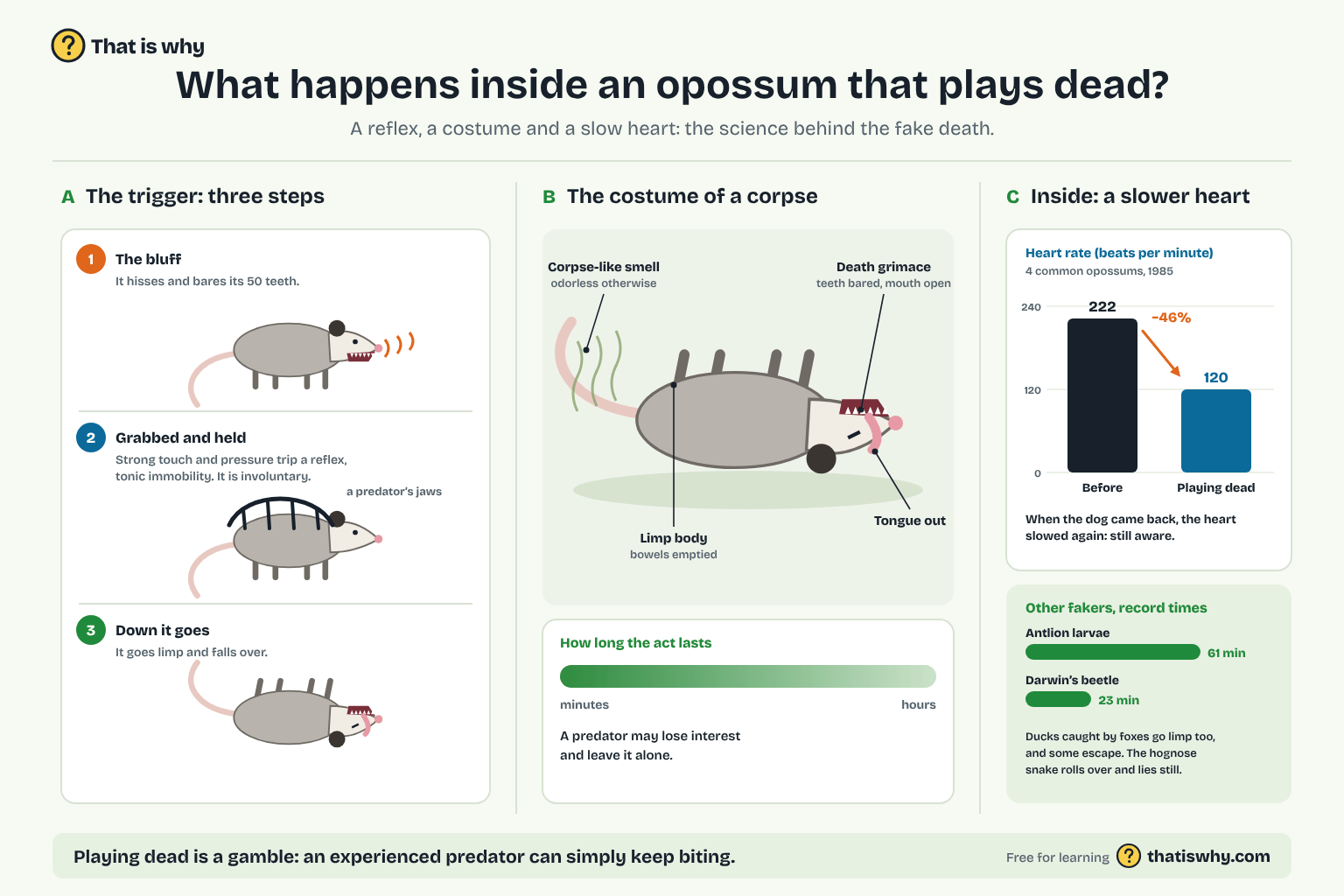
What the diagram shows
1. The bluff. A threatened Virginia opossum hisses and bares its 50 teeth, the most of any mammal in Illinois, according to Illinois Extension.
2. The grab. If a predator grabs and holds it, strong touch and pressure trip a reflex called tonic immobility. The Nature Conservancy is clear that it is involuntary.
3. The act. The opossum goes limp, teeth showing in a "death grimace," mouth open and tongue out, and it leaks a corpse-like smell. In a 1985 study of four common opossums, close cousins of the Virginia opossum, heart rate fell from about 222 to 120 beats per minute (bradycardia), and it dipped again when the dog came back.
4. All clear. After minutes to hours, the opossum gets up and leaves, if the predator has lost interest. An experienced hunter can simply keep biting.
Key numbers
| Fact | Value |
|---|---|
| Teeth in a Virginia opossum | 50 |
| Heart rate before playing dead (common opossum, 1985) | about 222 beats per minute |
| Heart rate while playing dead | about 120 beats per minute (46% lower) |
| How long the act lasts | minutes to hours |
| Antlion larvae playing dead | up to 61 minutes |
Common misconceptions
Myth Opossums decide to play dead.
The truth It is involuntary: a reflex triggered when a predator grabs and holds them.
Myth A 'dead' opossum knows nothing.
The truth In a 1985 study its heart slowed again when the dog came back, and the researchers concluded it stayed fully conscious.
Myth Playing dead always works.
The truth An experienced predator can keep biting. It only works when the predator chooses to leave.
Questions to use in class
Tap a question to reveal a model answer.
1What triggers an opossum to play dead?
Strong touch and pressure, like a predator grabbing and holding it, trip a reflex called tonic immobility.
2What happens to the opossum's heart?
In a 1985 study of four common opossums, heart rate fell from about 222 to 120 beats per minute, a 46 percent drop.
3How long does an opossum play dead?
Anywhere from minutes to hours.
4Which other animals fake death?
Ducks caught by foxes, the eastern hognose snake, antlion larvae and some beetles.
Key terms
- Tonic immobility
- A frozen, death-like stillness that an animal's body produces by reflex, usually when a predator grabs it. Opossums, some snakes, ducks and many insects do it.
- Bradycardia
- A heartbeat that is slower than normal. An opossum playing dead shows it: its heart rate falls by nearly half.
- Marsupial
- A mammal whose babies are born tiny and keep growing in a pouch on the mother's belly. The Virginia opossum is the only one found north of Mexico.
Sources
- Strange and Surprising Facts about Opossums (Matthew L. Miller) The Nature Conservancy
- Ode to the Opossum (Nancy Kuhajda) Illinois Extension, University of Illinois
- Physiological responses associated with feigned death in the American opossum (Gabrielsen and Smith, Acta Physiologica Scandinavica 1985), abstract Acta Physiologica Scandinavica (via Scilit)
- Many animals play dead—and not just to avoid getting eaten (Christine Peterson) National Geographic
- Tonic immobility and phenomenal consciousness in animals: a review (Woodruff, Frontiers in Psychology 2025) Frontiers in Psychology