Free teaching diagram
Mantis Shrimp Eye Diagram: How It Reads Color
Sweep, light up, look up: the mantis shrimp eye reads a color barcode instead of comparing shades.
The detailed teaching diagram
What the diagram shows
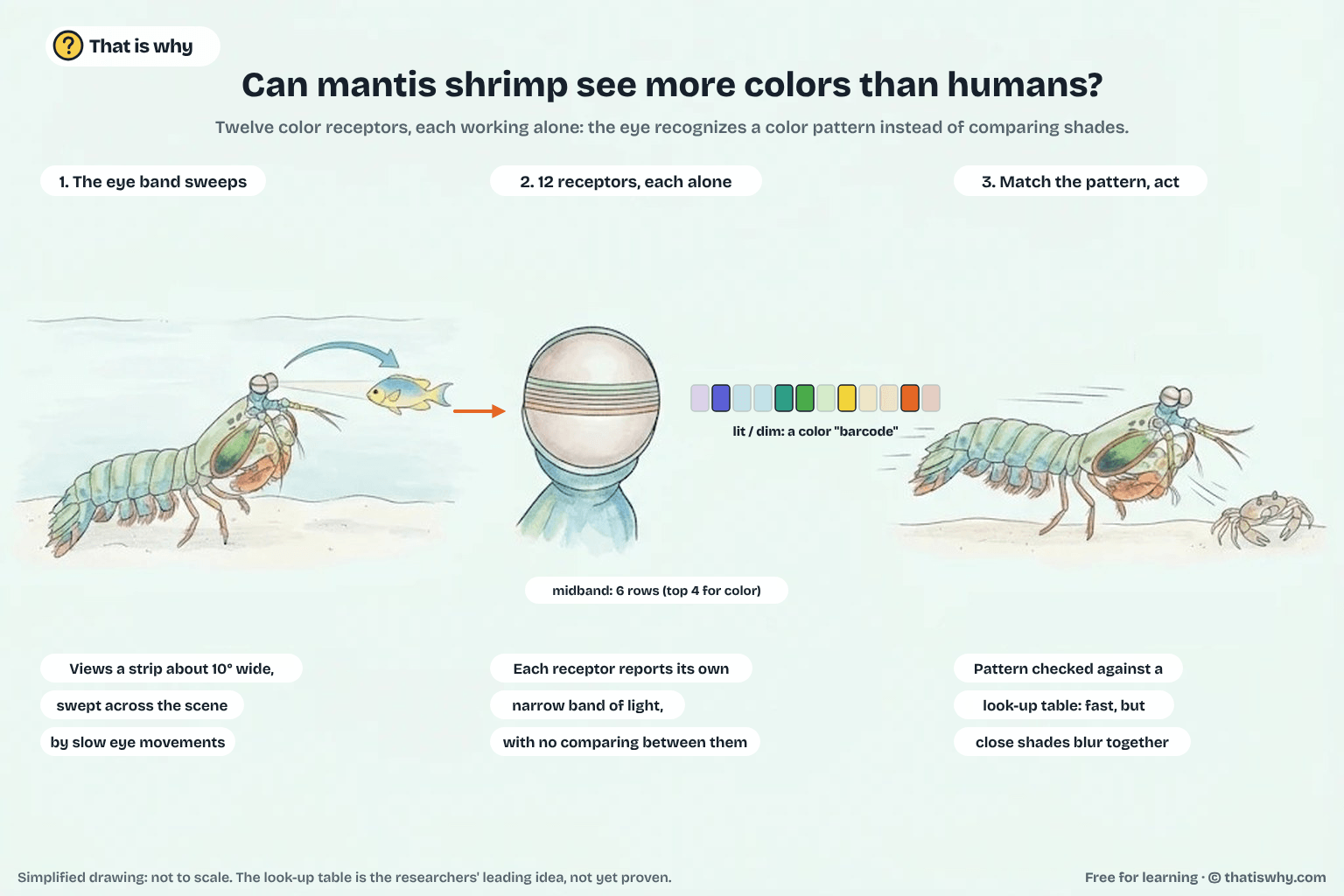
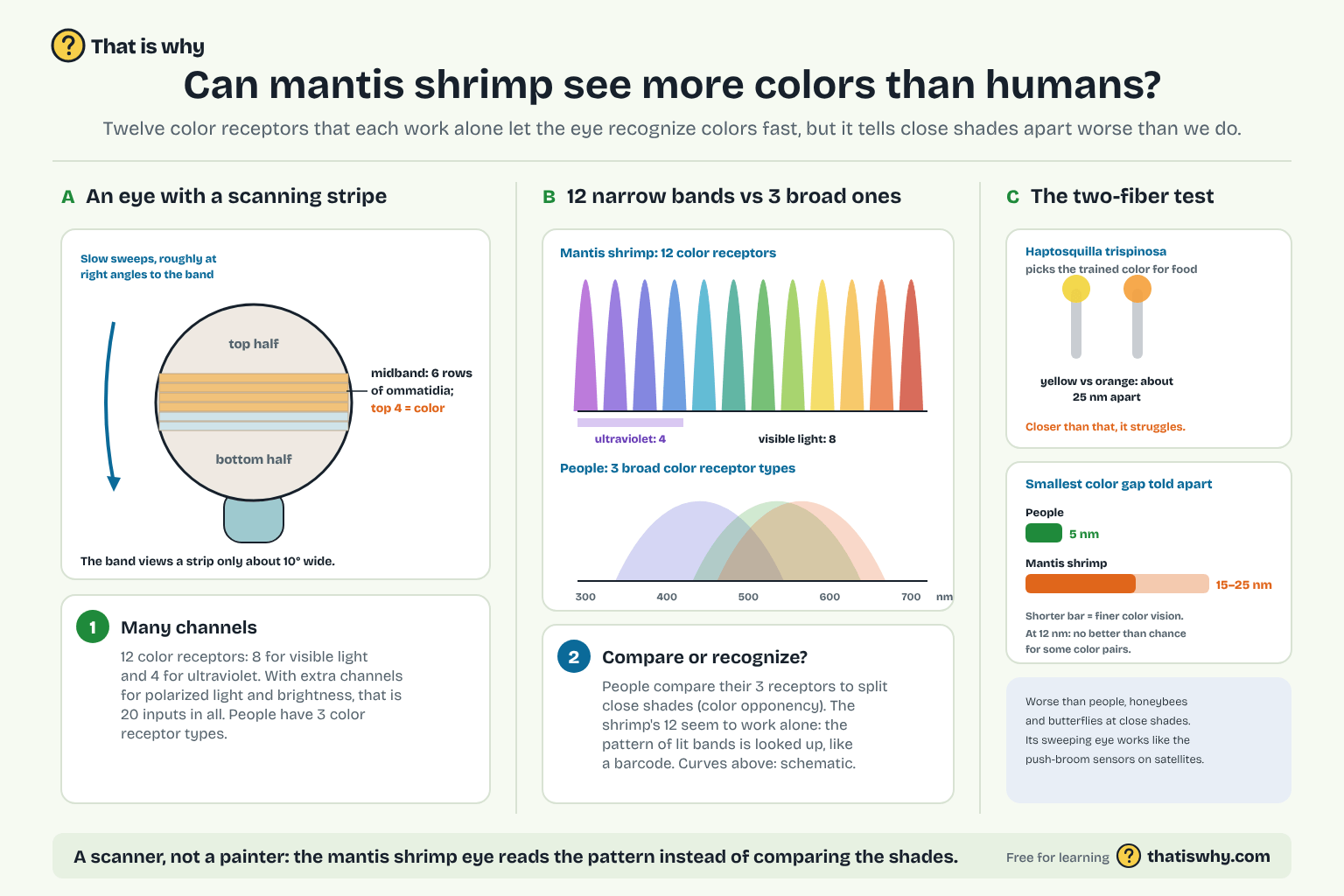
1. The eye band sweeps. Across the middle of each mantis shrimp eye runs the midband, six rows of ommatidia with the color specialists in the top four. It views a strip only about 10 degrees wide, so the shrimp sweeps its eyes slowly across a scene, roughly at right angles to the band.
2. Twelve receptors, each alone. The eye has 12 kinds of color photoreceptors, each tuned to a narrow band of wavelength, 4 of them in ultraviolet. People compare their 3 receptor types, a trick called color opponency. The shrimp's 12 seem to work alone, so the pattern of which ones light up acts like a color barcode.
3. Match the pattern and act. The researchers think the shrimp checks that pattern against a look-up table in its brain. That is fast, but close shades blur together: in tests it struggled with colors closer than 25 nanometers, while people can tell apart colors 5 nanometers apart.
Key numbers
| Fact | Value |
|---|---|
| Color receptor types (mantis shrimp) | 12: 8 visible, 4 ultraviolet |
| Color receptor types (people) | 3 |
| Range of the 12 receptors | just below 300 nm to above 700 nm |
| Total input channels (with polarized light and brightness) | 20 |
| Midband | 6 rows of ommatidia, color in the top 4 |
| Width of the strip the midband views | about 10° |
| Smallest color gap told apart (people) | 5 nm |
| Smallest color gap told apart (mantis shrimp) | 15 to 25 nm |
| Gap where some pairs fell to chance | 12 nm |
Common misconceptions
Myth Mantis shrimp see thousands of colors we can't imagine.
The truth In two-fiber tests they were worse than humans, honeybees and butterflies at telling close colors apart. They do see ultraviolet, which we can't.
Myth Mantis shrimp have 16 color receptors.
The truth The color count is 12. Extra channels for polarized light and brightness bring the total number of inputs to 20.
Myth So mantis shrimp are bad at color.
The truth They are good at a different job: recognizing a color fast. A 2022 study found Haptosquilla trispinosa could easily tell several colors apart.
Questions to use in class
Tap a question to reveal a model answer.
1Can mantis shrimp see more colors than humans?
No. They have 12 types of color receptors to our 3, but in tests they had trouble telling apart colors closer than 25 nanometers, while people can tell apart colors just 5 nanometers apart.
2How many color receptors does a mantis shrimp have?
Twelve: 8 for visible light and 4 for ultraviolet. With extra channels for polarized light and brightness, its eyes have 20 input channels in all.
3What is the barcode hypothesis?
The idea that each of the mantis shrimp's 12 color receptors works alone, so the pattern of which ones light up acts like a color barcode that the shrimp checks against a look-up table instead of comparing shades.
4What is the midband of a mantis shrimp eye?
A narrow band of six rows of ommatidia across the middle of the eye, with the color specialists in its top four rows. It views a strip about 10 degrees wide, so the shrimp sweeps its eyes across a scene.
Key terms
- Photoreceptor
- A light-sensing cell in the eye. Most people have three types for color, while the mantis shrimp has twelve.
- Ommatidium
- One of the many tiny units that make up a compound eye, such as an insect's or a mantis shrimp's. Each one looks at a small patch of the scene.
- Color opponency
- The way most color-seeing animals, including people, work out a color: the brain compares how strongly different types of color receptor are firing. Mantis shrimp seem not to do this.
- Wavelength
- The distance between one wave peak and the next. For light it sets the color: red light has longer wavelengths (about 620 to 750 nm) than blue light (about 450 to 495 nm).
Sources
- A different form of color vision in mantis shrimp (Thoen, How, Chiou and Marshall, Science 2014) University of Bristol
- The Mantis Shrimp Sees Like A Satellite National Geographic
- Mantis shrimp's bizarre visual system may save brainpower Science News
- Colour vision in stomatopod crustaceans: more questions than answers (Streets, England and Marshall, Journal of Experimental Biology 2022) The Company of Biologists (PubMed Central)
- Complex gaze stabilization in mantis shrimp (Daly, How, Partridge and Roberts, Proceedings of the Royal Society B 2018) The Royal Society (PubMed Central)