Free teaching diagram
Manchineel Tree Diagram: Why Its Sap Burns Skin
The manchineel's milky sap burns skin: rain carries it down, smoke carries it into eyes, and its fruit burns the mouth.
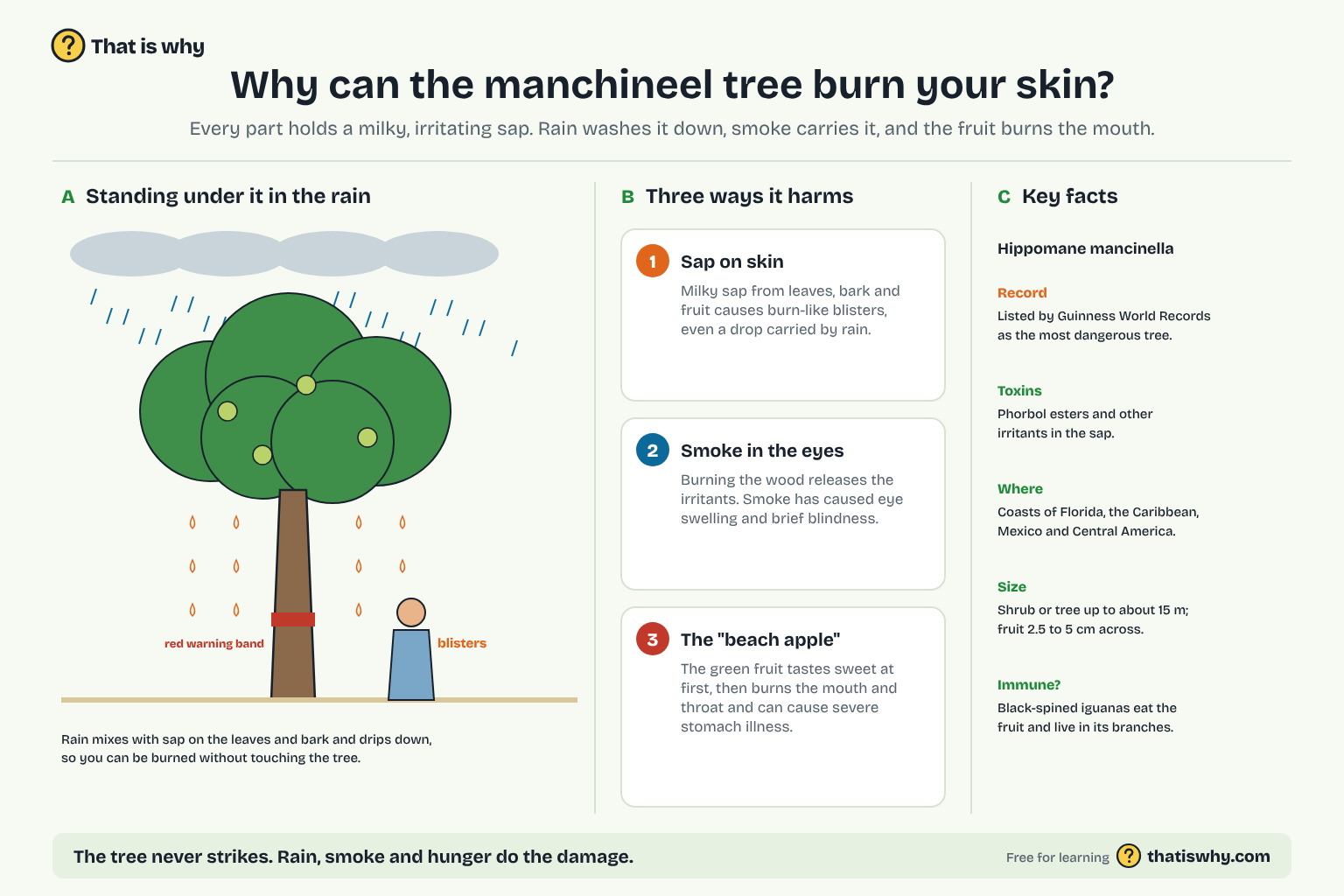
What the diagram shows
A. Standing under it in the rain. Every part of the manchineel, Hippomane mancinella, holds a thick, milky sap (latex). On a dry day it stays inside the tree. In a storm, rain runs over the leaves and bark, mixes with the sap and drips down, so a person sheltering underneath can be blistered without ever touching the tree. Some Caribbean islands paint a red band or a red X on manchineel trunks as a warning.
B. Three ways it harms.
- Sap on skin. The sap causes burn-like blisters, a severe contact dermatitis, even from a drop carried by rain.
- Smoke in the eyes. Burning the wood releases the irritants into the smoke, which has caused painful eye swelling and temporary blindness.
- The "beach apple". The small green fruit tastes sweet at first, then burns the mouth and throat and can cause severe stomach illness.
C. Key facts. Guinness World Records lists the manchineel as the most dangerous tree in the world. Its sap contains phorbol esters and other irritants. It grows on coasts and in mangrove swamps in Florida, the Caribbean, Mexico and Central America, as a shrub or a tree up to about 15 m tall, with fruit 2.5 to 5 cm across. One animal that copes with it is the black-spined iguana, which eats the fruit and lives in its branches.
Key facts
| Fact | Value |
|---|---|
| Scientific name | Hippomane mancinella |
| Height | up to about 15 m (50 ft) |
| Fruit size | 2.5 to 5 cm (1 to 2 in) |
| Main irritants | phorbol esters in the milky sap |
| Record | most dangerous tree (Guinness World Records) |
Common misconceptions
Myth You have to touch a manchineel to get hurt.
The truth Rain dripping from the tree carries its sap, so sheltering under it in a storm can blister skin. Smoke from burning it can also harm the eyes.
Myth The sap is a kind of acid.
The truth It contains strong irritants, including phorbol esters, that inflame skin and eyes. The injuries look like burns but are caused by irritation, not acid.
Myth No animal can go near it.
The truth The black-spined iguana eats its fruit and even lives in its branches.
Questions to use in class
Tap a question to reveal a model answer.
1How can rain carry the manchineel's toxins to someone who never touches the tree?
Rain washes over leaves and bark, mixes with the sap and drips down onto whatever is underneath, including skin.
2Why should you never burn manchineel wood?
The smoke carries the irritants into the air, and in the eyes it can cause painful swelling and temporary blindness.
3Why might a tree benefit from being so irritating to touch and eat?
It discourages animals from eating or damaging it, so it can keep its leaves, bark and seeds.
4Why do some islands paint a red band or a red X on manchineel trunks?
To warn people, especially visitors, not to touch the tree, shelter under it or eat its fruit.
Key terms
- Latex
- A milky fluid made by some plants, such as rubber trees, the sandbox tree and the manchineel, often as a defense. Some latex, like the manchineel's, is toxic and can blister skin and damage the eyes.
- Phorbol ester
- A type of chemical found in the sap of some spurge-family plants, including the manchineel, that strongly irritates skin and eyes.
- Contact dermatitis
- Red, itchy or blistered skin caused by touching an irritating or allergy-causing substance, such as manchineel sap.
Sources
- Hippomane mancinella, manchineel (Andreu & Friedman) UF/IFAS Extension
- Most dangerous tree Guinness World Records
- Manchineel Wikipedia