Free teaching diagram
Fall Leaf Color Diagram: Why Leaves Turn Yellow and Red
Trees take apart their green chlorophyll to save its nutrients, hidden yellows show through, and many trees make new red as a sunscreen.
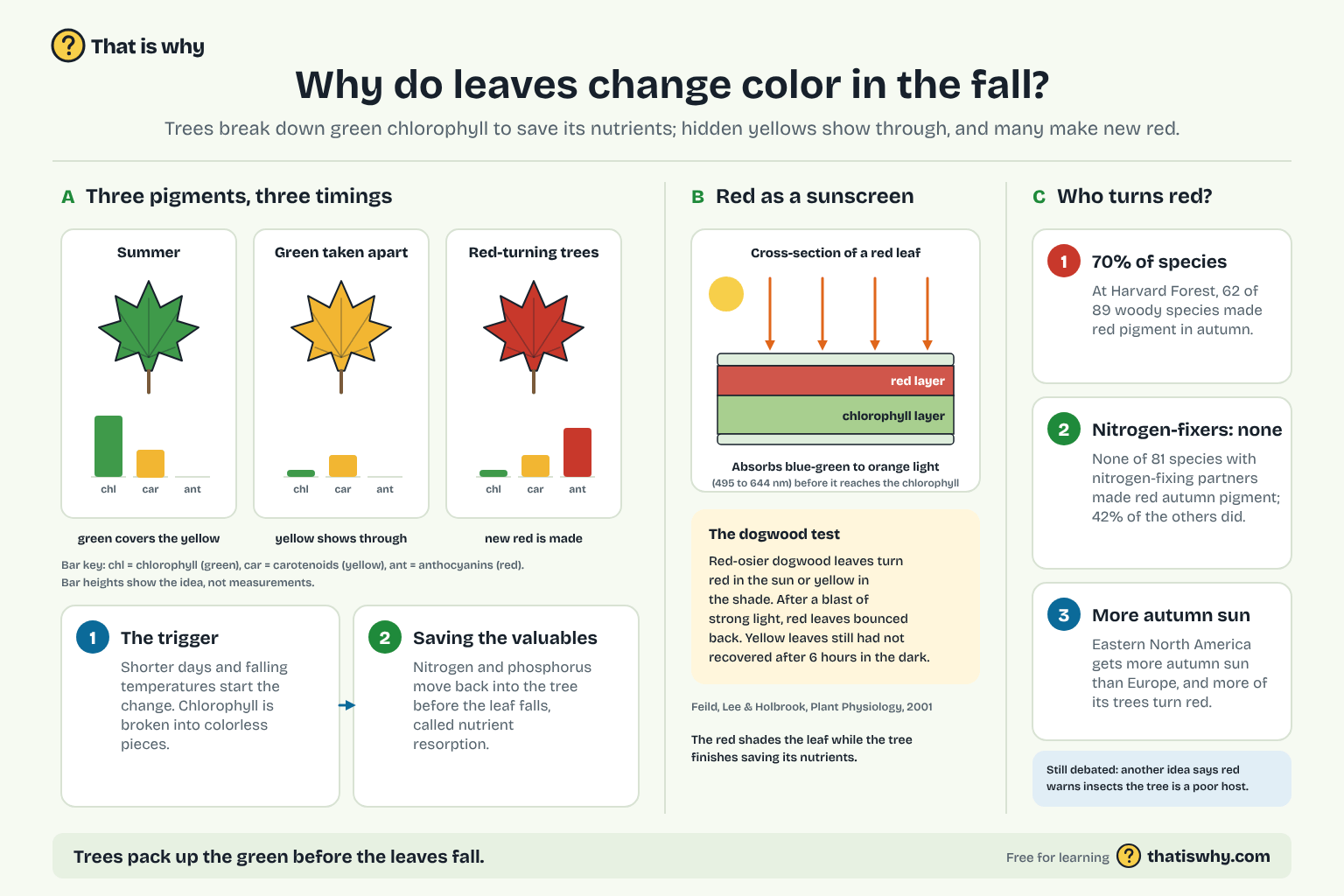
What the diagram shows
A. Three pigments, three timings. All summer, green chlorophyll covers the yellow and orange carotenoids, which are in the leaf all year. Shorter days and falling temperatures start the change: chlorophyll is broken into colorless pieces, and nitrogen and phosphorus move back into the tree before the leaf falls, a process called nutrient resorption. With the green gone, the yellow shows through. Many trees also make new red pigments, anthocyanins, midway through the leaf's decline. The bar heights show the idea, not measurements.
B. Red as a sunscreen. In red-osier dogwood, the red pigment forms a layer just under the leaf's upper surface and absorbs blue-green to orange light (495 to 644 nm) before it reaches the chlorophyll. After a blast of strong light, red leaves bounced back, while yellow leaves still had not recovered after 6 hours in the dark. The leading idea is that the red shades the leaf while the tree finishes saving its nutrients.
C. Who turns red? At Harvard Forest in central Massachusetts, 62 of 89 woody species (70%) made red pigment in autumn. None of 81 species with nitrogen-fixing partners made red autumn pigment, while 42% of the other species did. Eastern North America gets more autumn sun than Europe at the same latitude, and more of its trees turn red. The case is still debated: another idea says red warns insects that a tree is a poor host.
Key numbers
| Fact | Value |
|---|---|
| Woody species making red pigment at Harvard Forest | 62 of 89 (70%) |
| Light absorbed by the red layer | 495 to 644 nm (blue-green to orange) |
| Yellow dogwood leaves after strong light | not recovered after 6 hours in the dark |
| Nitrogen-fixing species making red autumn pigment | none of 81 |
| Other species making red autumn pigment | 42% |
Common misconceptions
Myth Trees paint their leaves yellow in the fall.
The truth Yellow carotenoids are in the leaf all year, hidden by green chlorophyll; autumn only takes the green away.
Myth Red leaves are just rotting leaves.
The truth Red anthocyanins are made new, midway through the leaf's decline, while the leaf is still working.
Myth Every tree turns red in the right weather.
The truth It depends on the tree: none of 81 nitrogen-fixing species made red autumn pigment, while 42% of other species did.
Questions to use in class
Tap a question to reveal a model answer.
1What starts the color change in the fall?
Shorter days and falling temperatures.
2Where does the yellow color come from?
From carotenoids that are in the leaf all year, hidden under green chlorophyll until it is broken down.
3What does the tree save from its leaves before they fall?
Mainly nitrogen and phosphorus, which move back into the tree.
4How might red pigment help a leaf?
It forms a layer under the upper surface that absorbs light before it reaches the chlorophyll, shading the leaf while the tree saves its nutrients.
5What share of woody species at Harvard Forest made red pigment in autumn?
62 of 89 species, or 70%.
Key terms
- Chlorophyll
- The green pigment that catches sunlight for photosynthesis. In autumn, many trees break it down into colorless pieces and pull its nutrients back before the leaves fall.
- Carotenoid
- Yellow and orange pigments found in leaves all year. They are hidden by green chlorophyll in summer and show through in autumn when the chlorophyll is broken down.
- Anthocyanin
- Red and purple pigments that many trees make fresh in autumn. In leaves they act as a light shade, which may protect a leaf while the tree recovers its nutrients.
- Nutrient resorption
- A plant pulling nutrients such as nitrogen and phosphorus out of its old leaves and back into its branches before the leaves fall, so they are not lost.
Sources
- Why Do Leaves Change Colors in the Fall? Encyclopaedia Britannica
- Unravelling the evolution of autumn colours: an interdisciplinary approach (Archetti et al., Trends in Ecology and Evolution 2009) USDA Forest Service Research
- Pigment dynamics and autumn leaf senescence in a New England deciduous forest, eastern USA (Lee, O'Keefe, Holbrook & Feild, Ecological Research 2003) Harvard Forest, Harvard University
- Why leaves turn red in autumn. The role of anthocyanins in senescing leaves of red-osier dogwood (Feild, Lee & Holbrook, Plant Physiology 2001) Plant Physiology (via PubMed Central)
- Trees growing in Eastern North America experience higher autumn solar irradiation than their European relatives (Renner & Zohner, Journal of Evolutionary Biology 2022) Washington University in St. Louis