Free teaching diagram
Why Are Flamingos Pink? Carotenoid Diagram (Free PNG and PDF)
From algae to feathers: a flamingo's pink is borrowed from its food.
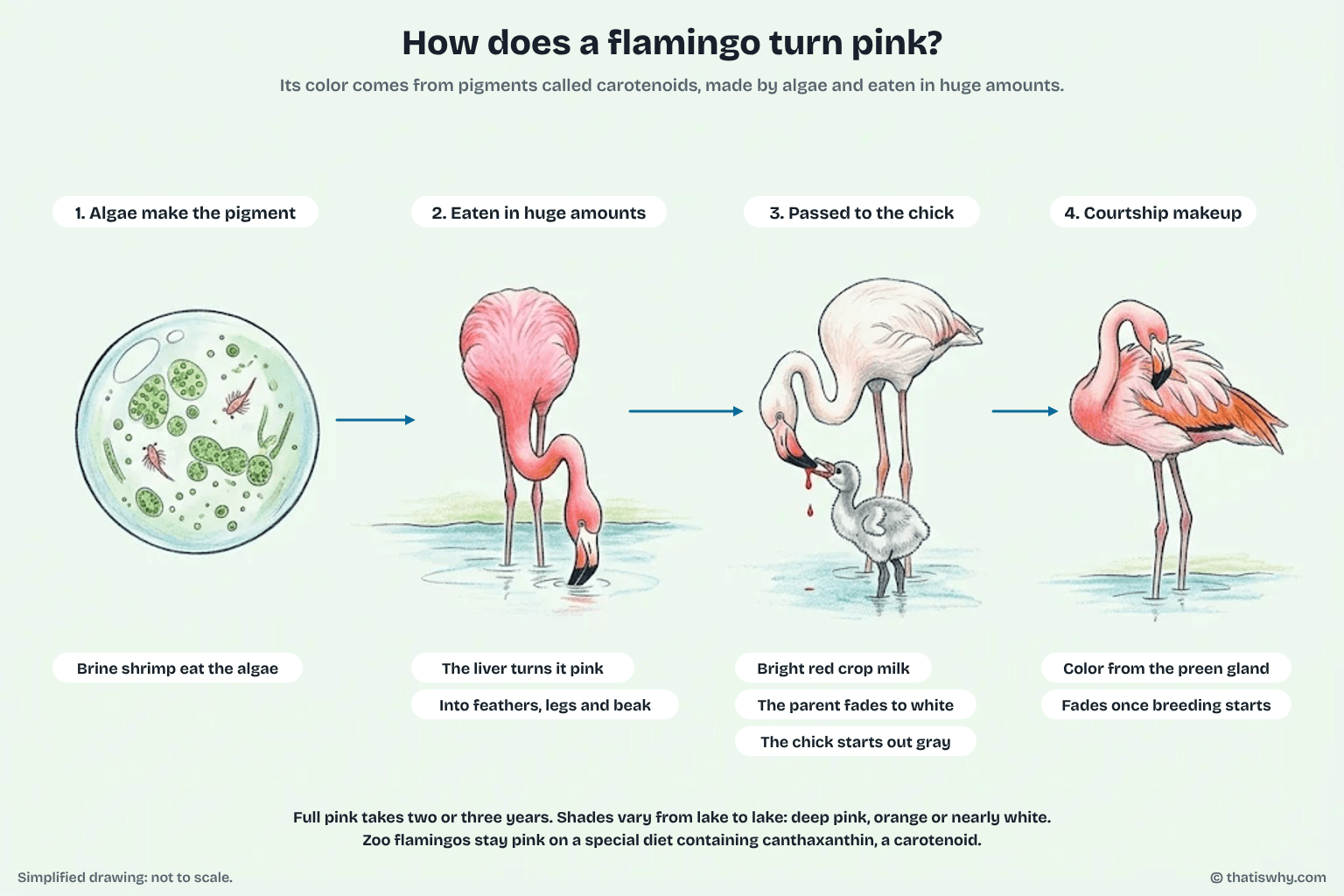
The detailed teaching diagram
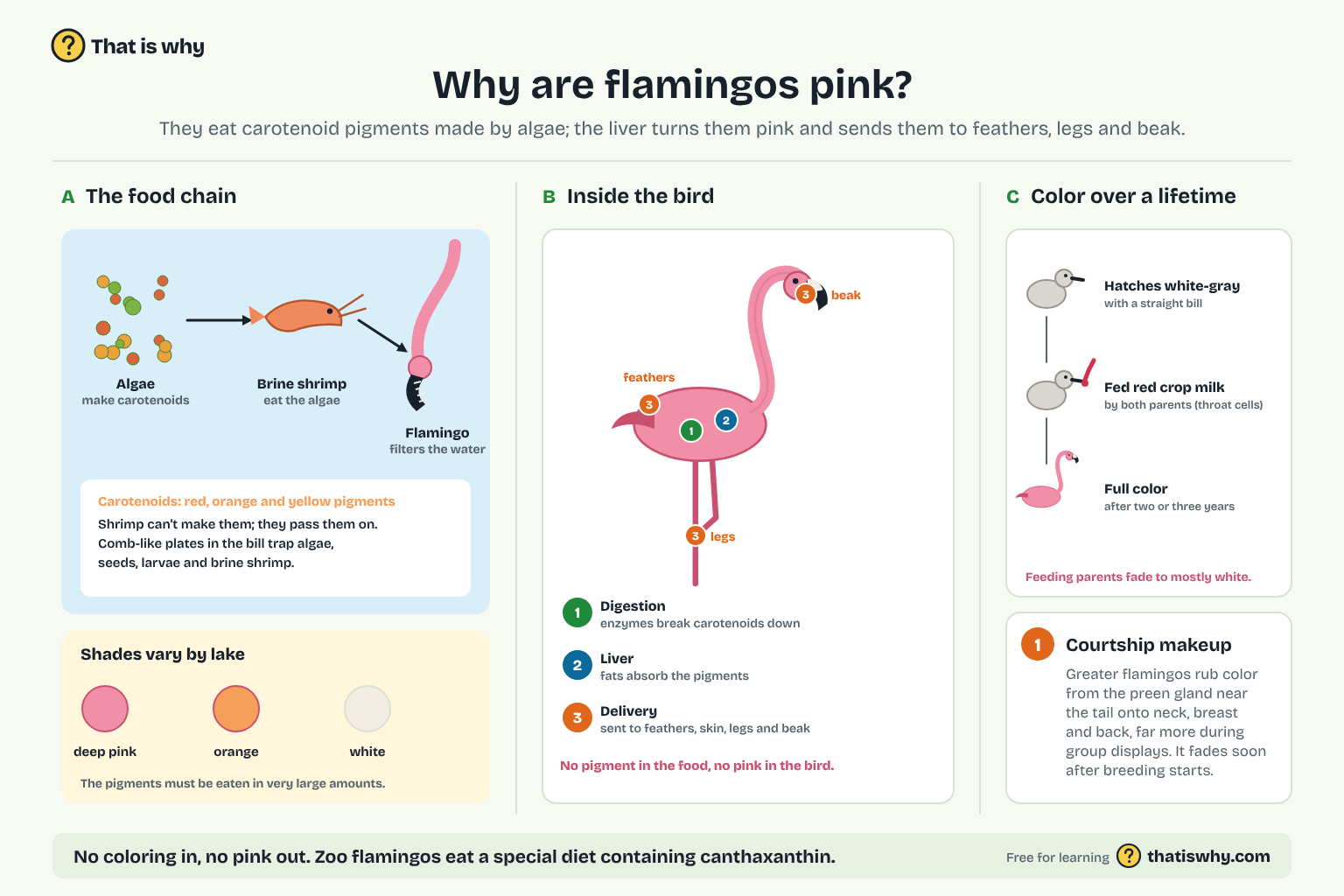
What the diagram shows
1. Algae make the pigment. Microscopic algae make carotenoids, red, orange and yellow pigments. Brine shrimp eat the algae, but they can't make the pigments either.
2. Eaten in huge amounts. Flamingos filter algae, seeds, larvae and brine shrimp out of the water. Enzymes break the carotenoids down, fats in the liver absorb them, and the pigments go to the feathers, skin, legs and beak. Shades vary from lake to lake.
3. Passed to the chick. Chicks hatch white-gray. Both parents feed them bright red crop milk, and by late in the breeding season the parents are mostly white while the chicks are a lot more pink. Full pink or orange plumage takes two or three years.
4. Courtship makeup. Greater flamingos rub carotenoid-colored secretion from the uropygial gland onto their feathers, far more often during group courtship displays. The color fades shortly after breeding starts.
Key numbers
| Fact | Value |
|---|---|
| Time for a chick to grow pink or orange plumage | two or three years |
| Color of flamingo crop milk | bright red |
| Number of flamingo parents that can make crop milk | both |
Common misconceptions
Myth Flamingos are born pink.
The truth Chicks hatch white-gray and take two or three years to grow their pink or orange plumage.
Myth The pink comes from the shrimp.
The truth Microscopic algae make the carotenoids; brine shrimp can't make them either.
Myth Zoos dye or paint their flamingos.
The truth Zoo flamingos eat a special diet containing canthaxanthin, a carotenoid. The color still comes from inside the bird.
Questions to use in class
Tap a question to reveal a model answer.
1Where does a flamingo's pink come from?
From carotenoid pigments made by algae, eaten directly or in brine shrimp. The liver turns them pink.
2What color is flamingo crop milk?
Bright red, colored by the same pigments that make adults pink.
3Why do flamingo parents turn pale?
As they keep feeding crop milk through the breeding season, the pigments move out of their feathers and into the milk.
4Do flamingos wear makeup?
In a way: greater flamingos rub carotenoid-colored secretion from the preen gland onto their feathers, especially during courtship.
Key terms
- Carotenoid
- Yellow and orange pigments found in leaves all year. They are hidden by green chlorophyll in summer and show through in autumn when the chlorophyll is broken down.
- Crop milk
- A nourishing liquid that a few bird species, including flamingos, make in the crop, part of the throat, to feed their chicks. Flamingo crop milk is bright red with the same pigments that make the adults pink.
- Uropygial gland
- A gland near the base of the tail found in most birds. In greater flamingos its secretion carries carotenoid pigments, which the birds rub onto their feathers as natural makeup during courtship.
Sources
- Why Are Flamingos Pink? And Other Flamingo Facts Smithsonian's National Zoo and Conservation Biology Institute
- Why Are Flamingos Pink? Encyclopaedia Britannica
- For Some Species, You Really Are What You Eat Smithsonian Magazine
- Practical Tips for Anyone Currently Raising Nine Flamingo Chicks at the Same Time Smithsonian Magazine (National Zoo and Conservation Biology Institute)
- Flamingos Los Angeles Zoo and Botanical Gardens
- Beauty from the bottom up: flamingos add natural color to their feathers to attract mates (Amat et al., Behavioral Ecology and Sociobiology) Springer, via EurekAlert!