Free teaching diagram
No Insects in the Ocean Diagram: Why Insects Stay on Land
Insects may need oxygen from air to harden their armor, while crustaceans use calcium from seawater and already fill the sea.
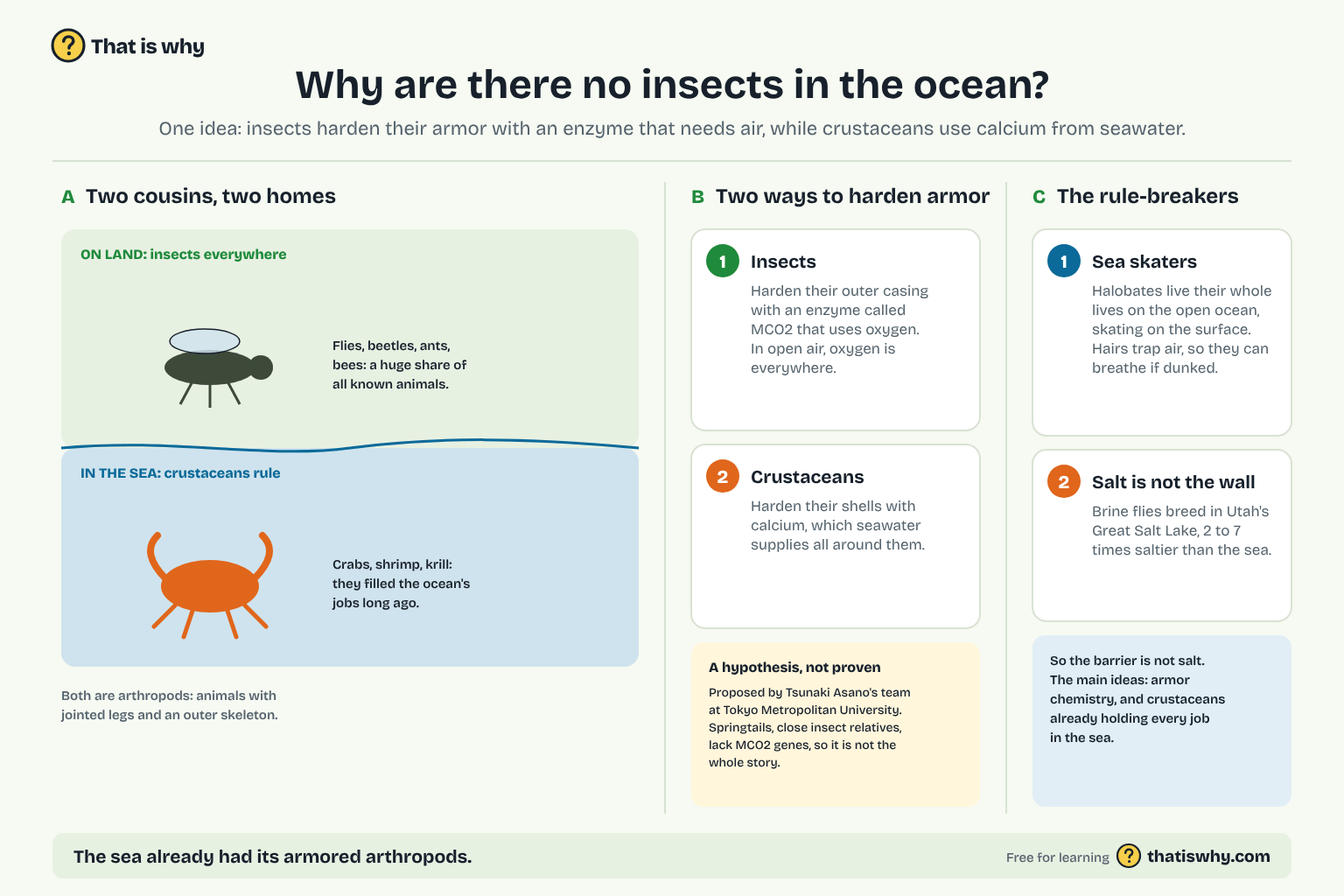
What the diagram shows
A. Two cousins, two homes. Insects and crustaceans are both arthropods, animals with jointed legs and an outer skeleton. Insects rule the land, while crabs, shrimp and krill fill the jobs in the sea.
B. Two ways to harden armor. A team led by Tsunaki Asano at Tokyo Metropolitan University proposed a simple explanation: insects harden their outer casing (sclerotization) with an enzyme called MCO2 that uses oxygen, which is everywhere in open air, while crustaceans harden their shells with calcium, which seawater supplies. It is a hypothesis, not a proven answer: springtails, close relatives of insects, lack MCO2 genes, so it isn't the whole story.
C. The rule-breakers. Sea skaters, Halobates, are the only insects known to spend their whole lives on the open ocean, skating on the surface; air trapped in their hairs even lets them breathe if dunked. And brine flies breed in Utah's Great Salt Lake, 2 to 7 times saltier than the ocean, so salt is not what keeps insects out.
Key numbers
| Fact | Value |
|---|---|
| Insect armor hardener | MCO2 enzyme, uses oxygen |
| Crustacean shell hardener | calcium from seawater |
| Great Salt Lake salinity | 2 to 7 times the ocean's |
| Open-ocean insects | sea skaters (Halobates) |
Common misconceptions
Myth Salt keeps insects out of the ocean.
The truth Brine flies breed in Utah's Great Salt Lake, 2 to 7 times saltier than the ocean, so salt alone is not the barrier.
Myth No insect lives on the open ocean.
The truth Sea skaters (Halobates) spend their whole lives on the ocean surface.
Myth Scientists have proved why insects avoid the sea.
The truth The oxygen-and-MCO2 idea is a hypothesis. Competition from crustaceans that already fill the sea's jobs is another key explanation.
Questions to use in class
Tap a question to reveal a model answer.
1How do insects and crustaceans harden their outer armor differently?
Insects use an enzyme called MCO2 that needs oxygen, while crustaceans use calcium from seawater.
2Why might the oxygen-using enzyme matter in the sea?
Air holds oxygen everywhere, but in water oxygen is much harder to get, which could make it hard for insects to harden their armor underwater.
3Which insects live on the open ocean, and how?
Sea skaters, Halobates, skate on the surface and trap air in their hairs so they can breathe if dunked.
4Why is salt not the main reason?
Brine flies breed in Utah's Great Salt Lake, which is 2 to 7 times saltier than the ocean.
Key terms
- Sclerotization
- The chemical hardening of an insect's outer casing after it forms. Insects use an oxygen-using enzyme, MCO2, for it, which may help explain why so few live in the sea.
Sources
- Surprisingly few insects live in the ocean, and we may finally know why ScienceAlert
- A Bug's Life at Sea Hakai Magazine
- Great Salt Lake, Utah U.S. Geological Survey