Free teaching diagram
Hoverfly Mimicry Diagram: Why Hoverflies Look Like Wasps
Same warning colors, no sting: birds see through the fakes, while mantises and crab spiders are easier to fool.
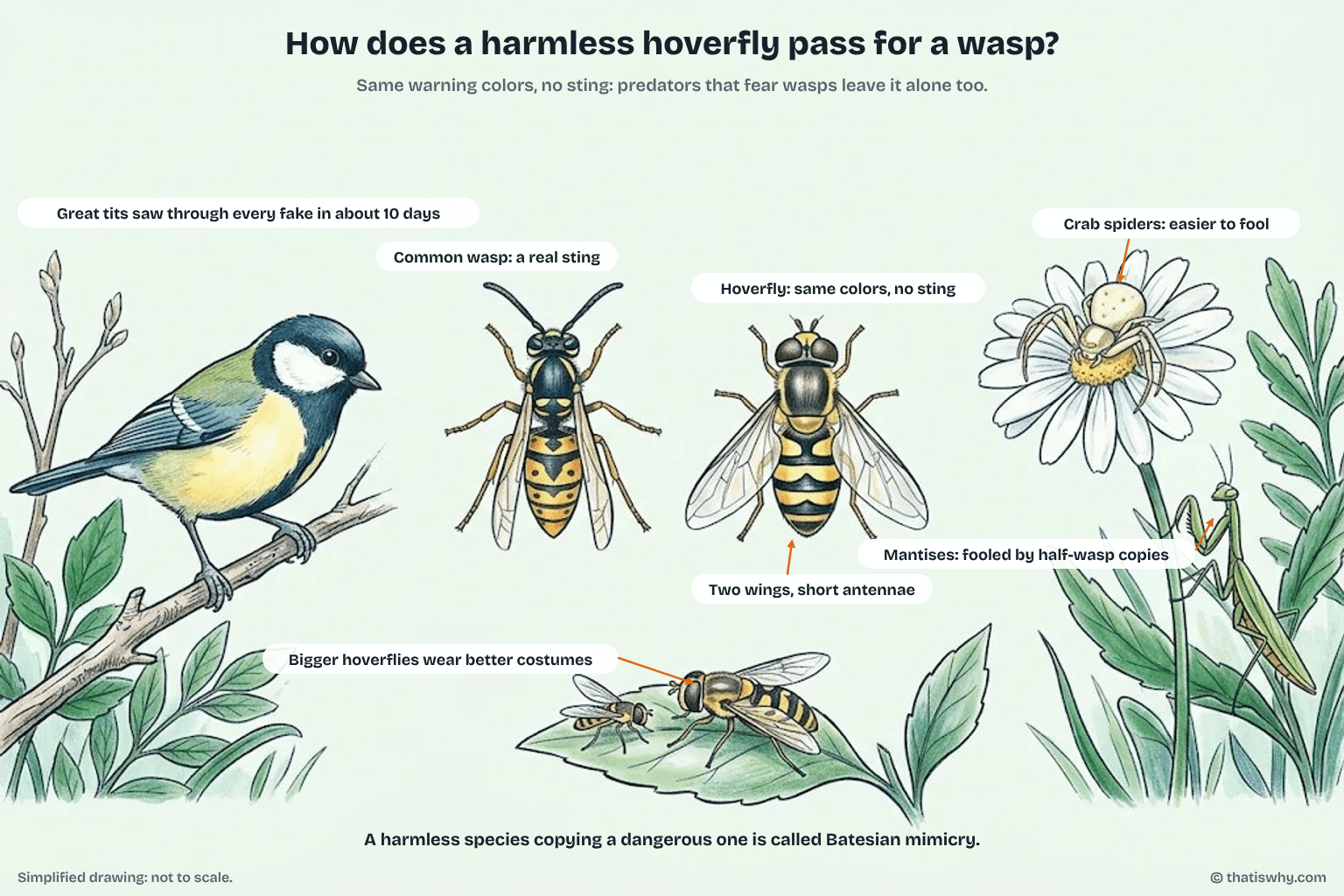
The detailed teaching diagram
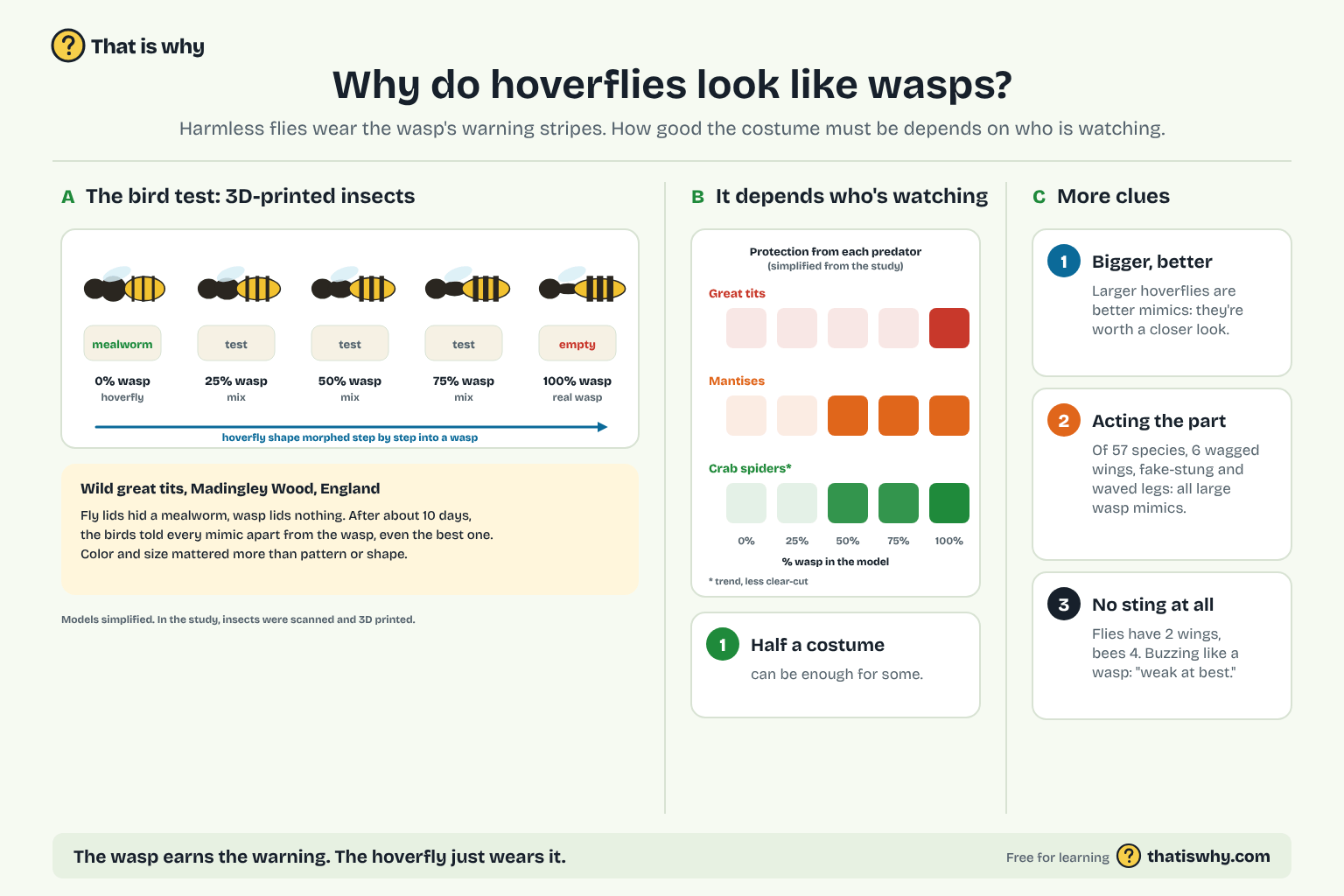
What the diagram shows
A. The bird test. Researchers scanned a hoverfly and a common wasp, morphed one into the other in steps (25%, 50%, 75% wasp) and 3D printed the models. Wild great tits in Madingley Wood, England, found a mealworm under fly models and nothing under wasp models. After about 10 days, the birds told every mimic apart from the wasp, even the best one. Color and size mattered more to them than pattern or shape. The models are drawn simplified.
B. It depends who's watching. Mantises were far easier to fool: protection jumped between the 25% and 50% wasp models, then matched the real wasp. Crab spiders showed a similar but less clear-cut trend. So a costume that never fools a bird can still save a hoverfly from a spider or a mantis. This is Batesian mimicry: a harmless species borrowing the warning coloration of a dangerous one. The grid is a simplified summary.
C. More clues. Larger hoverflies are better mimics; smaller ones face less scrutiny, a case of relaxed selection. Of 57 species tested in Canada, 6 also acted like wasps, wagging their wings, fake-stinging and waving their legs, all of them large wasp mimics. Hoverflies have no sting at all, and evidence that they buzz like wasps is "weak at best."
Key numbers
| Fact | Value |
|---|---|
| Time for great tits to spot every mimic | about 10 days |
| Model steps tested | 0, 25, 50, 75 and 100% wasp |
| Hoverflies tested for wasp-like behavior | 359, of 57 species |
| Species that acted like wasps | 6 |
| Wings on a fly / a bee | 2 / 4 |
Common misconceptions
Myth Hoverflies can sting.
The truth They have no sting at all; a few large wasp mimics fake a sting with their abdomen.
Myth Birds can't tell hoverflies from wasps.
The truth Wild great tits learned to tell every model mimic from the wasp within about 10 days.
Myth A poor mimic is a failed mimic.
The truth Mantises were fooled by models only halfway to a wasp, so a rough costume can still protect.
Questions to use in class
Tap a question to reveal a model answer.
1How did scientists test hoverfly costumes?
They 3D printed models morphed step by step from a hoverfly to a wasp and showed them to wild birds, mantises and crab spiders.
2What do birds notice most in a mimic?
Color and size matter more to them than pattern or shape.
3Why are some hoverflies better mimics than others?
Larger hoverflies are better mimics; they are worth a closer look from a predator.
4Do hoverflies act like wasps?
Of 57 species tested, 6 wagged their wings, fake-stung and waved their legs, all of them large wasp mimics.
Key terms
- Batesian mimicry
- When a harmless species resembles a harmful or unpalatable one, so predators or plant-eaters avoid it too.
- Warning coloration
- Bold, easy-to-remember colors, like a wasp's yellow and black, that tell predators an animal can hurt them. Predators learn the signal and avoid it.
- Relaxed selection
- When predators or other pressures barely punish small flaws in a trait, so evolution has little push to perfect it. Small hoverflies face less scrutiny, so rough wasp costumes survive.
Sources
- Mapping the adaptive landscape of Batesian mimicry using 3D-printed stimuli (Taylor et al., Nature 2025) University of Nottingham
- A comparative analysis of the evolution of imperfect mimicry (Penney et al., Nature 2012) Nature
- The relationship between morphological and behavioral mimicry in hover flies (Penney et al., The American Naturalist 2014) White Rose Research Online
- Carleton researchers make discovery about mimicry in flies Carleton University
- Bee Mimics: Their Buzz Is Worse Than Their Sting Northern Woodlands
- Batesian mimicry Encyclopaedia Britannica