Free teaching diagram
Honeycomb Hexagon Diagram: Why Bees Build Hexagons
Hexagons fill space with no gaps using the least wall, and warm wax pulls round cells into hexagons.
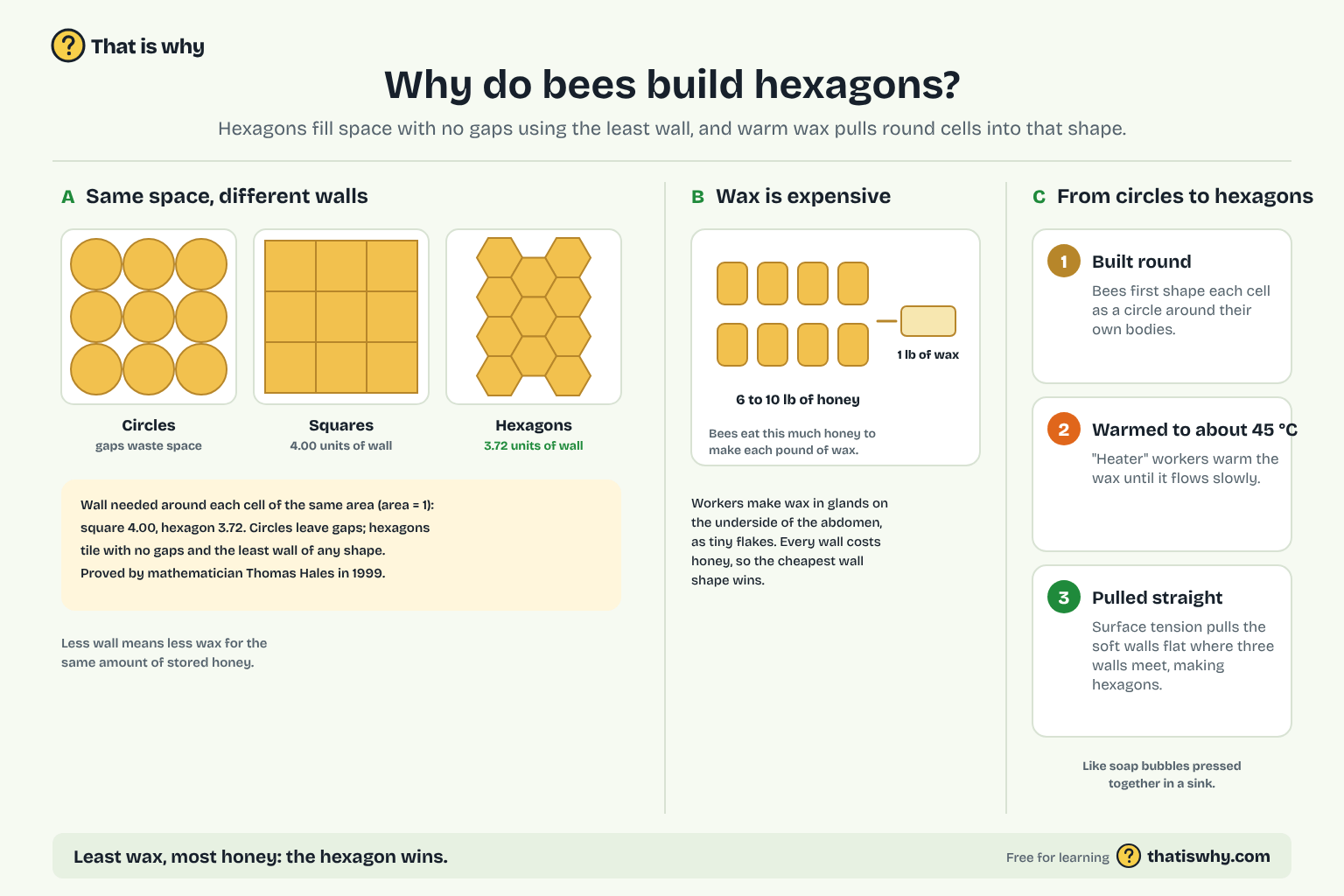
What the diagram shows
A. Same space, different walls. Circles leave gaps between them. Squares and hexagons both fit together with no gaps, a tessellation, but for cells of the same area a hexagon needs less wall: about 3.72 units around a cell of area 1, against 4.00 for a square. In 1999, mathematician Thomas Hales proved that no way of dividing a surface into equal areas uses less total edge than the hexagonal honeycomb.
B. Wax is expensive. Worker bees make wax as small flakes from glands on the underside of the abdomen, and they eat 6 to 10 pounds of honey for each pound of wax. Every bit of wall costs honey, so the shape with the least wall wins.
C. From circles to hexagons. Researchers at Cardiff University found that cells start out as circles. "Heater" workers warm the wax to about 45 °C, when it starts to flow slowly, and surface tension pulls the soft walls straight where three walls meet, turning the circles into hexagons, much like soap bubbles pressed together.
Key numbers
| Fact | Value |
|---|---|
| Wall per cell of area 1 | square 4.00, hexagon about 3.72 |
| Honey eaten per pound of wax | 6 to 10 lb |
| Wax temperature when it flows | about 45 °C |
| Honeycomb conjecture proved | 1999 (Thomas Hales) |
Common misconceptions
Myth Bees measure and calculate the angles.
The truth Cells start round; warm wax and surface tension pull the walls straight into hexagons.
Myth Any shape would hold honey just as well.
The truth Circles leave gaps, and squares need more wall than hexagons for the same space.
Myth Wax is cheap for bees.
The truth Bees eat 6 to 10 pounds of honey to make each pound of wax, so saving wall saves a lot of honey.
Questions to use in class
Tap a question to reveal a model answer.
1Why are hexagons better than circles for storing honey?
Circles leave gaps between them; hexagons fit together with no gaps.
2For cells of the same area, how much wall do squares and hexagons need?
For a cell of area 1, a square needs 4.00 units of wall and a hexagon about 3.72.
3How much honey does it cost to make wax?
Bees eat 6 to 10 pounds of honey for each pound of wax.
4How do round cells become hexagons?
Heater workers warm the wax to about 45 °C until it flows, and surface tension pulls the walls flat where three walls meet.
Key terms
- Tessellation
- Covering a flat surface with shapes that fit together with no gaps or overlaps. Of all ways to split a surface into equal areas, the hexagon tiling uses the least total edge.
- Surface tension
- The pull that makes a liquid's surface behave like a stretched skin, drawing it to the smallest area. In a warm hive it pulls soft wax walls straight into hexagons.
Sources
- The Honeycomb Conjecture (Hales, 1999) arXiv
- Secrets of bee honeycombs revealed Cardiff University
- Beeswax Encyclopaedia Britannica