Free teaching diagram
Hermit Crab Diagram: Why Hermit Crabs Line Up to Swap Shells
One roomy empty shell, a line sorted by size, and a chain of moves that fires in seconds.
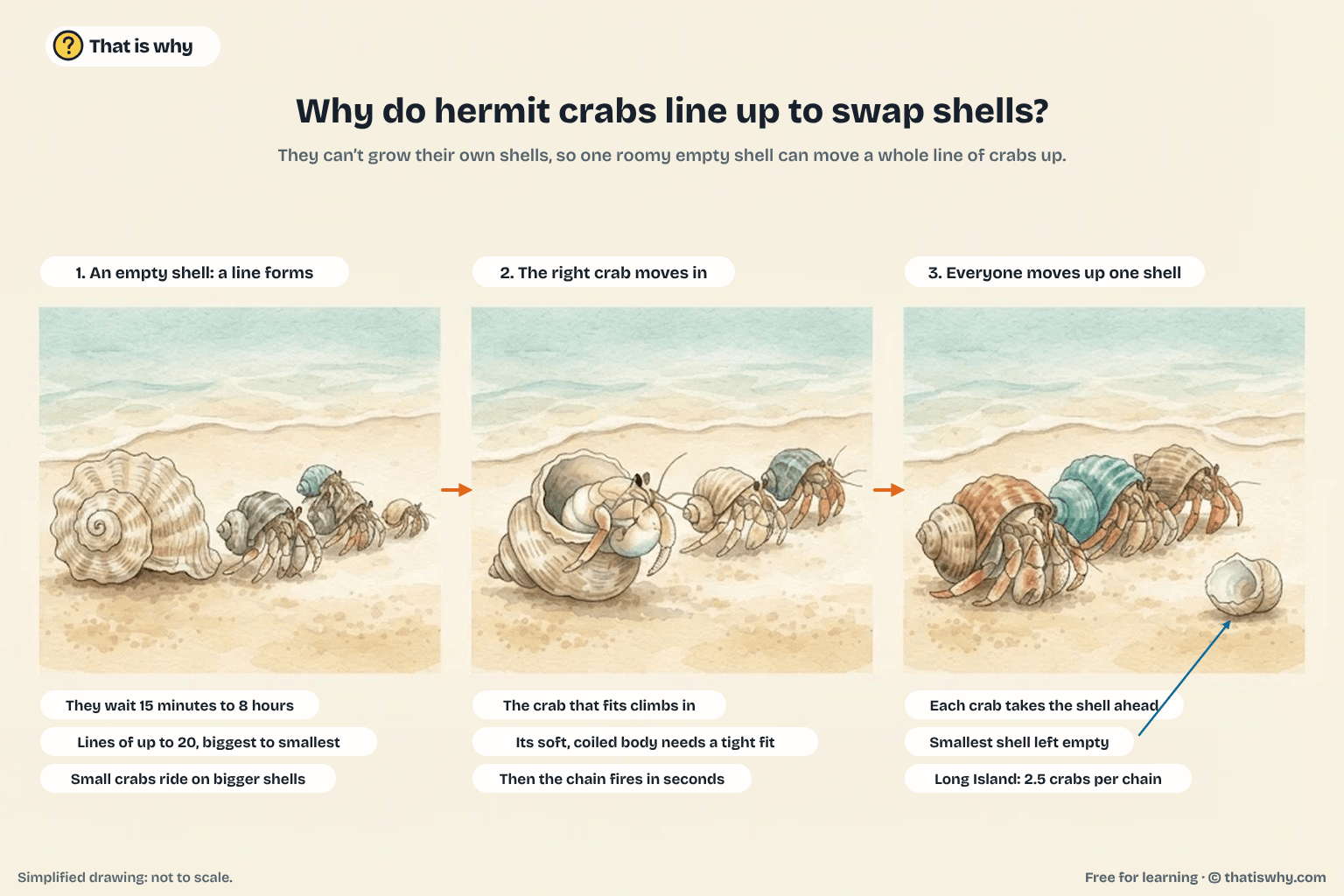
The detailed teaching diagram
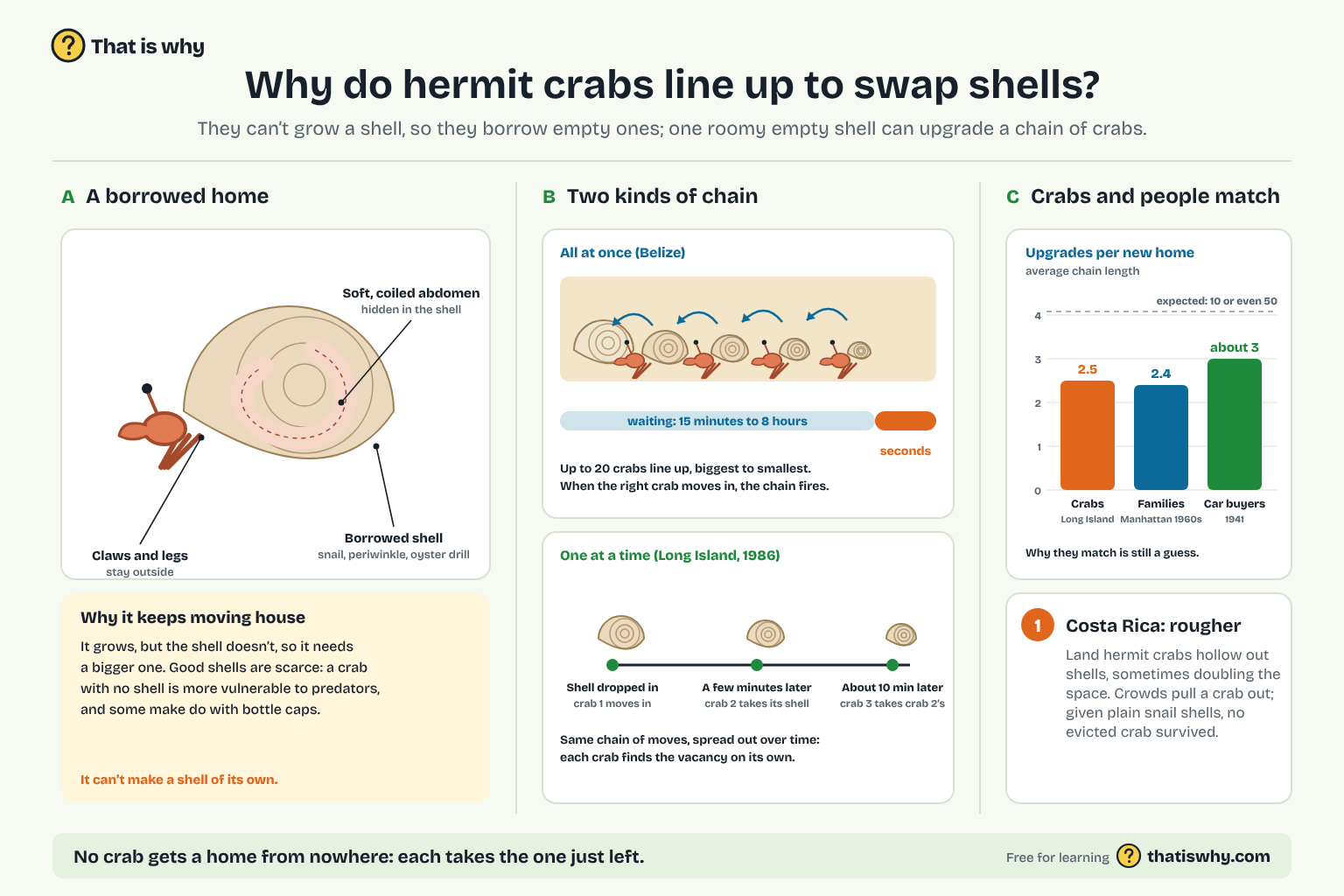
What the diagram shows
1. An empty shell, and a line forms. Hermit crabs have no shell of their own, so they borrow empty ones and need bigger ones as they grow. On Carrie Bow Cay in Belize, a crab that found a shell a little too big waited beside it for 15 minutes to 8 hours, while up to 20 crabs gathered in a line from biggest to smallest.
2. The right crab moves in. When the crab that fits the big shell arrives, it climbs in, and its old shell is suddenly free.
3. Everyone moves up one shell. Each crab in the line steps into the shell just left by the crab ahead, and the smallest shell is left empty. This cascade is a vacancy chain. On a Long Island beach, each chain upgraded 2.5 crabs on average, close to the 2.4 families per new apartment measured in 1960s Manhattan.
Key numbers
| Fact | Value |
|---|---|
| Shells set out on Carrie Bow Cay | 20 |
| Time crabs waited beside a too-big shell | 15 minutes to 8 hours |
| Largest group seen | 20 crabs |
| Crabs upgraded per chain, Long Island | 2.5 on average |
| Families upgraded per new apartment, 1960s Manhattan | about 2.4 |
| People per car chain, 1941 data | about 3 |
Common misconceptions
Myth Hermit crabs grow their own shells, like snails do.
The truth They have no shell of their own. They borrow an empty one that belonged to another animal, such as a snail, periwinkle or oyster drill, and trade up as they grow.
Myth One empty shell sets off a chain through dozens of crabs.
The truth In the chains started on a Long Island beach, between two and three crabs upgraded, 2.5 on average.
Myth Shell swapping is always friendly.
The truth Land hermit crabs in Costa Rica gang up to pull a neighbor out of its shell, and the evicted crab often ends up with the smallest one.
Questions to use in class
Tap a question to reveal a model answer.
1Why do hermit crabs line up by size?
When a roomy shell turns up, crabs wait beside it in a line from biggest to smallest, so that when the right crab moves in, each crab behind can step into the shell just left by the crab ahead.
2How long do hermit crabs wait for a shell?
On Carrie Bow Cay in Belize, crabs waited beside a too-big shell for anywhere from 15 minutes to 8 hours, in groups as large as 20.
3What is a vacancy chain?
A chain of moves set off by one newly empty home: each individual moves into the better home just left by another. The sociologist Harrison White coined the term.
4Do people form vacancy chains too?
Yes. In 1960s Manhattan, about 2.4 families moved to better apartments for each newly built home, close to the 2.5 crabs per chain seen on Long Island.
Key terms
- Vacancy chain
- A chain of moves set off by one newly empty home or job: each individual moves into the better one just left by another, so a single vacancy upgrades several in turn. Hermit crabs do it with shells, and people do it with apartments.
Sources
- On a Tiny Caribbean Island, Hermit Crabs Form Sophisticated Social Networks (Ferris Jabr) Scientific American
- Social Networking Helps Hermit Crabs Find Homes Tufts University, Tufts Now
- Hermit Crabs Trade Up by Exchanging Shells in Queue (printed as Life Is a Shell Game) Scientific American
- Hermit crabs socialize to evict their neighbors University of California, Berkeley, Berkeley News
- Hermit Crabs (Field Guide) Chesapeake Bay Program