Free teaching diagram
Clownfish Diagram: Why Clownfish Change Sex
Clownfish line up by size, the brain changes before the body, and a big female is what makes a pair successful.
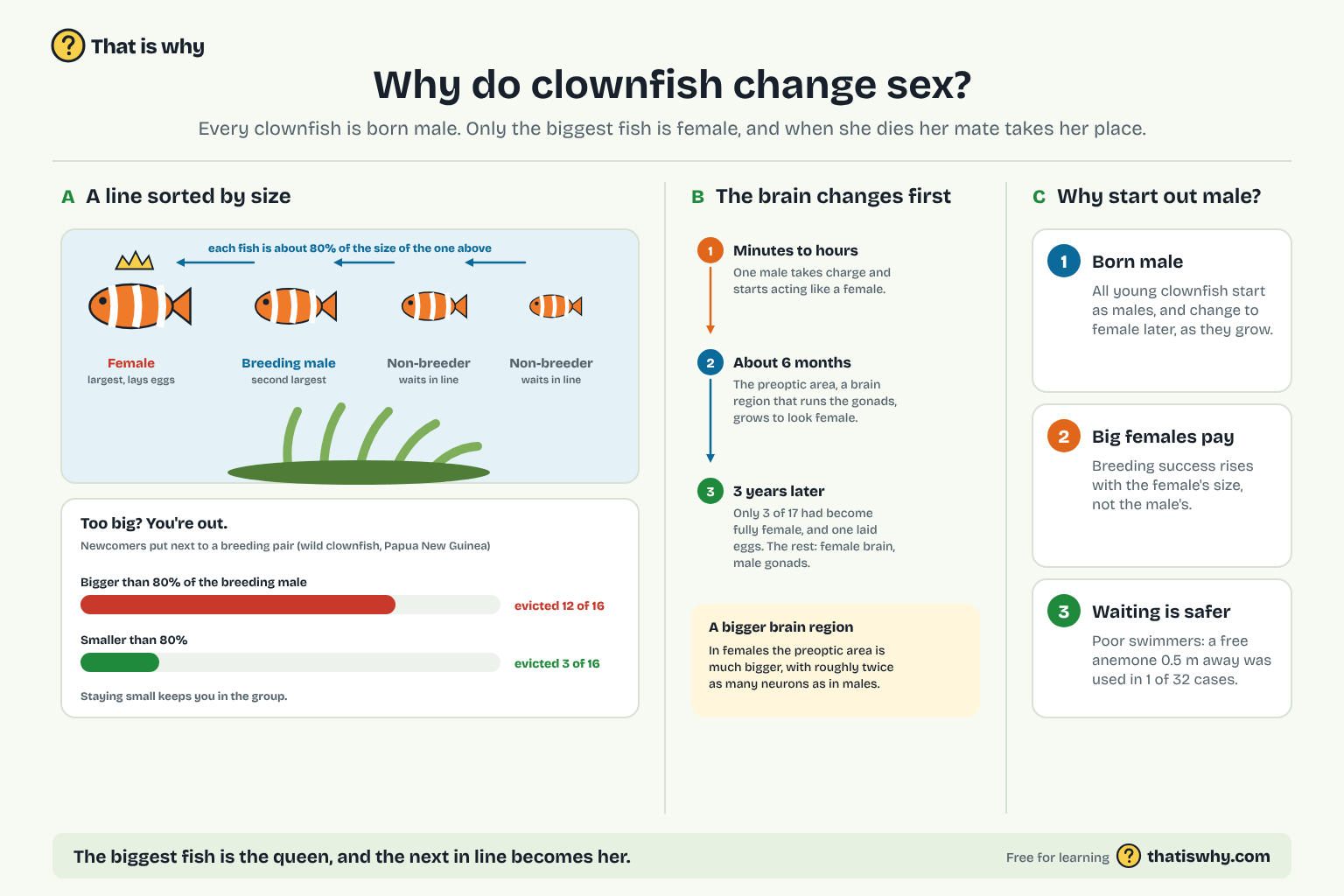
What the diagram shows
A. A line sorted by size. Clownfish live in small groups around one sea anemone. The largest fish is the female, the second largest is the breeding male, and the smaller fish are non-breeders waiting in line. Each fish tends to be about 80% of the size of the fish just above it. In wild clownfish in Kimbe Bay, Papua New Guinea, newcomers bigger than 80% of the breeding male's size were evicted in 12 of 16 cases, and smaller ones in only 3 of 16.
B. The brain changes first. When two males were put together in a lab, one took charge within minutes or hours and began acting like a female. Within about six months, its preoptic area, a brain region that regulates the gonads and is much bigger in females, with roughly twice as many neurons, had grown to look female. The gonads lagged: after three years only 3 of 17 dominant fish had become fully female, and one laid eggs.
C. Why start out male? All young clownfish start as males and change to female later as they grow, a pattern called protandrous sequential hermaphroditism. A pair's breeding success rises with the female's size but not the male's, which fits the size-advantage hypothesis. Waiting in line is also safer: clownfish are poor swimmers, and a free anemone placed 0.5 m away was used in only 1 of 32 cases.
Key numbers
| Fact | Value |
|---|---|
| Size of each fish vs the one above | about 80% |
| Too-big newcomers evicted | 12 of 16 |
| Smaller newcomers evicted | 3 of 16 |
| Brain change (preoptic area) | about 6 months |
| Fully female after 3 years | 3 of 17 |
| Free anemone 0.5 m away used | 1 of 32 cases |
Common misconceptions
Myth The biggest clownfish is the dad.
The truth The biggest one is the female. Her mate is the second largest.
Myth The sex change happens overnight.
The truth Behavior can change within minutes or hours and the brain within about six months, but in one lab study only 3 of 17 fish had fully become female after three years.
Myth The small fish are just young ones that haven't grown up yet.
The truth Many stay small on purpose: each tends to be about 80% of the size of the fish above it, and newcomers that are too big get evicted.
Questions to use in class
Tap a question to reveal a model answer.
1Which clownfish in a group is female?
Only the largest. The second largest is the breeding male, and smaller fish wait in line.
2What happens when the female dies?
Her mate starts acting female almost immediately and later becomes female, and the largest non-breeder becomes the new breeding male.
3What changes first, the brain or the body?
The brain. The preoptic area grows to look female within about six months while the gonads stay male for much longer.
4Why start out male?
A pair's breeding success rises with the female's size but not the male's, so it pays to be male while small and female when big.
Key terms
- Sequential hermaphroditism
- Changing sex partway through life. In protandry, the male-first version seen in clownfish, an animal starts out male and can later become female.
- Preoptic area
- A brain region that regulates the gonads, the organs that make eggs or sperm. In clownfish it is much bigger in females, with roughly twice as many neurons as in males.
- Size-advantage hypothesis
- The idea that an animal should change sex when a bigger body is worth more as one sex than the other. In clownfish, a pair's breeding success rises with the female's size but not the male's.
Sources
- For anemonefish, sex change happens first in the brain (Illinois News Bureau, on Rhodes and colleagues, Hormones and Behavior) University of Illinois, College of Liberal Arts and Sciences
- Ecological and social constraints combine to promote evolution of non-breeding strategies in clownfish (Branconi et al., Communications Biology 2020) Communications Biology (Nature Portfolio)
- Clownfish: Studying their Complex Lives and Anemone Homes Boston University
- Determinants of reproductive success in dominant pairs of clownfish: a boosted regression tree analysis (Buston and Elith, Journal of Animal Ecology 2011) Journal of Animal Ecology (PubMed abstract via PubAnnotation)
- The threat of punishment enforces peaceful cooperation and stabilizes queues in a coral-reef fish (Wong, Buston, Munday and Jones, Proceedings of the Royal Society B 2007) James Cook University
- Protandrous hermaphroditism in the clown fish Amphiprion percula from Andaman and Nicobar Islands Indian Journal of Fisheries (CMFRI repository)