Free teaching diagram
Cat Spine Diagram: Are Cats Really Liquid?
Whether something counts as liquid depends on time. A cat's bendy spine and loose collarbones let it fill a container, given a few minutes.
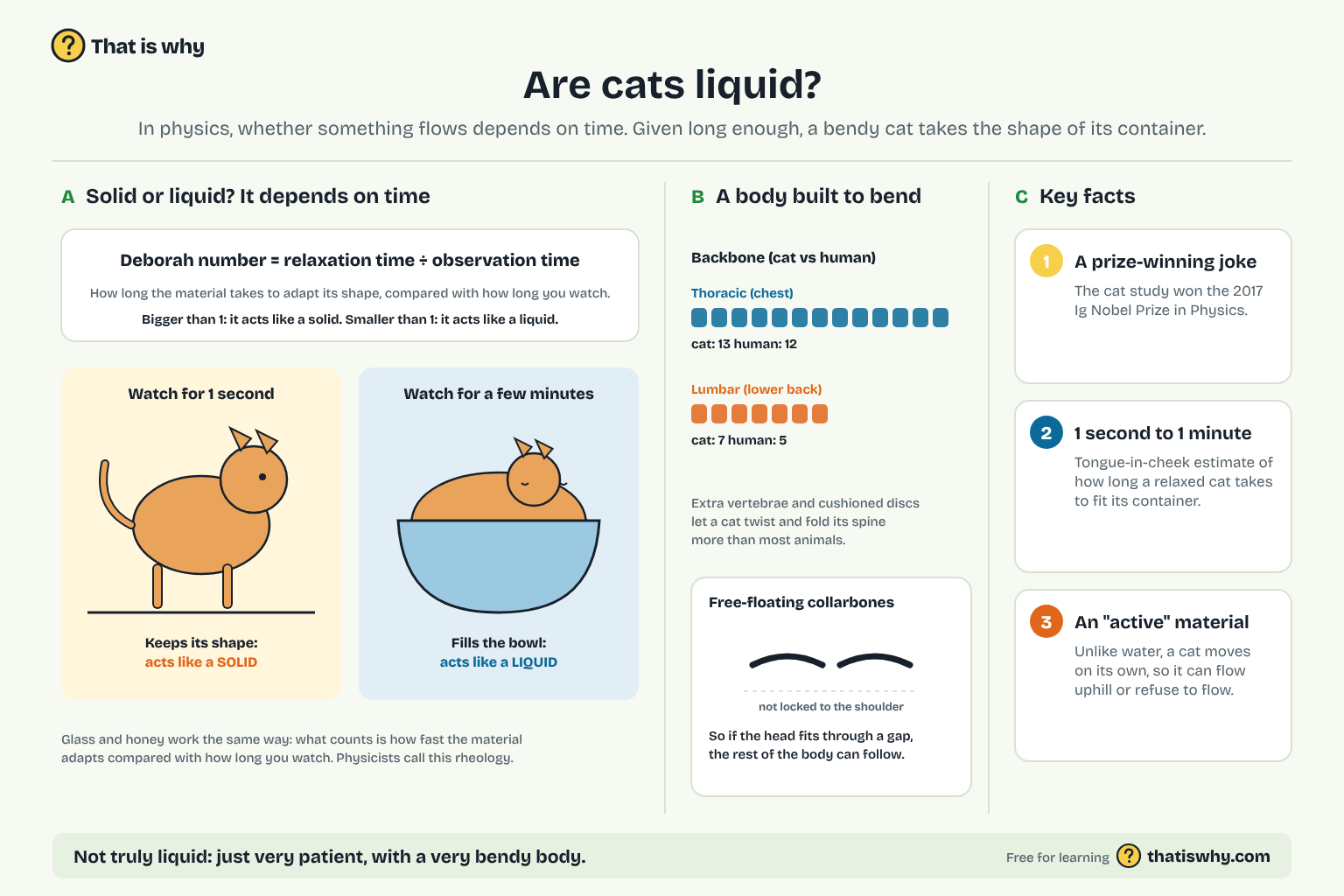
What the diagram shows
A. Solid or liquid? It depends on time. In rheology, the science of how materials flow, one useful measure is the Deborah number: a material's relaxation time (how long it takes to adapt its shape) divided by how long you watch it. If the number is bigger than 1, the material behaves like a solid; smaller than 1, like a liquid. Watch a cat for a second and it keeps its shape, like a solid. Watch for a few minutes and it may settle into a bowl, sink or box, filling it like a liquid.
B. A body built to bend. The joke works because cats really are very flexible. They have 13 chest (thoracic) vertebrae and 7 lower-back (lumbar) ones, against 12 and 5 in humans, with cushioning discs between them, so the spine can twist and fold more than most animals'. Their collarbones (clavicles) float freely instead of locking the shoulders in place, so a cat can pass its body through any gap its head fits through.
C. Key facts. The physicist Marc-Antoine Fardin's playful study of cat "rheology" won the 2017 Ig Nobel Prize in Physics. He estimated, tongue in cheek, that a relaxed cat takes about 1 second to 1 minute to adapt to its container. He also pointed out that cats are "active" materials: unlike water, they move on their own, so they can flow uphill or refuse to flow at all.
Key numbers
| Fact | Value |
|---|---|
| Thoracic vertebrae | cat 13, human 12 |
| Lumbar vertebrae | cat 7, human 5 |
| Solid-like | Deborah number above 1 |
| Liquid-like | Deborah number below 1 |
| Ig Nobel Prize | Physics, 2017 |
Common misconceptions
Myth Cats are boneless, which is how they squeeze into small spaces.
The truth Cats have a full skeleton. Their spines are very flexible and their collarbones are not locked to the shoulder, so they can fit wherever their head fits.
Myth Calling cats liquid is just a joke with no science.
The truth It is tongue-in-cheek, but it uses a real idea from rheology: whether a material flows depends on how long you watch compared with how fast it adapts.
Myth Solids and liquids are always clearly different.
The truth Many materials, like putty or honey, act solid over short times and flow over long times. The Deborah number captures this.
Questions to use in class
Tap a question to reveal a model answer.
1What is the Deborah number?
The material's relaxation time (how long it takes to adapt its shape) divided by the observation time. Above 1 it behaves like a solid; below 1, like a liquid.
2A cat takes about a minute to settle into a bowl. Is it solid or liquid if you watch for 5 seconds? For 10 minutes?
For 5 seconds, the Deborah number is about 60 ÷ 5 = 12, so solid-like. For 10 minutes, about 60 ÷ 600 = 0.1, so liquid-like.
3Why can a cat fit through any gap its head fits through?
Its collarbones float freely instead of being locked to the shoulder, so the shoulders can narrow, and its very flexible spine lets the body follow.
4Give an everyday example of a material that is solid-like or liquid-like depending on time.
Silly Putty bounces like a solid when dropped but slowly flows into a puddle if left alone.
Key terms
- Rheology
- The science of how materials flow and change shape, from honey and putty to, playfully, cats.
- Deborah number
- A material's relaxation time divided by the time you observe it. Above 1 it behaves like a solid; below 1, like a liquid.
- Relaxation time
- How long a material takes to adjust its shape after being pushed or poured into a new container.
- Vertebra
- One of the small bones that make up the backbone. Cats have more of them in the chest and lower back than humans do.
- Clavicle
- The collarbone. In cats it floats freely instead of locking to the shoulder, helping them squeeze through narrow gaps.
Sources
- On the rheology of cats (Fardin, Rheology Bulletin 2014) Fermat's Library
- Answering the question that won me the Ig Nobel prize: are cats liquid? PBS NewsHour
- Cat anatomy Wikipedia