Free teaching diagram
Bee Orchid Diagram: How a Flower Fakes a Female Bee
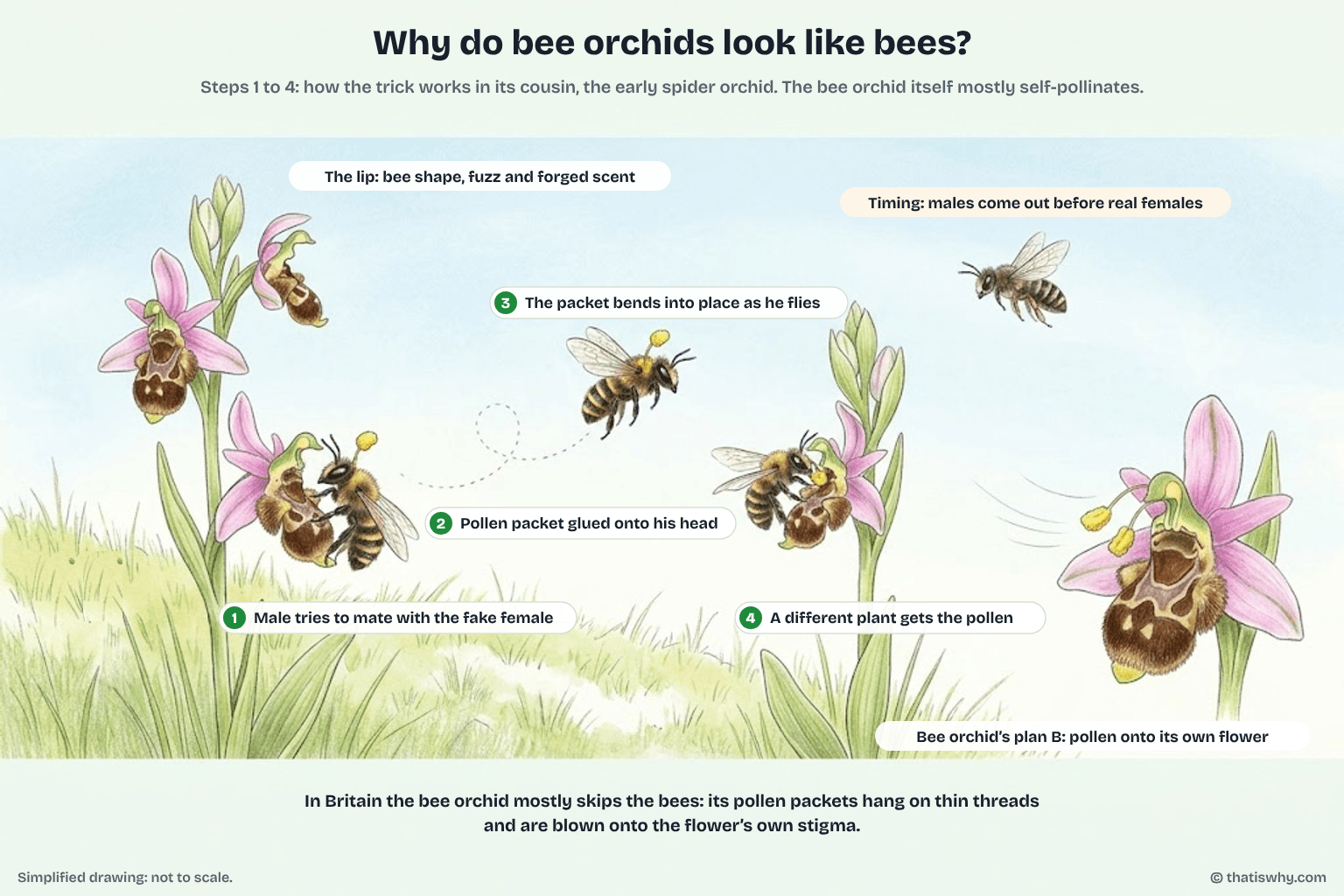
Steps 1 to 4 show the trick in the bee orchid's cousin, the early spider orchid; the bee orchid itself mostly takes plan B.
The detailed teaching diagram
What the diagram shows
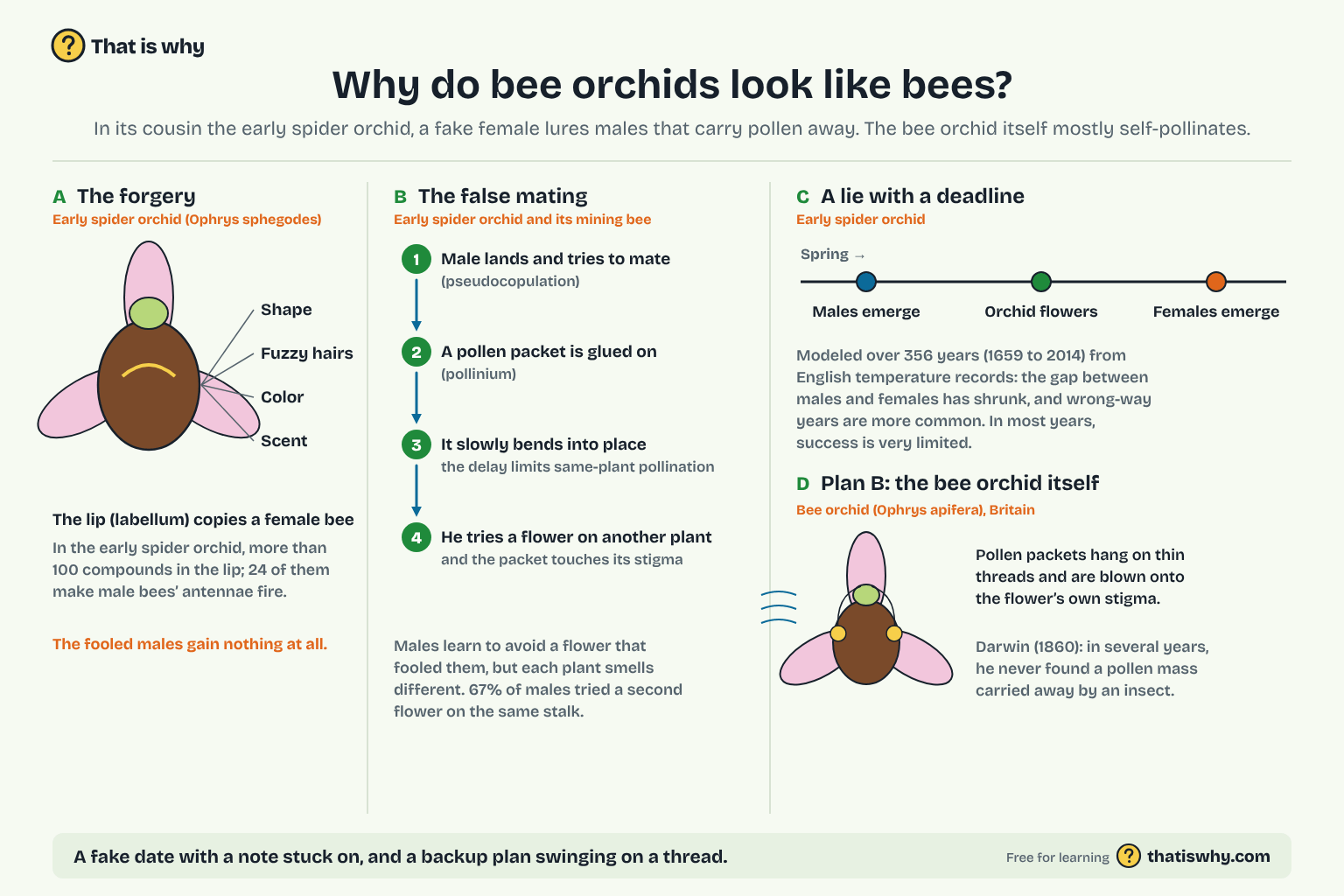
A. The forgery. In the bee orchid's family, the flower's lip (labellum) copies a female bee: its shape, its fuzzy hairs, its color and its scent. Most of what we know about the trick comes from a close cousin, the early spider orchid (Ophrys sphegodes), and its mining bee. In its lip, researchers found more than 100 compounds in the lip, and 24 of them made male bees' antennae fire. The fooled males gain nothing at all.
B. The false mating (early spider orchid). A male lands and tries to mate with the flower (pseudocopulation). A sticky pad glues a pollen packet (pollinium) onto him, and it slowly bends into place, a delay that limits pollination of another flower on the same plant. On a flower of another plant, the packet touches the stigma. Males learn to avoid a flower that fooled them, but each plant smells different, and 67% of males went on to a second flower on the same stalk. This whole trick is called sexual deception.
C. A lie with a deadline (early spider orchid). Male bees come out before females, and the orchid has to flower in that gap. Using temperature records back to 1659, researchers found that the gap has been shrinking and that wrong-way years have become more common. In most years, the system achieves very limited pollination success.
D. Plan B, the bee orchid itself. In Britain, the bee orchid is generally self-pollinated: its pollen packets hang on thin threads and are blown onto the flower's own stigma (self-pollination). In 1860, Darwin reported that in several years of looking he never found a single pollen mass carried away by an insect.
Key numbers
| Fact | Value |
|---|---|
| Compounds in the early spider orchid's lip | more than 100 |
| Compounds that make male bees' antennae respond | 24 |
| Males that tried a second flower on the same stalk | 67% |
| Years modeled in the timing study | 356 (1659 to 2014) |
| Darwin's letter about the bee orchid | 1860 |
Common misconceptions
Myth Bee orchids reward bees with nectar.
The truth The males fooled by these flowers gain nothing at all. They waste energy on a fake female and leave with only a pollen packet.
Myth The disguise is all about looks.
The truth The flower forges a scent too: in the early spider orchid, 24 compounds in the lip set off male bees' antennae.
Myth Every bee orchid depends on bees.
The truth In Britain the bee orchid is mostly self-pollinated: its pollen packets hang on thin threads and are blown onto its own stigma.
Questions to use in class
Tap a question to reveal a model answer.
1Why does a male bee try to mate with the flower?
In the bee orchid's relatives, like the early spider orchid, the lip copies a female bee's shape, fuzz, color and scent, so he takes it for a real female.
2Why does the pollen packet bend slowly after it is glued on?
The delay limits pollination of another flower on the same plant, so the pollen is more likely to reach a different plant.
3Why does the trick depend on timing?
Males come out before females. The orchid has to flower in that gap, before real females give the males something better to chase.
4How does the British bee orchid pollinate itself?
Its pollen packets hang on thin threads, and the breeze blows them onto the flower's own stigma.
Key terms
- Labellum
- The large central petal of an orchid flower, also called the lip. In Ophrys orchids, such as the bee orchid, it is reshaped to look, feel and smell like a female bee or wasp.
- Sexual deception
- A pollination trick in which a flower imitates a female insect's look, feel or scent, so males try to mate with it and carry its pollen away without any reward.
- Pseudocopulation
- A male insect's attempt to mate with a flower that imitates a female of its species. The flower uses it to stick pollen onto the male.
- Pollinium
- A packed bundle of pollen grains, made by orchids and a few other plants, that travels as one piece stuck to a visiting insect.
- Self-pollination
- When a flower is fertilized with pollen from the same flower or the same plant, with no need for an insect or another plant.
Sources
- Ophrys Encyclopaedia Britannica
- Evolution of reproductive strategies in the sexually deceptive orchid Ophrys sphegodes (Ayasse et al., Evolution 2000) Lund University
- Vulnerability of a specialised pollination mechanism to climate change revealed by a 356-year analysis (Hutchings et al., 2018) University of East Anglia
- Ophrys apifera Huds. Plants of the World Online, Royal Botanic Gardens, Kew
- Letter from Charles Darwin to the Gardeners' Chronicle, June 1860 Darwin Correspondence Project, University of Cambridge