Free teaching diagram
Anglerfish Light Diagram: Why Anglerfish Have a Glowing Lure
An anglerfish builds the rod and the bait, then catches its glowing bacteria from the open ocean.
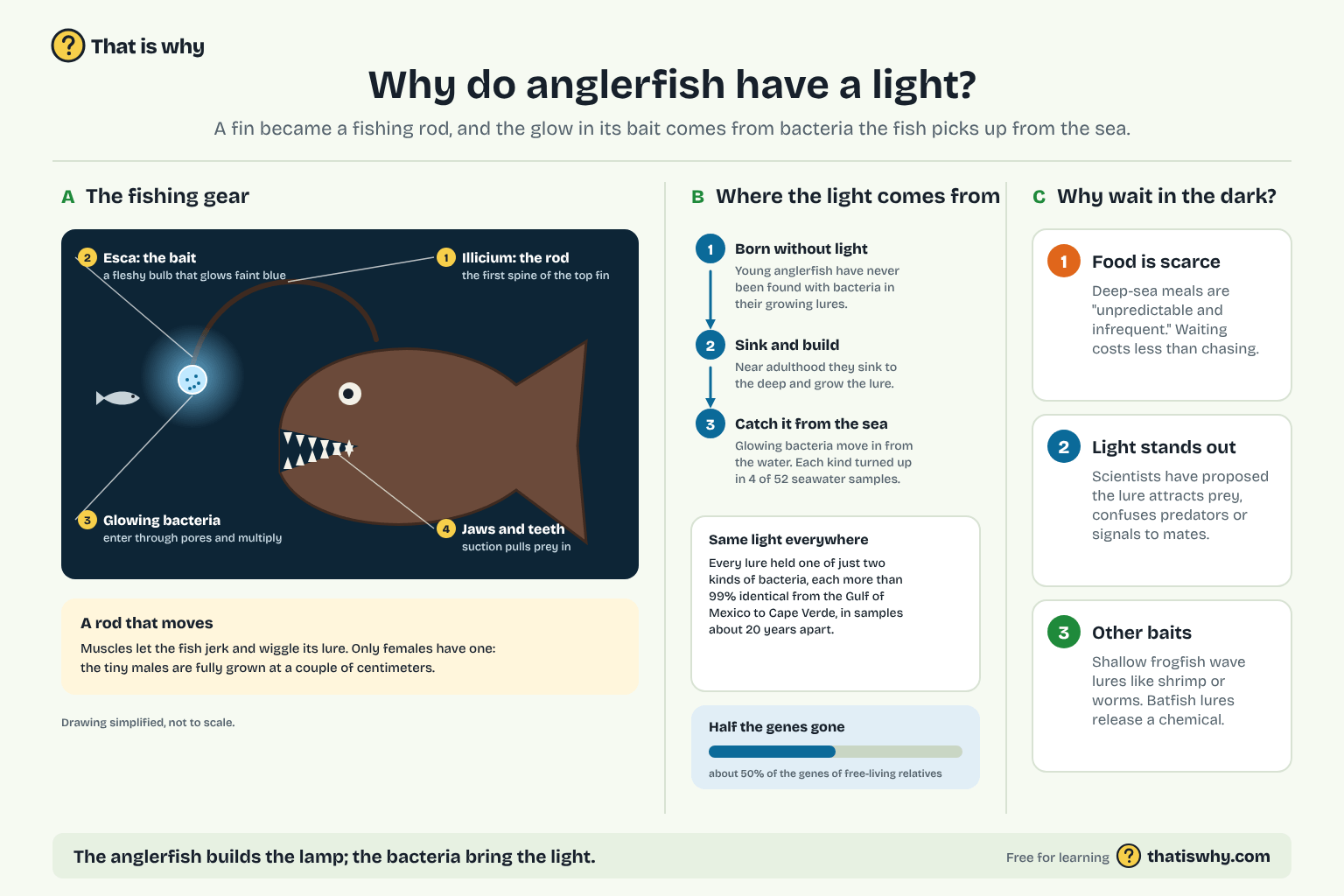
What the diagram shows
A. The fishing gear. The anglerfish's rod, the illicium, is the first spine of its top (dorsal) fin, stretched out over the head. At its tip sits the bait, the esca, a fleshy bulb that in deep-sea anglerfish glows a faint blue. The light is made by bioluminescent bacteria that enter through pores and multiply inside. Muscles let the fish jerk and wiggle the lure, and when prey comes close, a strong lower jaw creates suction that pulls it into a mouth of needle-sharp teeth. Only females have a lure; the males are fully grown at a couple of centimeters. The drawing is simplified and not to scale.
B. Where the light comes from. Young anglerfish have never been found with bacteria in their growing lures. Near adulthood they sink to the deep and grow the lure, and glowing bacteria move in from the water: each of the two known kinds turned up in 4 of 52 seawater samples. Every lure studied held one of just two kinds of bacteria, each more than 99% identical from the Gulf of Mexico to Cape Verde, in samples about 20 years apart. These bacteria have about half the genes of their free-living relatives, a case of genome reduction, yet they still survive in the open ocean. The partnership is a symbiosis: the fish gives shelter and food, the bacteria give light.
C. Why wait in the dark? Deep-sea food is "both unpredictable and infrequent," so waiting with a bait costs less than chasing. Scientists have proposed that the lure attracts prey, confuses predators or signals to mates. Not every anglerfish glows: shallow-water frogfish wave lures shaped like shrimp or worms, and batfish lures release a chemical.
Key numbers
| Fact | Value |
|---|---|
| Kinds of glowing bacteria found in anglerfish lures | 2 |
| How alike the bacteria of each kind were | more than 99% identical |
| Time between the oldest and newest samples | about 20 years |
| Seawater samples holding each kind of bacteria | 4 of 52 |
| Genes kept, compared with free-living relatives | about 50% |
| Size of a fully grown deep-sea anglerfish male | a couple of centimeters |
Common misconceptions
Myth The anglerfish makes its own light.
The truth The fish builds the lure, but the glow comes from bacteria living inside it, picked up from the seawater.
Myth Anglerfish are born with a glowing lure.
The truth Young anglerfish have never been found with bacteria in their growing lures; the lure grows near adulthood and the bacteria move in from the sea.
Myth Male anglerfish fish with a light too.
The truth In deep-sea anglerfish, only females have a lure. The males are fully grown at a couple of centimeters.
Questions to use in class
Tap a question to reveal a model answer.
1What is the anglerfish's fishing rod made of?
The first spine of its top (dorsal) fin, called the illicium. The bait at its tip is the esca.
2Where does the anglerfish's light come from?
From glowing bacteria that enter the bulb through pores and multiply inside. The fish picks them up from seawater.
3How do we know the bacteria come from the sea and not from the parents?
Young anglerfish have no bacteria in their growing lures, the bacteria do not follow the fish family tree, and the same bacteria were found floating in seawater samples.
4Why do anglerfish wait instead of hunting?
Deep-sea food is unpredictable and infrequent, so waiting with a bait costs less energy than chasing.
Key terms
- Illicium
- The anglerfish's fishing pole: the first spine of its dorsal fin, stretched out over the head, with the lure (esca) at its tip.
- Esca
- The fleshy bulb at the tip of an anglerfish's fishing pole. In deep-sea anglerfish it holds glowing bacteria that make it shine a faint blue.
- Bioluminescence
- Light made by a living thing through a chemical reaction. Most deep-sea bioluminescence is blue, the color that travels furthest in water.
- Symbiosis
- A close, long-lasting partnership between two different kinds of living thing, such as the scaly-foot snail and the bacteria that live inside it and make its food.
- Genome reduction
- When a microbe loses many of its genes over time, usually because a host supplies what those genes used to make. The bacteria in anglerfish lures have lost about half their genes.
Sources
- Study illuminates link between anglerfish, bacteria Cornell Chronicle, Cornell University
- Diverse deep-sea anglerfishes share a genetically reduced luminous symbiont that is acquired from the environment (Baker et al., eLife 2019) eLife
- Anglerfish Lure Prey Throughout the Ocean Smithsonian Ocean, Smithsonian Institution
- Pacific Footballfish California Academy of Sciences
- A rare black seadevil anglerfish sees the light Woods Hole Oceanographic Institution