Why Sound Travels Thousands of Miles in One Layer of the Ocean
If you drop a sound into the ocean at just the right depth, somewhere around 800 meters, it doesn’t behave the way you’d expect. It doesn’t spread out and gradually fade into the background. Instead, it seems to slip into a narrow layer of water and just… keep going, carrying on for distances that can stretch across entire ocean basins. This layer is known as the SOFAR channel, short for Sound Fixing and Ranging, and it’s one of the stranger quirks of how sound travels in the ocean. The odd part is how sharply this behavior is confined. Move a few hundred meters above or below that depth, and the same sound that could travel for thousands of miles becomes extremely difficult to detect, as if it never made the journey at all. It’s not simply that sound travels better in one place than another, it’s that one thin slice of the ocean seems to hold onto it, while the rest lets it slip away.
A Layer That Won’t Let Sound Drift Away
A helpful way to picture what’s going on is to imagine a long, open space—almost like a quiet room, where sound keeps trying to wander off but never quite succeeds. It drifts upward for a moment, then slowly curves back. It dips downward, then finds its way up again. There’s no wall to hit, no edge to bounce off, just this subtle, continuous tendency to return toward the middle, as if the space itself prefers to keep everything there. Over time, the sound stops spreading in every direction and instead settles into that central path, moving forward without really escaping it.
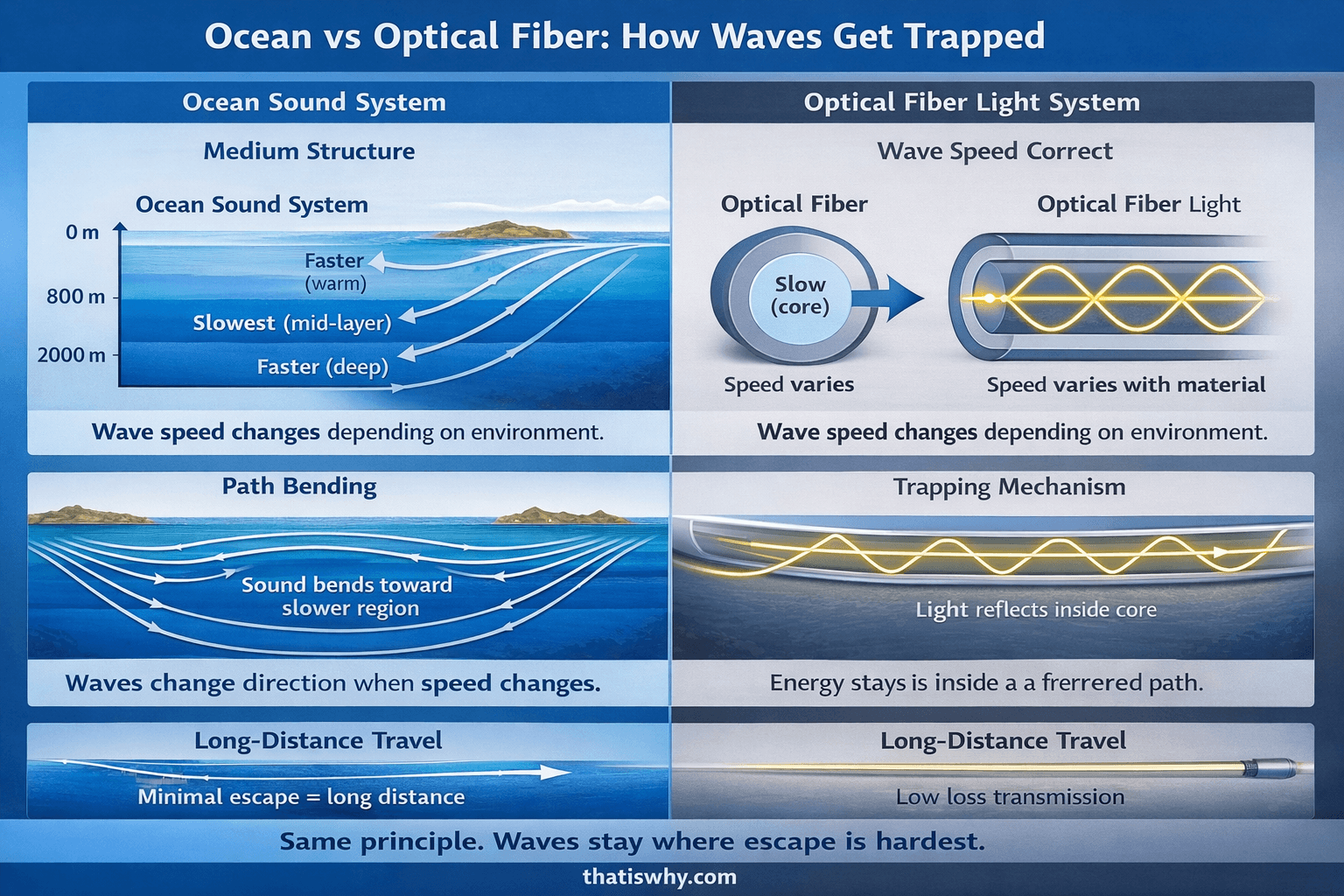
The SOFAR channel behaves in much the same way. There’s nothing you could point to and call a boundary, but the ocean quietly creates this kind of guidance. As the sound tries to leave that layer, its path begins to bend, gently turning it back again. Not abruptly, not all at once, just enough that it never gets very far before it’s drawn back into the same narrow band.
It’s not something you can point to or see happening. But the effect is clear enough: the sound never quite escapes that layer, even though nothing is physically stopping it.
Why Sound Keeps Finding Its Way Back
What’s giving that quiet room its strange behavior comes down to something you’d never notice just by looking at the ocean: the speed of sound isn’t the same at every depth.
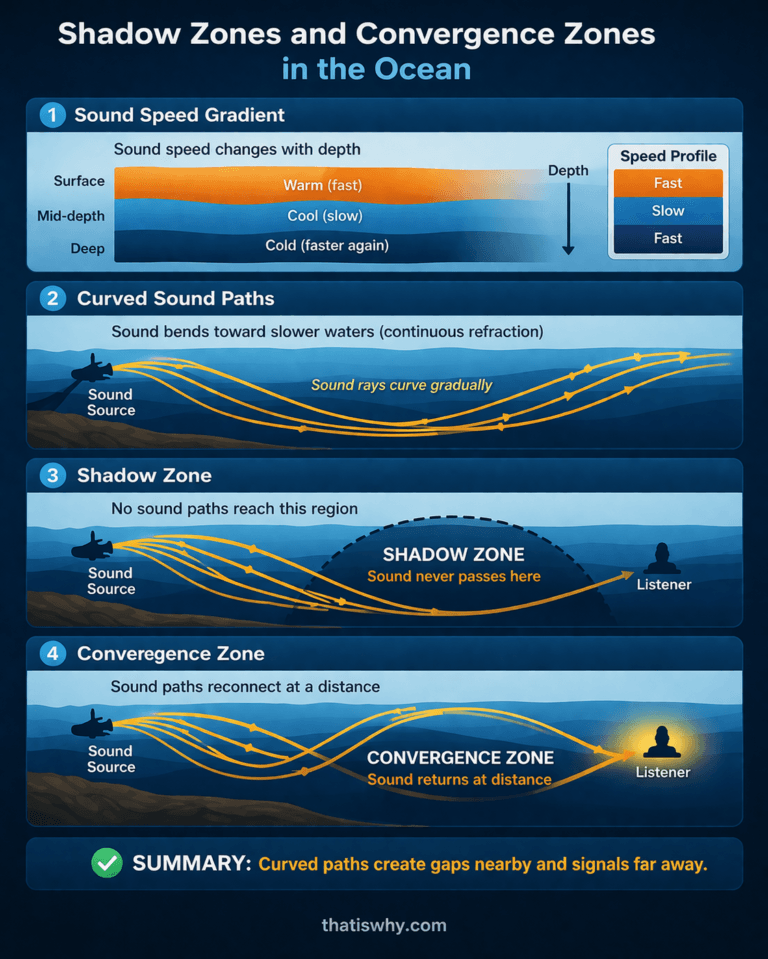
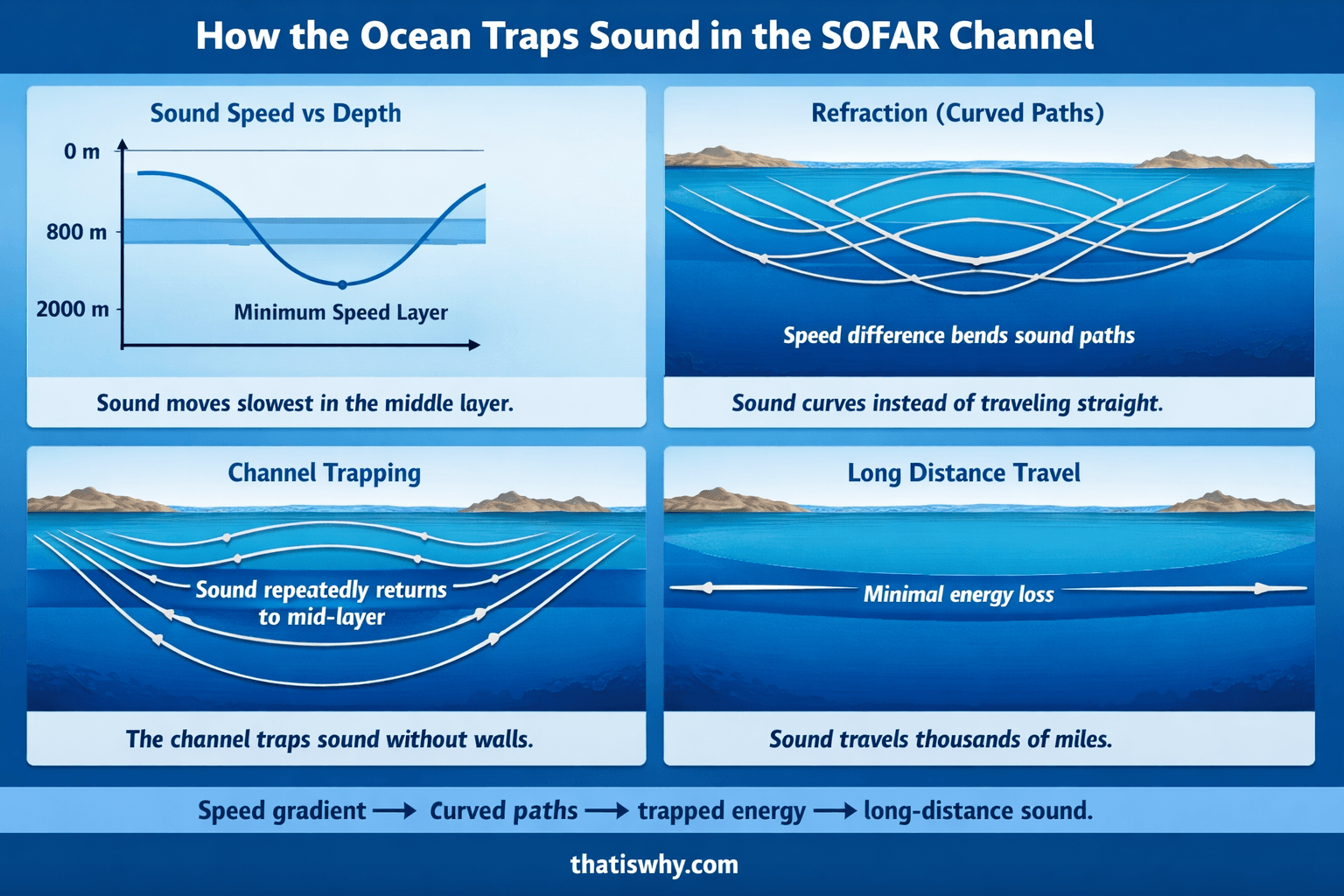
Up near the surface, where the water is warmer, sound moves a little quicker. As you go down, the temperature drops, and sound slows with it. But if you keep going deeper, something unexpected happens, pressure starts to take over, and sound begins to pick up speed again. So instead of changing in a straight line, the ocean ends up with this middle layer where sound is moving more slowly than it is above or below.
That layer is where everything starts to click.
If you return to that quiet room, this is what gives it that gentle “pull” back toward the center. When the sound drifts upward, it slips into a region where it moves faster, and its path begins to bend, almost lazily, back down again. If it dips too far, the same thing happens the other way, it curves upward without ever really breaking away.
Nothing dramatic is happening, no sudden turns, no sharp reflections just a path that keeps adjusting itself, over and over, so that every small detour turns into a slow return.
And after a while, that’s enough to keep it there.
Where Sound Never Quite Reaches You
If that middle layer behaves like a quiet room that keeps sound from drifting away, then the water just above and below it feels different in a way that’s hard to notice at first.
It’s not that those areas are silent, the ocean is never really quiet, there are always distant movements, shifting water, animals calling somewhere out of sight. But if you’re sitting outside that narrow layer, very little of that seems to reach you in a clear or consistent way.
Most of the sound never leaves that quiet room to begin with. It starts there, or gets drawn into it, and then keeps moving sideways instead of spreading up or down. And if something does begin outside that layer, it doesn’t travel freely either. Its path starts to curve away, slipping past rather than passing through.
So what you get isn’t a smooth drop-off in volume. It’s more uneven than that. Some places seem connected, where sound carries easily across long distances. Others feel oddly cut off, not because nothing is happening, but because you’re just not in the part of the ocean where those sounds are passing through.
Why Whale Songs Sound the Way They Do
Once you have that quiet room in mind, the way whales sound starts to feel less random. Their calls aren’t sharp or quick, but stretched out and low, with a kind of steady weight to them that doesn’t try to cut through the water so much as settle into it.
That difference turns out to matter more than it first seems. Shorter, higher sounds tend to lose their shape as they travel, breaking apart and fading long before they’ve covered any real distance. Longer, lower calls behave differently, they hold together, keeping their structure as they move through that same narrow layer without thinning out along the way.
So when a whale sends out a call like that, it isn’t forcing its way across the ocean or trying to overpower the distance. It’s placing the sound into that quiet room and letting the ocean carry it forward, using a type of sound that naturally stays intact once it’s there.
From that point on, the distance matters less than you’d expect. What matters more is that the sound fits the space it’s moving through.
When the Quiet Room Stops Working
For all the distance sound can travel in that layer, it isn’t something the ocean holds in place all the time. The quiet room only works as long as the conditions that shape it stay in balance, and that balance isn’t fixed.
Depending on where you are, that layer can sit deeper or closer to the surface, and it can shift slowly over time as the water above and below it changes. In calmer conditions, the paths stay smooth, and sound keeps folding back into that same narrow band. But when the ocean becomes more mixed, after strong winds, changing seasons, or moving currents, that pattern starts to loosen.
The sound still moves, but it no longer settles into that same steady rhythm. Instead of those gentle returns toward the middle, its path becomes less predictable, slipping away in places where it would normally be guided back. It doesn’t travel as far, and it doesn’t hold together in quite the same way.
What makes this interesting is that nothing about the sound itself has changed. The difference comes entirely from the space it’s moving through. The quiet room hasn’t disappeared, but it’s no longer as well defined, and without that subtle structure, the sound begins to behave more like we would expect it to in open water.
What We Tend to Assume About Sound in the Ocean
Myth #1: Sound travels far in the ocean because it’s loud.
Truth : It’s easy to picture distance as something you get by turning up the volume, but out there, loudness only gets you so far. A strong sound outside that narrow layer can fade much sooner than expected, while a quieter one placed inside it can carry much farther. The difference isn’t how powerful the sound is, it’s whether it ends up in that part of the ocean where its path keeps folding back into place instead of drifting outward.
Myth #2: The SOFAR channel is like a tunnel or a pipe.
Truth : That image feels natural because the effect is so focused, but there isn’t anything down there acting like a wall or a boundary. Nothing is enclosing the sound, what’s happening is more subtle than that. The path just keeps adjusting itself, again and again, so the sound stays close to the same depth without ever being physically contained.
Myth #3: The rest of the ocean is mostly quiet.
Truth : It can feel that way if you’re outside that layer, but not because nothing is happening. The ocean is full of sound, it’s just that most of it doesn’t travel in a clean, lasting way unless it happens to move through that same narrow band. So depending on where you are, you can end up slightly out of step with everything around you.
Where the Ocean Chooses to Carry a Voice
By the time you step back from all of this, the ocean starts to feel less like a place where sound simply travels, and more like a place where it moves unevenly.
In one thin layer, a call can cross enormous distances and still hold its shape. Just outside that layer, the same call can pass by without ever really arriving, not because it’s too weak, but because its path never quite lines up with where you are.
Nothing about the sound needs to change for that difference to happen. The only thing that changes is the space it moves through.
What carries far, and what fades early, isn’t always about how much force is behind it. Sometimes it comes down to whether it moves through a part of the world that lets it continue, or one that quietly disperses it along the way.
The ocean doesn’t amplify or silence anything on purpose. It just shapes the paths available. And depending on where you are, you can be surrounded by activity and still hear almost nothing, or find yourself in the path of something that began far beyond where you can see.
How We Researched This :
To explain this acoustic behavior, we looked at oceanographic research on the SOFAR (Sound Fixing and Ranging) channel, including work from NOAA, naval acoustics studies, and measurements of how sound speed changes with temperature and pressure at different depths.
But we knew that just citing sound speed profiles, thermoclines, and acoustic refraction data isn’t helpful. Our real job began when we asked, “What does this actually feel like?” That question led us to the “quiet room” analogy, a simple way to make the complex idea of sound paths constantly bending and returning toward a single layer feel intuitive.