Free teaching diagram
SOFAR Channel Diagram: How the Ocean Traps Sound
Sound is slowest about 1,000 m down, and sound waves keep bending back into that layer.
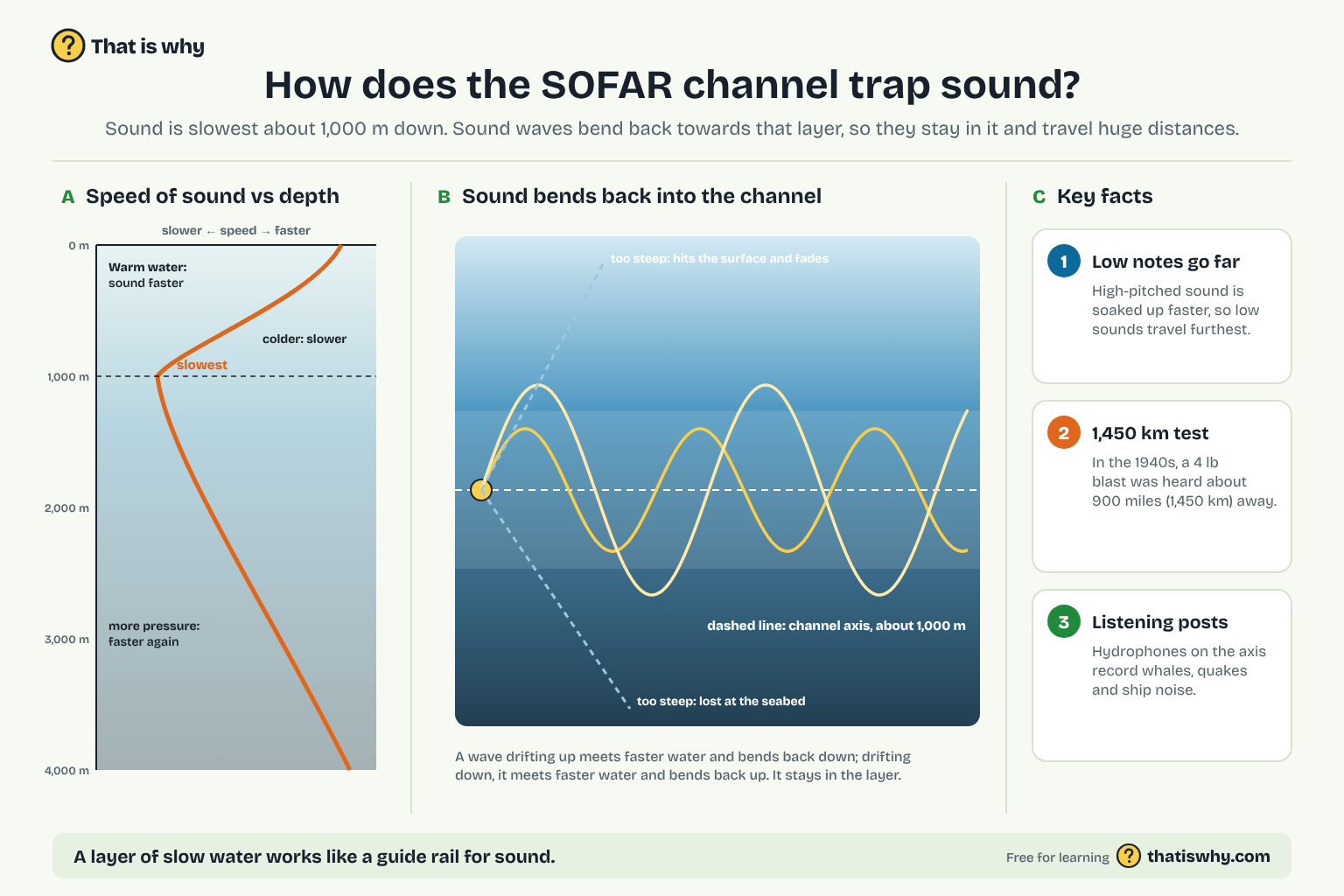
What the diagram shows
A. Speed of sound vs depth. The speed of sound in the sea depends mainly on temperature and pressure. Near the surface, the water is warm and sound is fast. Going down, the water cools and sound slows. Below about 1,000 m the temperature levels off at about 2 °C, but pressure keeps rising, and sound speeds up again. The result is a sound speed profile with a minimum, the slowest layer, at roughly 1,000 m in mid-latitudes.
B. Sound bends back into the channel. When a sound wave moves from slower to faster water, it bends (refraction) back towards the slower water. So a wave sent out near the slow layer that drifts upwards is bent back down, and one that drifts downwards is bent back up. It zigzags along the layer instead of spreading out. Waves that start too steeply, more than about 12° from horizontal, hit the surface or the seabed and fade.
C. Key facts. Low-pitched sound is absorbed far less than high-pitched sound, so it travels furthest. In the 1940s, a 4 lb explosive set off in the channel was heard about 900 miles (about 1,450 km) away. Today, hydrophones placed at the channel axis record whale calls, earthquakes and ship noise from huge distances.
Key numbers
| Fact | Value |
|---|---|
| Depth of the slow layer (mid-latitudes) | about 1,000 m |
| Deep water temperature | about 2 °C |
| Steepest waves that stay in the channel | about 12° |
| 1940s test distance | about 900 miles (1,450 km) |
Common misconceptions
Myth Sound travels far in the SOFAR channel because the water there is quiet.
The truth It travels far because waves that drift up or down bend back towards the slow layer, so the sound stays concentrated instead of spreading out.
Myth The SOFAR channel has walls, like a pipe.
The truth There is no boundary. The speed of sound simply changes with depth, and that gradual change bends the waves back.
Myth Louder sounds always travel further underwater.
The truth Pitch matters too. High-pitched sound is absorbed much faster, so low sounds go furthest.
Questions to use in class
Tap a question to reveal a model answer.
1Why does sound slow down as you go from the surface towards 1,000 m?
The water gets colder, and sound travels more slowly in colder water.
2Why does sound speed up again below about 1,000 m?
Below that depth the temperature hardly changes, but the pressure keeps rising, and higher pressure makes sound travel faster.
3A sound wave in the channel drifts upwards. What happens to it, and why?
It moves into faster water, which bends (refracts) it back down towards the slow layer.
4Why do whales use low-pitched calls to communicate over long distances?
Low sounds lose much less energy to absorption than high sounds, so they can be heard much further away, especially inside the channel.
Key terms
- SOFAR channel
- A layer of the ocean where sound travels slowest, so sound keeps bending back into it and can carry for hundreds or even thousands of kilometers.
- Sound speed profile
- A graph of how fast sound travels at each depth in the sea. It depends mainly on temperature and pressure, and usually has a minimum about 1,000 m down in mid-latitudes.
- Refraction
- The bending of a wave, such as light or sound, when its speed changes. In the sea, sound bends towards water where it travels more slowly.
- Thermocline
- A layer of water where the temperature drops quickly with depth, separating warm surface water from colder water below.
- Hydrophone
- An underwater microphone. Hydrophones placed in the SOFAR channel can record whale calls, earthquakes and ship noise from very far away.
Sources
- What is the SOFAR channel? NOAA Ocean Service
- Sound speed minimum Discovery of Sound in the Sea (DOSITS), University of Rhode Island
- Sound travel in the SOFAR channel Discovery of Sound in the Sea (DOSITS), University of Rhode Island