The Apple of Death: Why You Can’t Stand Under a Manchineel
The Manchineel doesn’t hurt you when you touch it.
It hurts you when you stand near it and let the weather do the rest.
It holds the Guinness World Record for the most dangerous tree in the world, not because it strikes or stings, but because rain turns it into a slow chemical burn. Shelter under it during a storm, and your skin can blister as if it’s been splashed with something corrosive.
The strange thing about the Manchineel isn’t that it’s toxic. What’s unusual is how little effort it takes for this one to hurt you. You don’t have to break a leaf, chew the fruit, or even touch it. In the wrong conditions, being nearby is enough.
That’s because this tree doesn’t defend itself the way we expect. There are no spines, no injected venom, no single dramatic encounter. Its danger behaves more like a leaking battery left in the rain. As long as it stays dry, the threat feels contained. Add water, and whatever was sealed inside begins to spread.
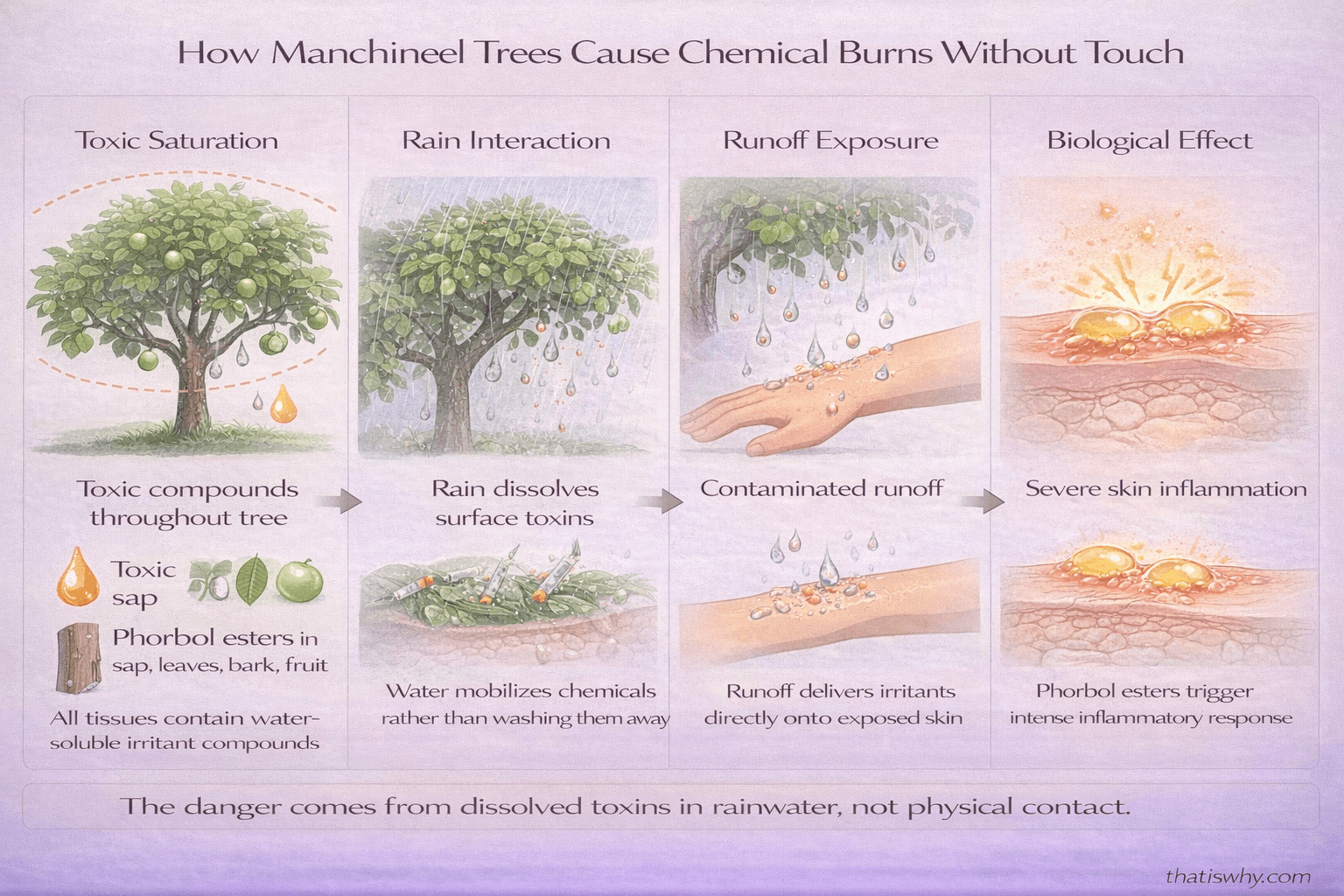
Every part of the Manchineel is saturated with toxic compounds. Bark, leaves, sap, and even the smoke from burning its wood carry the same chemistry. When rain hits the canopy, it doesn’t wash that chemistry away. It dissolves it and redistributes it downward. What reaches the ground isn’t shelter. It’s runoff.
Seen this way, the tree’s reputation stops sounding exaggerated. The Manchineel isn’t attacking anyone. It’s leaking, and the environment does the rest.
The Tree That Hates You
If the Manchineel looked dangerous, most of its reputation wouldn’t be necessary. But it does the opposite. It’s lush, green, and perfectly at home on beaches and coastal paths. In Florida and across the Caribbean, it grows exactly where people stop, sit, and look for shade. Nothing about it invites caution.
That mismatch has been causing trouble for centuries. Early Spanish explorers learned quickly that this tree didn’t behave like the others around it, and they gave it a name that stuck: manzanilla de la muerte, the little apple of death. Not because it killed indiscriminately, but because treating it like an ordinary tree kept ending badly.
The reason is saturation, it isn’t dangerous because of one toxic feature. The chemistry runs through the entire structure. In that sense, it’s less like a plant with a few poisonous parts and more like a sealed battery shaped like a tree. A milky white sap fills the bark, branches, and leaves, carrying corrosive compounds everywhere. Break a twig and it leaks, nick the bark and it seeps. Even small amounts on skin can cause severe inflammation, and a single drop in the eye can cause blindness.
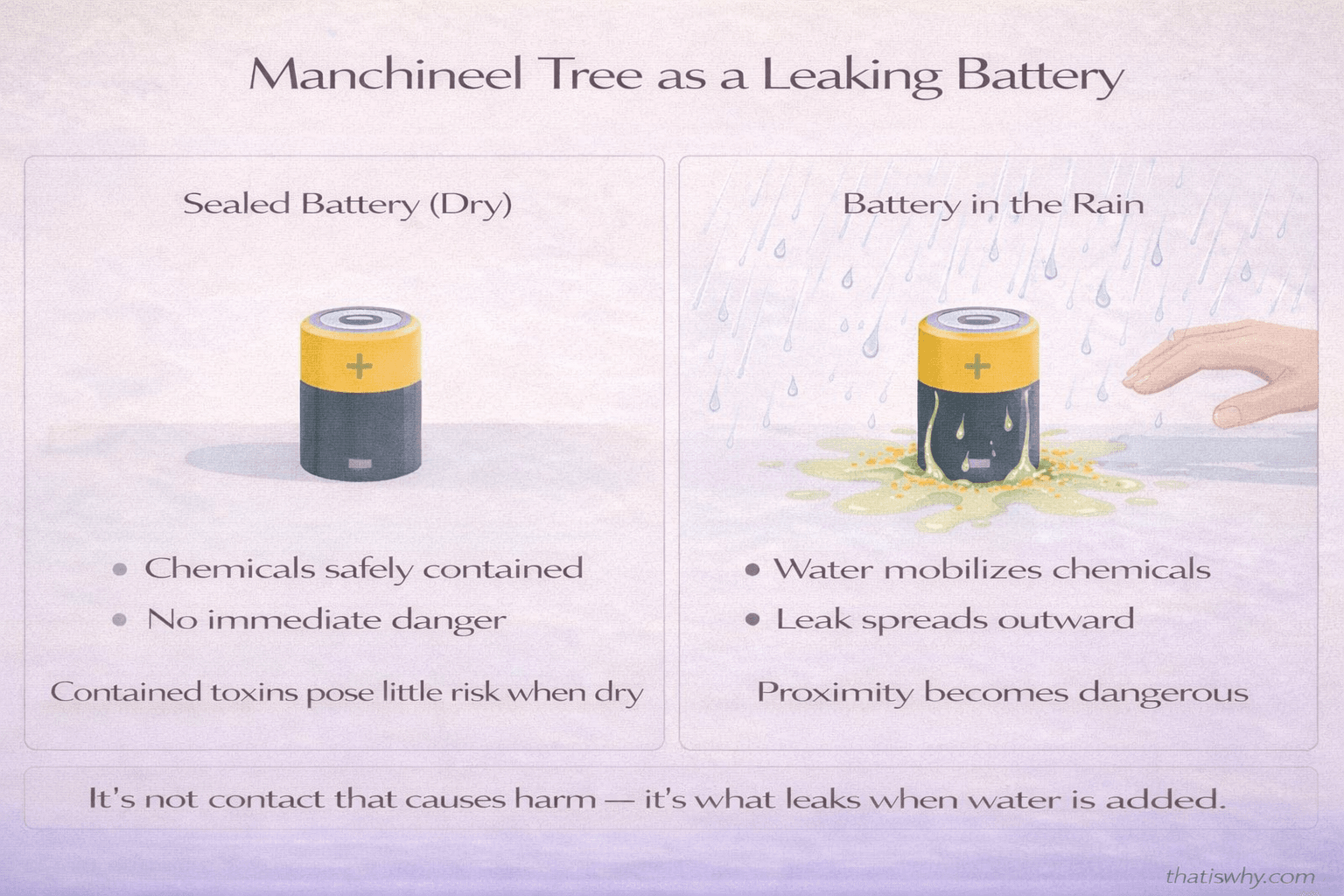
As long as everything stays intact and dry, the danger feels distant. The surface looks fine. The tree looks calm but what’s inside doesn’t weaken with time. It stays active, waiting for a way out.
The Manchineel doesn’t need to strike or react. Once the outer barrier fails, what’s inside leaks, spreads, and burns. The tree does what batteries do when containment fails.
The Rain of Terror
On a dry day, the Manchineel can seem uneventful everything looks sealed and the surface is intact. Nothing appears to be leaking. It’s the same uneasy confidence you get from an old battery that’s still holding its shape.
Rain breaks that illusion.
The tree’s toxins are water-soluble, which means rain doesn’t wash them away. It dissolves them. As water hits the leaves, it pulls sap into solution and carries it downward. What forms on the leaf surface isn’t just rain anymore. It’s runoff.
Once that starts, the behavior is predictable. The liquid gathers, drips, and spreads, following gravity and coating whatever is underneath. If you’re standing below, your skin becomes the surface it flows across. The exposure isn’t sharp or localized. It’s broad and continuous.
That’s why people can blister within minutes of sheltering under a Manchineel during a storm. The sensation feels like a burn because the compounds involved aggressively irritate skin cells, producing inflammation that closely resembles chemical injury. Nothing dramatic needs to happen. Once the contents start moving, contact is hard to avoid.
Scale is what makes this dangerous. A single leaf might irritate. A full canopy in the rain behaves more like an entire casing giving way at once. The tree doesn’t attack. It drips, steadily, and water does the rest.
The same logic explains another warning: never burn Manchineel wood. Heat drives the chemicals out through smoke instead of runoff. Inhaling that smoke can inflame eyes and airways, sometimes causing temporary blindness. Different route, same failure.
Rain isn’t an unlucky detail. It’s the moment containment fails. The tree stays put. Like a battery that finally gets wet, it stops keeping what’s inside to itself.
The Fruit: A Sweet Mistake
Of all the ways the Manchineel can hurt you, the fruit is the most deceptive. Small, green fruits hang from the branches, looking exactly like crabapples. They’re smooth, glossy, and unremarkable. Without context, there’s no reason to be suspicious.
That’s how people get into trouble. The fruit smells pleasant, and the first bite doesn’t feel alarming. It’s often described as sweet at first, with a faint peppery note. Radiologist Nicola Strickland documented how ordinary those first moments felt, which helps explain why this mistake keeps happening.
The reaction comes quickly. The mouth and throat burn. Swelling follows. Blisters form along the lining of the mouth and esophagus. Swallowing becomes painful and difficult. The experience feels less like food poisoning and more like a chemical injury, because the same compounds that burn skin don’t become harmless when eaten.
The fruit behaves like a damaged battery casing when it’s breached. As long as it’s intact, the contents stay contained. Bite into it, and that containment fails directly onto sensitive tissue. There’s no delayed toxin and no clever delivery the chemistry is simply released.
Deaths are rare, largely because the pain is immediate and convincing. People stop eating quickly, usually followed by a trip to the emergency room. The danger isn’t that the fruit is secretly lethal. It’s that it’s convincingly normal until it isn’t.
Some animals, particularly iguanas, can eat the fruit without harm. Their physiology handles the compounds differently, suggesting the apple was never meant for mammals at all. Like much of the tree’s chemistry, the danger is selective.
Why So Toxic?
At some point, the Manchineel stopped relying on one-off defenses and started shaping the space around it instead. That shift makes sense once you consider where it lives.
Coastlines are punishing environments. Large animals pass through repeatedly. Storms break branches. Salt, wind, and sand wear everything down. In that setting, a defense that works once isn’t very useful. What matters is preventing repeat contact.
The Manchineel’s solution was saturation. Instead of hiding toxins in one place, it spread them everywhere, the way corrosive material fills a battery casing. Bark, leaves, sap, fruit, and smoke all carry the same chemistry. There’s no safe place to touch and no clever workaround.
One explanation is deterrence. Extinct megafauna, like giant ground sloths, were large enough to damage trees simply by moving through them. A chemistry that punished proximity would have made repeated contact a losing strategy.
Another explanation is exclusion. The same compounds that burn skin also inhibit nearby plant growth. Once the chemistry spreads, the space itself becomes difficult to occupy. Like a leaking battery, the problem doesn’t stay neatly contained.
In both cases, the logic is the same. The tree isn’t built to strike or react. It’s built to hold something harmful and let the environment release it.
When Danger Becomes Part of the Environment
Once you understand what the Manchineel is doing, it starts to feel familiar. Not because trees like this are common, but because humans build hazards that behave the same way.
A leaking battery isn’t dangerous because it explodes, it’s dangerous because it spreads. Moisture carries corrosion outward while heat turns it into fumes. The safest response isn’t careful handling, it’s distance.
That’s exactly how the Manchineel operates. Rain turns shade into exposure and smoke turns distance into risk. Over time, animals and people learn the same lesson without needing a sign.
Humans design exclusion zones for the same reason. Leaks travel. Runoff spreads. Air carries things farther than expected. The danger isn’t confined to a point. It’s distributed.
The Manchineel arrived at this logic on its own. Instead of reacting to threats, it lets ordinary conditions do the work.
A Dangerous Tree We Get Wrong
Myth #1: “It’s basically acid.”
Truth: The injuries feel like acid burns, but the chemistry is different. Phorbol esters are powerful irritants, which explains why the damage behaves like an extreme inflammatory burn rather than a simple corrosive splash.
Myth #2: “It kills instantly.”
Truth: The danger comes from how easily exposure happens, not from sudden lethality. Deaths are rare because pain and damage stop people from continuing.
Myth #3: “You’re safe if you don’t touch it.”
Truth: Rain and smoke can carry toxins without direct contact. Once the chemistry moves, proximity matters more than touch.
Myth #4: “If animals eat it, it can’t be that dangerous.”
Truth: Some species tolerate the fruit, but that selectivity doesn’t extend to humans.
The Kind of Danger You Learn to Avoid
We’re good at spotting danger that announces itself clearly. The Manchineel belongs to a quieter category, the kind that makes the space around it uncomfortable rather than chasing you away.
Most people already understand this pattern. You don’t pick up a corroded battery sitting in the rain. You notice the residue and step back. The danger isn’t in a single touch. It’s in what leaks and spreads.
That’s how the Manchineel works. Shade feels safe until rain changes the equation. Distance feels reassuring until smoke carries the chemistry farther than expected.
Humans design around this instinctively. We avoid damaged equipment not because we’re timid, but because contamination rarely stays put. Space is often the smartest response.
The Manchineel arrived at the same solution through evolution. Instead of reacting to threats, it makes interaction itself the mistake.
Some dangers don’t need to be confronted. They only need to be recognized early enough to step back. The Manchineel doesn’t reward bravery. It rewards restraint.
How We Researched This :
To explain why the Manchineel causes burns even without direct contact, we looked at toxicology research on Hippomane mancinella, forestry and public safety documentation from the Florida Poison Information Center, and The Journal of Toxicology: Clinical Toxicology. We also reviewed field guidance from the Florida Department of Agriculture.
But we knew that just citing chemical names and case reports isn’t helpful. Our real job began when we asked, What does this feel like? That question led us to the “leaking battery” analogy—a simple story to make passive, environmental chemical exposure feel intuitive.