
Why Some Antarctic Fish Have Clear Blood
Some Antarctic fish have clear blood because they lack hemoglobin entirely.
Instead of relying on red blood cells to carry oxygen, they absorb oxygen directly into their blood plasma, a strategy that only works in the frigid, oxygen-rich waters of the Southern Ocean.
That’s the fact.
Now here’s how it all started.
The Ghost of Antarctica
In 1927, a biologist working in Antarctica pulled up a fish with pale, almost white gills—an immediate red flag in a vertebrate. When he dissected it, there was no red blood at all. What flowed from its vessels was clear, nearly colorless.
This wasn’t a defect. The fish belonged to an entire family now known as Antarctic icefish. Every species in that group lacks hemoglobin, the molecule that normally carries most of the oxygen in vertebrate blood.
On paper, that absence should be fatal. Hemoglobin does roughly 90 percent of the work of oxygen transport. Remove it, and tissues should suffocate.
And yet the icefish swims normally.
The reason becomes clearer once you stop treating blood as a symbol of life and start treating it as a mechanical system.
Think of it as coolant.
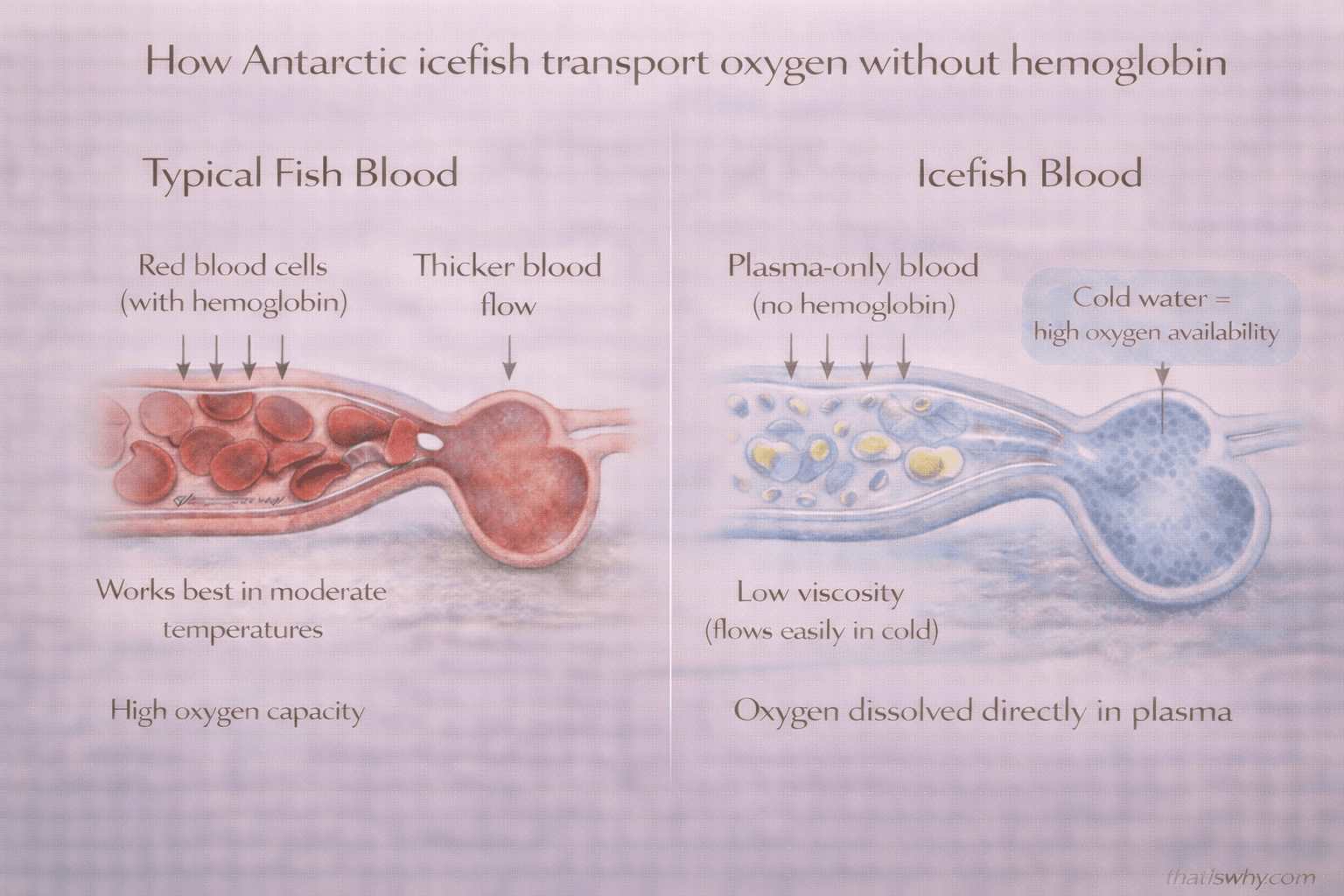
In most animals, blood is a dense, additive-heavy fluid. Red blood cells are solid particles suspended inside it, each packed with hemoglobin. That works well at moderate temperatures. In extreme cold, it becomes a liability.
Antarctic seawater sits at about –1.8°C. In those conditions, pumping a thick, cell-packed fluid through narrow vessels is like trying to circulate syrup through a frozen radiator.
The icefish solves this by doing something radical.
It deletes the additives.
The Cost of Red Blood (Viscosity)
Imagine an engine forced to run in extreme cold.

The coolant flowing through it isn’t just liquid. It’s loaded with particles—additives suspended in the fluid to improve performance under normal conditions. As temperatures drop, the fluid thickens, those particles increase resistance, and the pump has to work harder just to keep circulation going.
That’s what red blood becomes in Antarctic water.
Biologically, blood is a suspension. Red blood cells are solid objects moving through plasma, each one packed with hemoglobin. At moderate temperatures, this design is efficient. Oxygen delivery is high, and flow remains manageable.
Cold changes the equation.
As temperature falls, fluids become more viscous. When solid particles are suspended inside them, resistance rises faster still. The coolant becomes harder to push through narrow channels, forcing the pump to compensate for the added strain.
In the Southern Ocean, where seawater sits around –1.8°C, pumping cell-packed blood through fine vessels starts to resemble forcing slush through a radiator built for liquid. More energy is spent overcoming resistance than delivering oxygen.
Most fish are stuck with that cost.
The icefish takes a different approach. Instead of upgrading the pump, it redesigns the coolant.
By deleting red blood cells entirely, its blood becomes almost pure plasma, a thin, clear fluid with no suspended solids, the additives are gone. What remains flows easily even in extreme cold, reducing resistance throughout the system.
Oxygen no longer rides inside specialized carriers. It simply dissolves directly into the fluid, the same way oxygen dissolves into cold seawater. The system sacrifices efficiency, but gains reliability, keeping circulation smooth when thicker fluids would begin to fail.
In an environment where oxygen is abundant and cold lowers demand, keeping the coolant moving matters more than maximizing capacity.
Antifreeze in the Pipes
Keeping coolant moving is only half the battle in extreme cold. The other problem is ice.
At subzero temperatures, water doesn’t just thicken. It begins to form microscopic ice crystals. In a mechanical system, those crystals are catastrophic. Once they appear inside pipes, they grow, block flow, and damage the system from the inside.
Icefish face that exact risk.
Their blood plasma is mostly water, and the surrounding seawater is well below the freezing point of fresh water. Without protection, ice crystals would begin forming inside their circulation.
The solution is chemical.
Icefish produce antifreeze glycoproteins, molecules that bind to the surface of tiny ice crystals and prevent them from growing. Instead of allowing ice to expand into solid blocks, these proteins keep crystals small and harmless, even at subzero temperatures.
This is a dedicated antifreeze additive.
The fluid stays thin and easy to pump, while the antifreeze chemistry actively prevents freezing. The proteins don’t simply lower the freezing point. They interfere with ice formation itself, stopping crystals before they can damage the system.
This allows the icefish to run a circulation loop that would destroy almost any other vertebrate. Thin coolant flows through narrow vessels, while antifreeze chemistry keeps the pipes clear.
Without this protection, deleting red blood cells would be pointless.
With it, the system stays liquid where almost nothing else can.
The Trade-Off: A Fragile System
Deleting red blood cells solves one problem, but it creates another.
Thin coolant flows easily, but it carries far less oxygen. Plasma alone can only transport a fraction of what hemoglobin-packed blood can manage. The icefish trades capacity for reliability, and that trade-off has consequences.
To compensate, the icefish moves far more fluid.
Its heart is oversized relative to its body, and its blood vessels are unusually wide. Instead of sending small amounts of oxygen-rich coolant, it pushes large volumes of low-capacity fluid through the system. Thin coolant and wide pipes keep resistance low enough for this strategy to work, the system trades concentration for throughput.
That design is perfectly tuned to Antarctic conditions. Cold water holds large amounts of dissolved oxygen, and low temperatures reduce metabolic demand.
But it is a narrow optimization.
If the water warms even slightly, oxygen levels drop while metabolic demand rises. Under those conditions, plasma-based oxygen delivery becomes a bottleneck. No amount of pumping can fully compensate for a fluid that simply cannot carry enough oxygen.
The icefish didn’t evolve a better circulatory system.
It evolved one that only works where almost nothing else can.
Where Thin Beats Rich
The icefish’s solution feels extreme, but the principle behind it appears whenever systems are pushed toward failure.
In engineering, high-capacity fluids often come with a cost. Additives increase what a fluid can carry, but they also make it harder to move. In cold environments, rich coolant thickens, strains pumps, and clogs lines. Under those conditions, designers often choose thinner fluids that move reliably, even if they carry less per unit volume.
Biology faces the same constraint.
Animals in cold climates prioritize circulation over packing blood with capacity, keeping flow reliable at their extremities. Insects that overwinter thin and chemically protect their internal fluids rather than relying on dense transport systems. Even plants face similar limits when sap thickens in winter, forcing them to manage flow before efficiency.
When systems approach their breaking point, stability matters more than optimization.
The icefish applies that logic to blood itself. By stripping circulation down to a thin, protected fluid, it builds a system that keeps moving where richer designs would stall.
It isn’t better blood; it’s blood redesigned for reliability.
Blood Myths: What the Icefish Is Not
Myth #1: Icefish have no blood
Truth: They circulate plasma, not red blood cells. Icefish still have blood. What they’ve removed are the red blood cells suspended inside it. The system isn’t empty; it has been stripped of solid additives, leaving a thin fluid that can still move oxygen, just less efficiently.
Myth #2: Icefish don’t need oxygen
Truth: They survive because oxygen is everywhere.
Icefish rely on oxygen like any vertebrate, but they absorb it directly into their plasma instead of binding it to hemoglobin. This only works because Antarctic water is extremely cold and unusually rich in dissolved oxygen.
Myth #3: Clear blood is an upgrade
Truth: It’s a fragile specialization.
Thin coolant flows easily but carries little oxygen. That’s why icefish require oversized hearts and wide blood vessels. The system works in Antarctic conditions and breaks down quickly outside them.
When Life Deletes a Feature
From the outside, the Antarctic icefish looks like a biological glitch. Clear blood feels like something missing, not something engineered. But once you follow the logic of the system, the absence starts to look deliberate.
In the coldest water on Earth, red blood isn’t a benefit. It’s resistance.
By stripping its circulation down to thin plasma and protecting it chemically, the icefish builds a coolant system designed for reliability rather than capacity. The fluid flows easily when everything else would thicken. The pump works steadily instead of straining. The system keeps running in conditions that would cause richer designs to seize up.
What looks like loss is subtraction with purpose.
We are still learning this lesson in our own systems. We tend to add features and capacity, assuming that more complexity always means better performance. But in extreme environments, complexity often becomes a liability. Engineers thin fluids, simplify designs, and trade efficiency for stability because a system that keeps moving beats one that stalls. The icefish reached that conclusion millions of years earlier.
It didn’t evolve superior blood. It evolved blood that stops trying to do everything.
And in a place where the margin for error is razor-thin, that restraint is what keeps it alive.
How We Researched This
To explain how Antarctic icefish survive without hemoglobin, we relied on long-standing physiological research on the family Channichthyidae, particularly work by Kristin O’Brien and Bruce Sidell documenting blood viscosity, oversized hearts, and oxygen transport in polar fish. We also drew on studies published in Journal of Experimental Biology and Physiological and Biochemical Zoology showing that near-freezing Antarctic seawater holds unusually high levels of dissolved oxygen, making direct oxygen diffusion into blood plasma possible.
But beyond citing mechanisms, we asked a simpler question: What does this feel like ? That led us to the coolant system analogy, a simple story to make complex chemistry feel intuitive